
Key Points
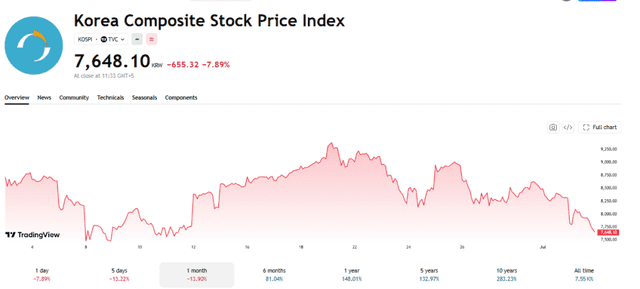
Kospi Index dropped nearly 8% on July 2, 2026, amid a broad AI chip selloff.
SK hynix plunged about 14%, while Samsung Electronics fell more than 9%.
Concerns over future AI infrastructure spending and chip demand drove investor selling.
Analysts see the decline as a short-term correction, with earnings and AI trends key to the market outlook.
The Kospi Index dropped nearly 8% on July 2, 2026, marking one of its steepest daily declines this year as a sharp selloff hit South Korea’s semiconductor sector. SK hynix tumbled about 14%, while Samsung Electronics lost more than 9%, dragging the broader market lower.
The decline came as investors reacted to growing concerns about future AI infrastructure spending and global chip demand. Here’s what triggered the selloff and what it could mean for markets ahead.
Why Did the Kospi Index Fall Nearly 8% Today?
AI chip sell-off spreads from Wall Street to Asia
The Kospi Index suffered one of its biggest losses of 2026 on July 2, falling about 7.9%–8% after a sharp decline in global semiconductor stocks. The sell-off began in the U.S. and quickly spread across Asian markets. Investors reduced exposure to technology shares after renewed concerns about AI-related spending and future chip demand.
Why did Meta’s AI strategy trigger market fears?
Reports that Meta could monetize excess AI computing capacity raised concerns that the industry may eventually face oversupply. That led investors to question whether the rapid pace of AI infrastructure investment can continue.
Since South Korea’s stock market is heavily weighted toward memory-chip companies, selling pressure intensified. The Kospi has now erased a large part of its recent gains, with volatility remaining elevated ahead of key U.S. economic data and the earnings season.
SK hynix and Samsung Lead the Semiconductor Rout
Why did SK hynix stock fall more than 14%?
SK hynix dropped about 14.6%, one of its sharpest single-day losses in years. The company has been one of the biggest beneficiaries of the AI boom because of its leadership in High Bandwidth Memory (HBM) chips. This time, though, investors focused on the possibility that future capacity growth could outpace demand.
The selloff came even as SK hynix announced a 100 trillion won ($64 billion) long-term investment plan to expand its semiconductor business, showing that the company still expects strong AI demand over the coming years.
Samsung Electronics also came under pressure
Samsung Electronics lost more than 9%, adding to the Kospi’s decline because of its heavy weighting in the index. Selling spread across the semiconductor sector as investors moved away from high-growth AI stocks, pulling several chipmakers lower during the session.
Stock outlook and technical analysis
Short-term forecast: Market sentiment remains weak, so the near-term outlook is bearish.
Technical summary: The stock has slipped below several support levels, leaving momentum negative. Price swings could stay elevated until buying interest returns.
What Meyka says: The recent drop appears to reflect investor sentiment rather than a change in business fundamentals. Long-term demand for AI memory chips is still intact, but earnings results and AI infrastructure spending will be the main factors to watch. An AI stock analysis tool can help investors track technical signals alongside fundamental developments.
What other analysts say: Most market analysts believe the recent decline is a correction following a strong AI-driven rally, not a sign that the semiconductor cycle has peaked.
What does this mean for South Korea’s stock market outlook?
Is a foreign investor selling making the decline worse?
Yes. Foreign investors stepped up profit-taking after months of strong gains in South Korean technology stocks. Because Samsung Electronics and SK hynix make up a large share of the Kospi Index, heavy selling in both stocks had an outsized effect on the broader market. Leveraged products tied to semiconductor shares added to the volatility.
Is this a correction or the start of a bigger downturn?
Many analysts still see the recent weakness as a correction rather than the start of a prolonged decline. Demand for AI memory chips remains healthy, and chipmakers continue to invest billions in expanding production.
Even so, investors have become more cautious as valuations remain elevated. Upcoming earnings reports and AI spending plans will likely shape market sentiment over the next few months.
Key market factors investors should watch next
Investors should keep an eye on:
- Upcoming U.S. inflation and employment data.
- Federal Reserve interest rate expectations.
- Quarterly earnings from major semiconductor companies.
- AI infrastructure spending by large technology companies.
- Demand for HBM memory chips.
- Foreign investment flows into South Korean equities, which could influence whether the Kospi stabilizes or stays under pressure.
Conclusion
The Kospi Index’s sharp decline shows how quickly sentiment can shift in AI-focused markets. The steep losses in SK hynix and Samsung Electronics have increased short-term uncertainty, but demand for advanced memory chips continues to support the industry’s longer-term outlook.
For now, investors will be watching earnings, AI investment plans, and economic data to judge whether this pullback is a temporary correction or the start of a deeper downturn.
Disclaimer:
The content shared by Meyka AI PTY LTD is solely for research and informational purposes. Meyka is not a financial advisory service, and the information provided should not be considered investment or trading advice.
What brings you to Meyka?
Pick what interests you most and we will get you started.
I'm here to read news
Find more articles like this one
I'm here to research stocks
Ask Meyka Analyst about any stock
I'm here to track my Portfolio
Get daily updates and alerts (coming March 2026)