
Key Points
AI chip stocks extended losses as Micron and Western Digital fell around 2.1%.
Meta's reported AI cloud strategy sparked concerns over future infrastructure spending.
Analysts see the decline as profit-taking despite strong AI memory demand.
Investors are watching AI capex, memory pricing, and upcoming earnings for direction.
AI chip stocks stayed under pressure on July 2, 2026, with Micron Technology and Western Digital each falling about 2.1%. The decline added to a wider selloff across semiconductor stocks after reports raised fresh questions about Meta’s long-term AI infrastructure plans. That prompted investors to rethink expectations for future spending on memory chips and AI data centers. Is this simply a short-term market correction, or are investors becoming more cautious about AI spending?
Why are AI chip stocks falling despite strong AI demand?
Demand for AI hardware remains strong, but that hasn’t stopped chip stocks from pulling back. On July 2, 2026, Micron Technology and Western Digital both dropped roughly 2.1% in premarket trading as weakness spread across the semiconductor sector. After months of strong gains, investors appear more willing to reduce exposure and lock in profits.
Profit-taking after a massive 2026 rally
AI-focused semiconductor companies have been among the market’s biggest winners in 2026. Many posted triple-digit gains, making profit-taking a natural move after such an extended rally.
Selling wasn’t limited to Micron and Western Digital. AMD, Intel, Marvell Technology, Applied Materials, and Lam Research also declined as investors pulled back from high-priced AI stocks. The move reflects changing investor sentiment more than any meaningful drop in demand for AI chips.
Valuation concerns return
Another factor behind the sell-off is valuation. After months of steady gains, many analysts believe semiconductor stocks have become expensive.
JPMorgan pointed out that AI chip and memory companies have outperformed cloud providers since late 2025. That left the sector more exposed when investors started questioning whether prices had moved too far ahead of fundamentals.
Even with the recent weakness, demand for AI memory remains healthy. DRAM prices increased by about 3% in June, while NAND prices rose roughly 2.4%. Tight supply and continued investment in AI infrastructure continue to support the memory market.
How did Meta’s AI strategy spark new investor concerns?
Why did Meta’s reported strategy change market sentiment?
According to a Bloomberg report, Meta Platforms is considering building a cloud business that would sell excess AI computing capacity.
While the report was generally seen as positive for Meta, it also raised concerns that AI infrastructure spending across the industry could become more disciplined than investors had expected.
That doesn’t mean AI spending is slowing today. Instead, investors are reacting to the possibility that hyperscale companies could become more efficient, reducing the pace of future purchases for memory and storage hardware.
Why does this matter for chipmakers?
Companies such as Micron and Western Digital benefit directly from AI data center investment. Every AI server requires large amounts of DRAM, high-bandwidth memory, and enterprise storage.
Even so, recent business results continue to support demand. Micron’s latest earnings included stronger revenue guidance and approximately $22 billion in long-term customer commitments for future memory supply. Those agreements suggest customers still expect strong AI-related demand despite recent market volatility.
Market reaction across the semiconductor sector
Which stocks were hit during the sell-off?
Selling spreads across much of the semiconductor industry. Among the companies that declined were:
- Micron Technology
- Western Digital
- Applied Materials
- Lam Research
- AMD
- Intel
- Marvell Technology
- Coherent
The broader semiconductor index also moved lower, weighing on technology shares overall. At the same time, Meta stock gained after reports about its potential cloud business.
What do analysts think about the outlook?
Most analysts continue to describe the recent decline as a market correction rather than the start of a long-term downturn.
Short stock details/forecast – Meyka:
Micron (MU) holds a B+ rating on Meyka. The platform maintains a cautious 12-month outlook, noting that valuation has become more demanding after the stock’s strong rally, even though AI demand remains healthy.
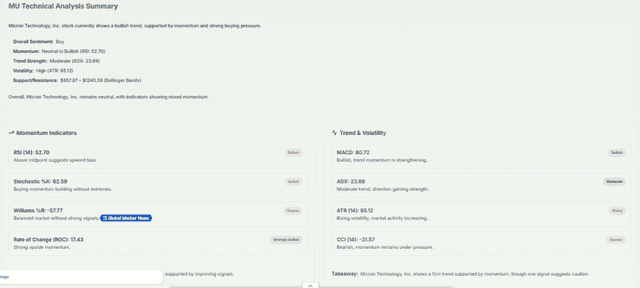
Technical analysis summary:
Micron is facing short-term selling pressure after slipping below recent support levels. Longer-term momentum is still backed by strong AI memory demand and tight supply conditions.
What Meyka says:
Meyka believes investors should stay cautious because high expectations leave the stock more sensitive to any concerns about AI infrastructure spending.
Supporting insights from other analysts:
KeyBanc continues to rate Micron as heigher weight with a $1,600 price target. Wedbush and Citi also raised their price targets after the company’s strong earnings report and long-term customer agreements. Most analysts still expect favorable DRAM and NAND pricing throughout 2026.
Investors can also use an AI stock analysis tool to compare technical signals, analyst forecasts, and market risk before making investment decisions.
What should investors watch next?
The next few weeks may provide a clearer direction for the semiconductor sector. Investors will be watching U.S. economic data, interest rate expectations, AI capital spending plans from major technology companies, Micron’s guidance, memory pricing, and any new details from Meta about its reported cloud strategy. If AI infrastructure spending remains strong, the recent pullback could prove temporary.
Conclusion
The recent decline in AI chip stocks appears to be driven mainly by profit-taking and concerns over high valuations rather than weaker demand for AI hardware. Meta’s reported cloud plans introduced another question for investors, but memory pricing remains firm and analysts continue to expect healthy demand through 2026. Upcoming earnings, AI spending updates, and market data will likely determine whether the sector stabilizes or faces additional pressure.
Disclaimer:
The content shared by Meyka AI PTY LTD is solely for research and informational purposes. Meyka is not a financial advisory service, and the information provided should not be considered investment or trading advice.
What brings you to Meyka?
Pick what interests you most and we will get you started.
I'm here to read news
Find more articles like this one
I'm here to research stocks
Ask Meyka Analyst about any stock
I'm here to track my Portfolio
Get daily updates and alerts (coming March 2026)