
Key Points
Oil prices surged past $102 after reports of attacks on ships in the Strait of Hormuz
Iran-related tensions raised fears of global supply disruptions in the oil market
Gold prices slipped around 0.7% due to a stronger dollar and higher rate expectations
Markets turned highly volatile as traders reacted to geopolitical risks and inflation concerns.
On April 23, 2026, global commodity markets turned volatile. Oil prices climbed above $102 per barrel after reports that Iran targeted commercial ships in the Strait of Hormuz. The incident raised fresh fears about supply disruptions in one of the world’s most important oil routes. At the same time, gold prices slipped around 0.7%, showing mixed investor sentiment. Traders moved quickly between safe-haven assets and energy markets as uncertainty grew. The sudden shift highlights how fast geopolitical events can impact global prices.
Investors are now watching the Middle East closely, as any further escalation could push energy costs even higher and reshape market expectations in the coming days. Volatility is expected to continue in the short term.
Oil Prices Surge Above $102 Amid Iran-Linked Shipping Attacks
Why did oil prices suddenly cross $102?
On April 23, 2026, Brent crude moved above the $102 per barrel mark. This sharp rise came after reports of attacks on commercial ships linked to Iran in the Strait of Hormuz. Traders reacted quickly because this route is critical for global oil flow.
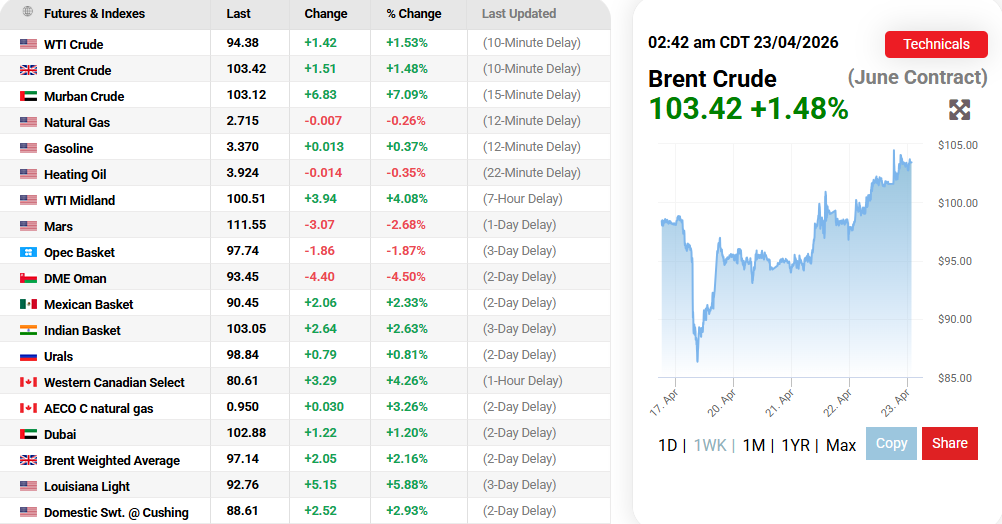
The Strait of Hormuz carries nearly one-fifth of the world’s oil supply. Even small disruptions here can move global prices.
Key market reaction:
- Brent crude touched highs above $102–$103
- WTI crude also moved higher near the mid-$90 range
- Trading volumes increased due to panic buying
What role did the Strait of Hormuz play in the surge?
The Strait of Hormuz is one of the most important energy chokepoints in the world. It connects oil producers in the Gulf with global buyers.
When shipping risks rise:
- Insurance costs for tankers increase
- Oil delivery becomes uncertain
- Traders add a “risk premium” to prices
This is exactly what pushed prices above $100 again.
Geopolitical Risk Premium Driving Oil Rally
How are US-Iran tensions affecting oil markets?
Markets are highly sensitive to Middle East tensions. On April 23, renewed friction between the US and Iran added pressure to energy markets. Talks over maritime security have shown little progress.
Analysts say even rumors of escalation can move oil prices by 3-5% in a single session.
Why do small events create big price moves?
Oil is a global benchmark commodity. Supply fear matters more than actual disruption. Main reasons:
- Limited spare supply capacity globally
- Heavy dependence on Gulf exports
- Fast algorithm-based trading reactions
Some hedge funds increased long positions in crude futures after the incident, expecting further upside risk.
Gold Slips 0.7% Despite Global Uncertainty
Why did gold fall when oil rose?
Gold prices moved in the opposite direction. Spot gold fell around 0.7%, even as geopolitical risks increased. This happened because:
- The US dollar became stronger
- Investors expected higher interest rates for longer
- Profit booking after recent gold gains
Gold is often a safe asset, but it also reacts to interest rate expectations.
Is gold losing its safe-haven appeal?
Not exactly. Gold is still a safe-haven asset. But in this case, inflation fears from rising oil pushed bond yields higher. That made gold less attractive in the short term.
Key point:
- Higher oil = inflation risk
- Higher inflation = stronger rate expectations
- Strong rates = weaker gold demand
Inflation Fears Reshape Global Commodity Trends
How does oil impact global inflation?
When oil crosses $100, it affects almost every sector:
- Transport costs rise
- Food supply chains get expensive
- Manufacturing costs increase
This creates inflation pressure across economies.
What are central banks likely to do next?
Markets now expect central banks to stay cautious. If oil stays above $100:
- Interest rate cuts may be delayed
- Inflation control becomes a priority
- Growth expectations may slow down
This creates uncertainty for both stocks and commodities.
Market Outlook – What Happens Next?
Will oil prices stay above $100?
Short-term direction depends on Middle East stability. If tensions continue:
- Oil could test $105-110
- Volatility may remain high
- Shipping insurance costs may rise further
If tensions ease:
- Prices may fall back below $100 quickly
What should investors watch now?
Key signals:
- Updates on Iran-related shipping activity
- US foreign policy statements
- OPEC production guidance
- Dollar index movement
An AI stock analysis tool used by traders is also flagging energy stocks as “high volatility, high risk” due to geopolitical uncertainty.
Can gold recover from this dip?
Gold may recover if:
- Geopolitical tensions escalate further
- Dollar weakens
- Interest rate cut expectations return
Otherwise, it may stay range-bound in the short term.
Conclusion
Oil markets reacted strongly on April 23, 2026, as prices surged above $102 after shipping disruptions in the Strait of Hormuz raised supply fears. At the same time, gold slipped as a stronger dollar and interest rate expectations pressured demand.
The opposite movement shows how global markets are balancing inflation risks with monetary policy uncertainty. Investors now face a sensitive period where geopolitical news can quickly shift prices in both directions.
Disclaimer:
The content shared by Meyka AI PTY LTD is solely for research and informational purposes. Meyka is not a financial advisory service, and the information provided should not be considered investment or trading advice.
What brings you to Meyka?
Pick what interests you most and we will get you started.
I'm here to read news
Find more articles like this one
I'm here to research stocks
Ask Meyka Analyst about any stock
I'm here to track my Portfolio
Get daily updates and alerts (coming March 2026)