
Key Points
Oil prices near $100 due to ongoing Strait of Hormuz disruptions
Ceasefire fails to restore supply confidence or stabilize markets
Global inflation is rising as fuel and transport costs increase
Risk of further price spikes if geopolitical tensions escalate
Oil prices are once again nearing the $100 mark in April 2026, despite a ceasefire aimed at easing tensions in the Middle East. Brent crude has hovered close to this level, while key shipping routes remain disrupted. The Strait of Hormuz, which carries nearly one-fifth of global oil supply, is still facing limited traffic and security risks. This has kept global markets on edge.
Traders are reacting not to peace headlines, but to real supply constraints. Even small disruptions are pushing prices higher. So what is really driving this surge, and how long can it last? The answers reveal a deeper story about global energy dependence and geopolitical uncertainty.
Why Oil Prices are Climbing Toward $100 Again?
What is driving the latest oil price surge?
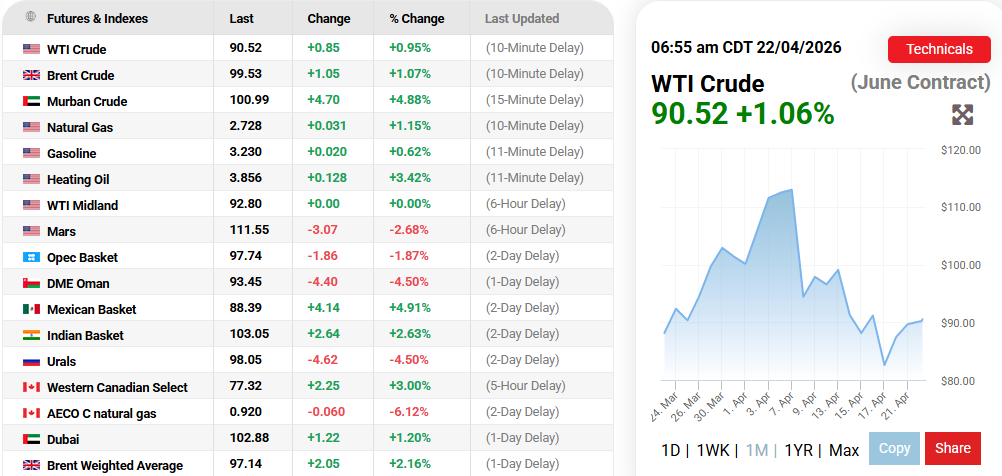
Oil prices are rising again in April 2026 due to supply fears and geopolitical risk. Markets are reacting to real disruptions, not just headlines.
- Brent crude is trading near $98-100 per barrel as of mid-April 2026
- WTI crude is holding above $90 per barrel
- Traders are adding a risk premium due to uncertainty in the Middle East
The key driver is supply tightness. Even small disruptions are enough to push prices higher in a fragile market.
Persistent Supply Disruptions in the Strait of Hormuz
The Strait of Hormuz remains the biggest concern.
- Around 20% of the global oil supply passes through this route daily
- Tanker movement is still restricted despite the ceasefire
- Shipping delays and rerouting are increasing costs
Some estimates suggest up to 10 million barrels per day could be affected in worst-case scenarios. This creates panic in global markets.
Why hasn’t the ceasefire stabilized prices?
The ceasefire has not restored confidence.
- Military presence is still high in the region
- Insurance costs for tankers remain elevated
- Traders fear a sudden escalation at any time
Markets need stability, not temporary agreements. That stability is still missing.
The Strategic Importance of the Strait of Hormuz
Why is this route so critical to global energy?
The Strait of Hormuz is a narrow but vital energy corridor.
- It connects the Persian Gulf to global markets
- Major exporters like Saudi Arabia, the UAE, and Iraq depend on it
- Asia relies heavily on oil passing through this route
Any disruption here impacts global oil prices instantly.
Could this become the biggest energy shock in decades?
There is growing concern among analysts.
- Some experts compare the situation to the 1970s oil crisis
- A prolonged disruption could trigger a global energy shortage
- Governments may be forced to release strategic reserves
This is not just a regional issue. It is a global economic risk.
Market Reaction: Volatility, Spikes, and Investor Behavior
Why are oil prices so volatile right now?
Oil markets are reacting to every update.
- Prices swing daily based on geopolitical news
- Even rumors can move prices by 2-3% in a single session
- Traders are highly sensitive to supply signals
This volatility reflects uncertainty, not stability.
Are inventories making the situation worse?
Yes. Falling inventories are adding pressure.
- US crude inventories dropped by around 4-5 million barrels recently
- Global stockpiles are lower than seasonal averages
- Demand remains steady despite high prices
Low supply plus steady demand equals higher prices.
Global Economic Impact of Rising Oil Prices
How are rising oil prices affecting inflation?
Higher oil prices are pushing inflation up worldwide.
- Fuel costs are rising across major economies
- Transport and logistics expenses are increasing
- Food prices are also affected due to higher shipping costs
In April 2026, several economies reported renewed inflation pressure due to energy prices.
What does this mean for emerging markets?
Emerging economies face greater risks.
- Countries like Pakistan and India rely heavily on oil imports
- Currency depreciation increases import costs
- Fiscal deficits may widen due to higher energy bills
This can slow economic growth and increase financial stress.
Supply Chain Disruptions and Trade Implications
How are shipping and logistics being affected?
Shipping risks are rising in the region.
- Insurance premiums for oil tankers have surged
- Some companies are avoiding the Hormuz route
- Freight costs are increasing globally
This is impacting not just oil, but overall trade flows.
Are countries changing their oil sourcing strategies?
Yes, many countries are adapting.
- Some are increasing strategic reserves
- Others are diversifying suppliers
- Alternative routes are being explored
These shifts may reshape global energy trade patterns.
Can Oil Prices Cross $100 Again? Expert Outlook
What is the bullish case for oil prices?
Many analysts see further upside risk.
- Continued disruption could push prices to $105-110
- OPEC+ spare capacity is limited
- Strong demand from Asia supports prices
If tensions rise again, prices could spike quickly.
What could bring prices down?
There are also downside scenarios.
- A stable ceasefire and restored shipping could ease pressure
- Demand may weaken if prices stay high
- Strategic reserves could be released to control prices
Markets are balancing between fear and fundamentals.
Key Trends Investors Should Watch
Investors should track these factors closely:
- Developments in US-Iran negotiations
- Real-time tanker movement in the Strait of Hormuz
- OPEC+ production decisions
- Global inventory data
- Inflation trends linked to energy prices
Using an AI stock analysis tool can help investors track oil-linked equities and market sentiment more efficiently in such volatile conditions.
Wrap Up
Oil markets remain highly sensitive as prices approach $100 again in April 2026. The ceasefire has not resolved core supply risks in the Strait of Hormuz. This keeps volatility high and confidence low. Global economies are already feeling the pressure through inflation and trade disruptions. Unless supply routes stabilize fully, oil prices may stay elevated, with sudden spikes still a real possibility.
Disclaimer:
The content shared by Meyka AI PTY LTD is solely for research and informational purposes. Meyka is not a financial advisory service, and the information provided should not be considered investment or trading advice.
What brings you to Meyka?
Pick what interests you most and we will get you started.
I'm here to read news
Find more articles like this one
I'm here to research stocks
Ask Meyka Analyst about any stock
I'm here to track my Portfolio
Get daily updates and alerts (coming March 2026)