
Key Points
Oil prices stay below $100 as Middle East peace talks ease geopolitical tensions
Brent crude holds near $96-$98 while WTI trades in the low $90s range
Strait of Hormuz risks and supply concerns continue to support price stability
Markets remain volatile as diplomacy and conflict risks shape oil trends in 2026
As of April 17, 2026, global oil prices are holding just below the $100 per barrel mark. Brent crude is trading in the mid-$90s, while WTI remains slightly lower in the low-$90s range. Markets are reacting to easing tensions in the Middle East, where early signs of peace discussions and temporary ceasefires have improved investor sentiment. This shift has reduced the “war risk premium” that previously pushed prices higher.
Even so, the situation remains uncertain. Key shipping routes like the Strait of Hormuz are still under close watch, and traders are cautious about sudden disruptions. The result is a fragile balance between optimism and risk. In this environment, oil prices are not just about supply and demand; they are also shaped by diplomacy, trust, and timing.
Global Oil Market Snapshot – Prices Stay Below $100 Amid Geopolitical Relief
Oil markets remain sensitive on April 17, 2026, with Brent crude trading near $96-$98 per barrel and WTI around $87-$91 per barrel. The main trigger is easing tension in the Middle East, especially after a 10-day Israel-Lebanon ceasefire and renewed signals of U.S.-Iran diplomatic engagement.
According to Reuters-linked market coverage, oil briefly dipped over 3% in a single session, as traders reduced the war-risk premium that had previously pushed prices above $110 earlier this year.
Why are oil prices reacting so fast?
Markets are pricing in three key expectations:
- Reduced risk of immediate war escalation
- Possible reopening or easing of Strait of Hormuz restrictions
- Short-term stabilization in global shipping routes
However, volatility remains high because even small geopolitical headlines can move prices by 2-5% in a day.
Middle East Peace Prospects and Oil Price Reaction
What is driving peace optimism in April 2026?
Recent diplomatic signals are shaping oil sentiment more than supply-demand fundamentals. Reports suggest indirect talks between U.S. and Iranian officials are continuing, with discussions linked to nuclear limits and regional de-escalation.
At the same time:
- A temporary ceasefire between Israel and Lebanon is holding in parts of the conflict zone
- Global leaders are pushing for broader negotiations involving regional security guarantees
- Markets are responding to “risk reduction expectations” rather than confirmed peace
How much impact does this have on oil?
Very significant. Before the ceasefire headlines, Brent had surged close to $115 per barrel in March 2026 due to supply fears. After diplomatic signals in early April, prices dropped sharply, losing nearly $10-15 per barrel risk premium in a short period.
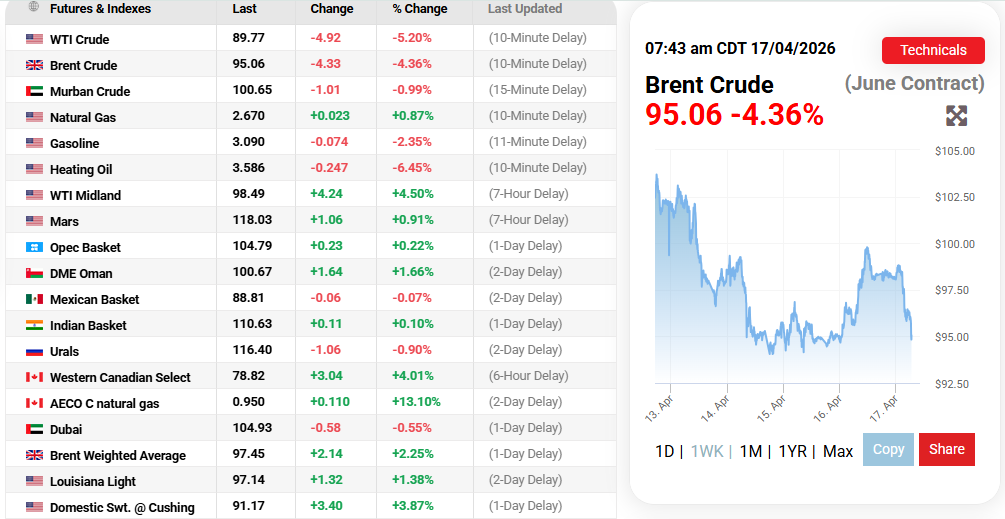
This shows a clear pattern: Oil is no longer driven only by supply; it is now heavily driven by geopolitics.
Why Supply Risks Still Keep Oil Near $100?
Is the Strait of Hormuz still a risk?
Yes. It remains the most critical pressure point.
- Around 20% of global crude oil flows through it
- Even partial restrictions can remove millions of barrels per day from supply chains
- Insurance and freight costs remain elevated despite ceasefire progress
Even during peace talks, reports suggest shipping flow is not fully normalized, keeping prices from collapsing.
Why don’t prices fall further below $90?
Even with peace optimism, structural risks remain:
- Damaged infrastructure in key producing regions
- Slow recovery of logistics and export systems
- Traders hedging against sudden conflict reversal
As a result, oil is stuck in a tight range-bound market instead of a full downward correction.
Market Volatility and Global Economic Impact
Oil price movements are now directly influencing global inflation expectations.
Inflation pressure
Energy costs remain higher than pre-conflict levels. This keeps pressure on:
- Transport and logistics costs
- Food supply chains
- Manufacturing inputs
Financial market reaction
Global equities have stayed strong due to optimism around peace. But bond markets are still cautious, showing that investors do not fully trust the stability of the situation.
Recent market data shows:
- Stock markets near record highs
- Oil is still fluctuating between the $90-$100 range
- Mixed signals across currencies and commodities
Oil Price Forecast – Will It Stay Below $100?
Short-term outlook – April–June 2026
Oil is expected to remain in a tight range:
- Brent: $90-$100
- WTI: $85-$95
Any major political headline can push prices outside this range within hours.
Medium-term outlook (mid–late 2026)
- If peace negotiations progress, prices may drift toward $80-$90
- If talks fail or tensions return, Brent could quickly move above $100 again
What experts are watching?
Key triggers include:
- U.S.–Iran negotiations outcome
- Stability of ceasefire agreements
- Security of shipping routes
- OPEC+ production decisions
- Global demand recovery, especially from Asia
AI stock analysis tool mentioned
Many traders are now also using AI-driven stock analysis tools to track energy sector movements and predict short-term oil-linked equity reactions, especially in oil majors and shipping companies.
Final Market Insight
Oil prices staying below $100 reflect a fragile balance between diplomacy and disruption. Markets are pricing in hope, not certainty. Peace progress in the Middle East has reduced immediate fear, but structural risks in supply routes and geopolitics continue to hold a strong floor under crude prices. Until a stable agreement is fully secured, volatility will remain the defining feature of global oil trading in 2026.
Disclaimer:
The content shared by Meyka AI PTY LTD is solely for research and informational purposes. Meyka is not a financial advisory service, and the information provided should not be considered investment or trading advice.
What brings you to Meyka?
Pick what interests you most and we will get you started.
I'm here to read news
Find more articles like this one
I'm here to research stocks
Ask Meyka Analyst about any stock
I'm here to track my Portfolio
Get daily updates and alerts (coming March 2026)