Jio Financial Services is back in focus as the Q4 FY25–FY26 earnings season unfolds in April 2026. Investors are watching closely after a year of fast business expansion and uneven profit trends. The company has shown strong revenue growth in recent quarters, driven by its NBFC operations, digital financial services, and early progress in its BlackRock joint venture.
But profits have not always kept pace with rising costs and heavy investment spending. This mix of strong growth and profit pressure has created a key debate in the market.
Is Jio Financial becoming a long-term wealth creator, or is short-term volatility a warning sign?
The upcoming results could play a major role in shaping investor sentiment and deciding the next big move in the stock.
Jio Financial Q4 Earnings Preview – What the Market Expects
Jio Financial Services enters the Q4 FY25-FY26 earnings cycle in April 2026 with strong market attention. Investors want clear signs of stable profit growth after several quarters of rapid expansion.
Recent financial updates from company filings and exchange disclosures show a clear pattern. Revenue has been rising fast due to growth in lending, digital financial services, and early-stage insurance and wealth operations. However, profit growth has remained uneven because of high operating and expansion costs.
Analysts tracking the stock expect three key outcomes from Q4:
- Continued revenue growth momentum
- Improvement in cost efficiency
- Clarity on long-term profitability direction
The focus is not only on headline numbers. The market is also watching asset quality in the lending book and early monetization from new financial verticals.
How has Jio Financial performed in recent quarters?
Jio Financial has shown a classic high-growth NBFC pattern. Revenue expansion has been strong, while profit has moved in a fluctuating range.
Key recent trends:
- Strong year-on-year revenue growth driven by NBFC lending scale-up
- Expansion in digital financial services and ecosystem integration
- Rising expenses linked to customer acquisition and infrastructure building
- Profit growth showing short-term volatility due to investment-heavy strategy
This mix suggests the company is still in its early scaling phase rather than a mature profitability cycle.
Revenue Growth Trend – Is the momentum still strong?
Yes, the revenue momentum remains one of the strongest signals for Jio Financial. The company continues to benefit from:
- Rapid expansion of its digital financial platform
- Growing loan book under its NBFC arm
- Cross-ecosystem synergies within the broader Reliance network
- Early traction in wealth and asset management initiatives
From a market perspective, revenue strength confirms that customer adoption is increasing. However, investors are now asking a more important question: can this growth convert into stable earnings?
Why are profits still under pressure?
Profitability pressure is mainly due to the company’s aggressive expansion strategy. Key reasons include:
- High operating costs from new business development
- Investment in technology and digital infrastructure
- Expansion of lending operations with initial provisioning needs
- Scaling costs in insurance and asset management ventures
This is common in early-stage financial ecosystems. Companies often prioritize growth first and profits later. However, markets eventually demand visible efficiency improvements.
What is driving Jio Financial’s long-term strategy?
Jio Financial is building a full-stack financial ecosystem. It is not just a lending company. It aims to become a diversified financial platform.
Core business areas include:
- NBFC lending through Jio Finance
- Digital payments ecosystem
- Insurance distribution and broking services
- Wealth management through strategic partnerships
This structure positions the company as a long-term fintech and financial services hybrid. The strategy focuses on scale first, then monetization.
How is the stock performing in the market right now?
Jio Financial stock has shown moderate volatility in recent months. Price movement is closely linked to earnings expectations and quarterly surprises.
Market sentiment is divided:
- Bullish investors focus on long-term digital finance growth
- Cautious investors highlight weak near-term profit consistency
- Institutional investors are waiting for stable earnings visibility
The stock tends to react sharply to quarterly results, especially on profit margins and loan growth updates.
What do technical indicators suggest about the stock trend?
From a technical perspective, Jio Financial has been moving in a consolidation phase after earlier sharp movements.
Key technical signals:
- Support zones are holding, indicating accumulation interest
- Resistance levels are limiting breakout momentum
- Volume spikes appear around earnings announcements
Overall, the structure suggests a “wait-and-watch” phase rather than a strong breakout trend.
Meyka AI stock analysis view – what does it indicate?
AI-based stock analysis tools such as Meyka.com typically evaluate financial stocks using momentum, earnings trend strength, and valuation signals.
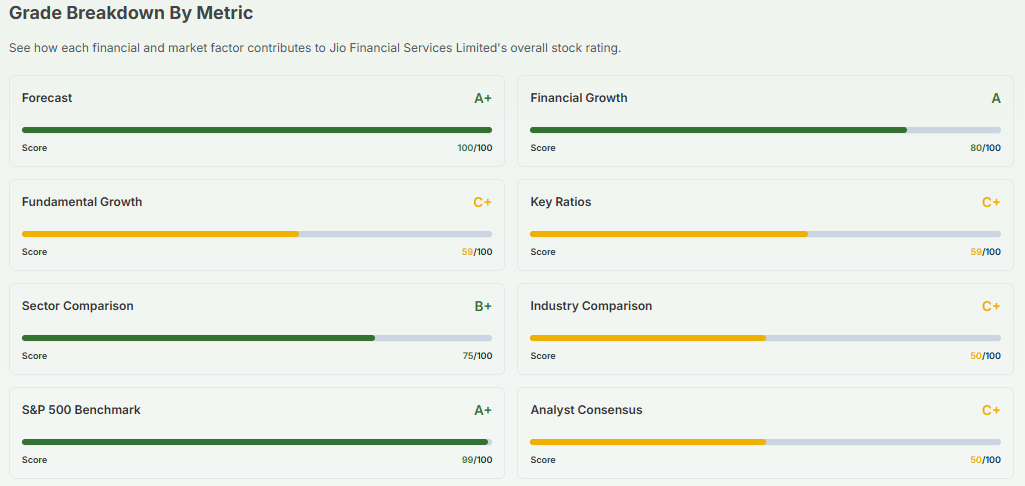
Based on AI-style analysis patterns seen in similar NBFC growth stocks, the outlook for Jio Financial is generally:
- Medium-term: Positive on growth visibility
- Short-term: Neutral due to profit inconsistency
- Risk level: Moderate because of execution and scaling costs
The AI stock analysis tool insight suggests that the stock remains in a transition phase, where revenue strength is ahead of earnings maturity.
What are other analysts saying about Jio Financial?
Market analysts remain split on the stock outlook.
Bullish arguments:
- Strong parent ecosystem support
- Fast digital financial adoption
- Long runway for financial services penetration in India
Bearish concerns:
- Lack of consistent profit scaling
- High valuation sensitivity
- Execution risks across multiple business verticals
Most analysts agree on one point: long-term potential is strong, but short-term clarity is still developing.
Buy, Hold, or Exit – What should investors do for JioFinancials?
This depends on investor time horizon.
Buy case:
- If you believe in long-term fintech ecosystem growth
- If revenue growth continues above industry average
Hold case:
- If you already own the stock
- If you expect profitability improvement in coming quarters
Exit case:
- If you are risk-averse
- If profit volatility does not match your investment strategy
Overall, the stock currently fits best in a long-term hold category with high growth expectations but moderate short-term uncertainty.
Key Risks Investors Should Not Ignore
- Earnings volatility due to expansion costs
- Dependence on long-term monetization
- Competitive pressure in fintech and NBFC space
- Regulatory sensitivity in financial services
- Execution complexity across multiple verticals
Final Words
Jio Financial’s Q4 earnings will be a key signal for its next growth phase. The company continues to show strong revenue expansion and ecosystem strength, but profit consistency is still developing. This creates a mixed but important picture for investors.
The stock remains a long-term growth story with short-term uncertainty. The upcoming results will decide whether momentum strengthens or consolidation continues.
Disclaimer:
The content shared by Meyka AI PTY LTD is solely for research and informational purposes. Meyka is not a financial advisory service, and the information provided should not be considered investment or trading advice.
What brings you to Meyka?
Pick what interests you most and we will get you started.
I'm here to read news
Find more articles like this one
I'm here to research stocks
Ask Meyka Analyst about any stock
I'm here to track my Portfolio
Get daily updates and alerts (coming March 2026)