



FTSE 100 Today: Index Rises 0.16% as BP Jumps 2.1%, Shell Gains 1.5% Despite Hormuz Strike

Key Points
FTSE 100 rises 0.16% despite Hormuz tensions.
BP shares jump 2.1% as oil prices stay elevated.
Shell gains 1.5% on stronger energy market sentiment.
Hormuz disruption raises global oil supply concerns.
The FTSE 100 today edged 0.16% higher on August 18, 2026, with energy stocks helping the index stay in positive territory despite fresh tensions around the Strait of Hormuz. BP shares climbed 2.1%, while Shell gained 1.5% as oil prices moved higher after a vessel was struck along the key shipping route. Brent crude was near $91 a barrel, leaving investors to assess whether higher energy prices can keep supporting UK oil stocks or add to wider market risks.
FTSE 100 Today: Why Is the Index Holding Up?
FTSE 100 performance on August 18
The FTSE 100 today gained 0.16% on August 18, 2026, reaching 10,725.50 in morning trading. The rise came as other major European markets moved lower. Germany’s DAX fell 0.48%, while France’s CAC 40 slipped 0.18%. Sterling also weakened 0.13% against the US dollar to $1.3526.
Energy and consumer stocks helped support the UK index. BP and Shell were among the strongest energy names. Centrica added 2.2%, while Whitbread rose 1.9% and Marks & Spencer gained 1.6%.
Energy stocks offset broader weakness
Energy stocks carry significant weight in the FTSE 100, so stronger oil prices can lift earnings expectations for major producers. That strength helped balance losses in other parts of the index. Brent crude was trading around $90.96 a barrel, while WTI stood near $84.04.
BP Shares Jump 2.1% as Oil Prices Rise
BP shares rose 2.1% on August 18 as the stronger oil market lifted sentiment across the energy sector. The stock had also posted a strong session on August 11, when BP gained 2.15% to £5.36.
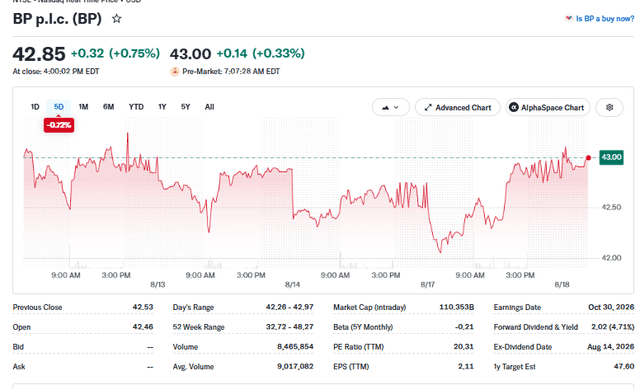
BP’s recent earnings have given investors another reason to watch the stock. The company reported $5.73 billion in second-quarter 2026 underlying replacement-cost profit, more than double the figure from a year earlier. Strong trading and refining margins helped drive the result. BP also increased its dividend by 4%.
What is the BP stock forecast?
Analyst views remain mixed, although the overall picture leans positive. Investing.com lists nine Buy ratings, nine Holds and one Sell, with an average 12-month target of 593.93p. Berenberg has set a £6.00 target, while RBC Capital Markets has a £7.00 target.
Meyka’s latest BP page gives the stock a B+ AI score and shows a neutral RSI reading of 47.21. Its model has a 12-month target of $32.41. Investors should view this as one model-based scenario rather than a guaranteed outcome.
Shell Shares Gain 1.5%: What Is Driving the Rally?
Shell gained 1.5% on August 18 as oil prices moved higher. The stock has also held up well in recent sessions. Shell rose 1.76% on August 11 and added another 0.97% on August 14.
The main support comes from higher energy prices. Stronger oil prices can improve upstream earnings and lift investor sentiment. Shell is still exposed to changes in oil and gas prices, as well as shifts in global demand.
What are analysts saying about Shell?
Recent analyst views remain generally positive. Argus raised its Shell target in August, while Investing.com shows six Buy ratings and 10 Holds in its latest consensus. The average 12-month target was $98.03.
Strait of Hormuz Strike Puts Oil and Shipping Back in Focus
Vessel incident raises supply concerns
A fresh vessel incident in the Strait of Hormuz added another layer of risk on August 18. UKMTO reported that a vessel was struck by an unknown projectile while travelling outbound. The incident damaged the engine room and left one crew member dead.
Shipping activity is already showing signs of pressure. Kpler data showed that only six commodity ships crossed the strait on August 17, compared with a 10-day average of 11. No very large crude carriers or LNG tankers crossed the route that day.
Why does Hormuz matter for markets?
The Strait of Hormuz is a major route for global energy shipments. A prolonged disruption could increase transport costs and push crude prices higher.
That would have mixed effects across financial markets. Oil producers such as BP and Shell could benefit from stronger commodity prices. Airlines, transport companies and consumers would face higher fuel costs.
What Investors Should Watch Next?
Investors should keep an eye on Brent crude, Hormuz shipping activity and further geopolitical developments. Brent was already close to $91 a barrel on August 18.
BP’s strong earnings provide company-specific support, but higher oil prices can also add to inflation pressure. The next moves in the FTSE 100 will depend partly on whether gains in energy stocks continue to offset weakness across other sectors.
An AI stock analysis tool can help investors compare price momentum, technical signals and analyst forecasts more quickly. These tools are best used alongside independent research rather than as a replacement for it.
Conclusion
The FTSE 100 today remained in positive territory as BP and Shell benefited from higher oil prices. At the same time, the latest Strait of Hormuz incident has raised fresh concerns about energy shipments. Investors will be watching crude prices, shipping volumes and geopolitical developments closely. A further rise in oil prices could support energy stocks, but it could also add to inflation and wider market pressure.
Disclaimer:
The content shared by Meyka AI PTY LTD is for research and informational purposes only. Meyka is not a financial advisory service, and the information provided should not be treated as investment or trading advice.
What brings you to Meyka?
Pick what interests you most and we will get you started.
I'm here to read news
Find more articles like this one
I'm here to research stocks
Ask Meyka Analyst about any stock
I'm here to track my Portfolio
Get daily updates and alerts (coming March 2026)