




Key Points
Euro bond yields rise as ECB officials signal a cautious approach to future rate cuts.
Hawkish Sintra remarks prompt investors to reduce easing expectations.
German Bund and other Eurozone yields climb following the market repricing.
Upcoming inflation and ECB policy decisions will drive the next bond market moves.
Euro bond yields rose on July 2, 2026, after European Central Bank (ECB) officials struck a hawkish tone at the annual Sintra Forum in Portugal. Their comments prompted investors to dial back expectations for additional interest rate cuts over the coming months.
Markets responded quickly, pushing benchmark government bond yields higher across the Eurozone. The move shows how closely investors follow central bank guidance when pricing borrowing costs, investment risks, and monetary policy.
What Did ECB Officials Say at the Sintra Forum?
Hawkish Tone Signals Patience on Future Rate Cuts
European Central Bank (ECB) officials delivered a cautious message during the annual Sintra Forum in Portugal. Although inflation has come down from its previous highs, policymakers said it is still too early to be confident that price pressures are fully under control.
ECB President Christine Lagarde noted that inflation risks are becoming more balanced, but stressed that future decisions will depend on incoming economic data. Those remarks reduced expectations for faster interest rate cuts and led investors to adjust their positions in the bond market.
Why Investors Repriced ECB Expectations?
Bond markets reacted almost immediately because interest rate expectations have a direct effect on government debt prices. As traders reduced bets on near-term ECB rate cuts, bond prices declined while yields moved higher.
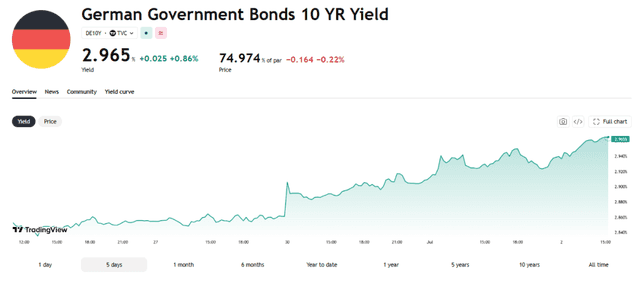
Germany’s benchmark 10-year Bund yield climbed to around 2.95% on July 2, recovering part of its recent decline. Since bond prices and yields move in opposite directions, the shift reflected growing expectations that borrowing costs could remain higher for longer.
Eurozone Bond Markets Respond With Higher Yields
German Bunds Lead the Move Higher
Germany’s 10-year Bund, the benchmark for the Eurozone bond market, led the gains after the Sintra comments. Its yield rose to nearly 2.95%, while shorter-term German government bond yields also increased as investors reassessed the ECB’s policy outlook. Government bond yields in France, Italy, and Spain moved higher as well, though the pace varied depending on investor demand and each country’s fiscal position.
Peripheral Bond Spreads Stay in Focus
Investors continued to watch the spread between Italian BTPs and German Bunds, a widely followed measure of sovereign risk within the Eurozone. The relatively stable spread suggested that markets viewed the rise in yields as a response to changing monetary policy expectations rather than concerns about individual countries.
Analysts expect bond market volatility to remain elevated until fresh inflation and economic growth data offer more clarity on the ECB’s next steps.
Inflation Still Keeps the ECB Cautious
Sticky Inflation Limits Room for Rate Cuts
Inflation has eased, but price pressures remain above the ECB’s comfort level in several parts of the economy. Reuters reported that June inflation slowed across Germany, France, and Italy, with France reaching the ECB’s 2% target. Even so, core inflation and services inflation continue to hold at relatively high levels. That has made policymakers reluctant to move too quickly with additional rate cuts.
Energy Prices and Global Risks Add Pressure
Energy prices and geopolitical tensions are still influencing inflation expectations across Europe. Sharp moves in oil prices or fresh geopolitical risks could slow the recent progress on inflation.
For that reason, ECB officials continue to favor a gradual, data-driven approach instead of signaling immediate policy easing. Investors are now paying closer attention to upcoming inflation reports for clues about future interest rate decisions.
What Higher Bond Yields Mean for Investors and the Economy?
Rising Borrowing Costs Across Europe
Higher government bond yields usually translate into higher borrowing costs throughout the economy. Governments may have to pay more when issuing new debt, while companies could face higher financing costs. Mortgage rates and corporate borrowing expenses may also stay elevated if bond yields continue to rise.
Winners and Losers in Financial Markets
Banks often benefit from higher interest rates because wider lending margins can improve profitability. At the same time, sectors such as real estate and utilities may come under pressure as financing becomes more expensive. Investors using an AI stock analysis tool can also track how changing interest rate expectations affect financial stocks and broader European market trends alongside traditional economic indicators.
Key Economic Events Investors Should Watch Next
Investors will be watching the ECB’s next monetary policy meeting, along with upcoming Eurozone inflation data, GDP figures, and labor market reports. Future speeches from ECB officials will also be closely followed for any change in policy guidance. Unexpected economic data could quickly reshape interest rate expectations and trigger another move in Eurozone bond yields.
Conclusion
The ECB’s hawkish comments at the Sintra Forum prompted investors to rethink expectations for near-term interest rate cuts, sending Eurozone bond yields higher. While inflation has eased, policymakers remain cautious because underlying price pressures have not fully disappeared.
The next round of inflation data, economic indicators, and ECB communication will help determine whether bond yields continue to rise or begin to stabilize in the months ahead.
Disclaimer:
The content shared by Meyka AI PTY LTD is solely for research and informational purposes. Meyka is not a financial advisory service, and the information provided should not be considered investment or trading advice.
What brings you to Meyka?
Pick what interests you most and we will get you started.
I'm here to read news
Find more articles like this one
I'm here to research stocks
Ask Meyka Analyst about any stock
I'm here to track my Portfolio
Get daily updates and alerts (coming March 2026)