Crypto Prices Today: Bitcoin Dips to ~$79K as PPI Rises to 6% and CLARITY Act Vote Nears

Key Points
Bitcoin slips near $79K after inflation (PPI ~6%) and regulatory uncertainty.
CLARITY Act vote adds short-term volatility to crypto markets.
ETF inflows and institutional demand still support the long-term trend.
Key levels: $78K support, $81K resistance in the current consolidation range.
On May 14, 2026, Bitcoin slipped toward the $79,000 level as crypto markets reacted to fresh U.S. inflation data and policy uncertainty. The Producer Price Index (PPI) rose near 6%, signaling stronger-than-expected cost pressures. At the same time, investors are watching the upcoming crypto price and CLARITY Act vote in the U.S. Senate. These combined forces are creating short-term pressure on digital assets, while keeping traders alert for the next major market move.
Bitcoin Price Movement Today and Market Reaction
Bitcoin traded near the $79,000 support zone on May 14, 2026, after losing momentum from recent highs above $81,000. The move reflects rising caution in both crypto and broader risk markets.
The drop is mainly linked to two key factors. First, the U.S. Producer Price Index (PPI) rose close to 6%, signaling persistent inflation at the wholesale level. Second, traders are positioning ahead of the CLARITY Act Senate vote, which could reshape crypto regulation in the United States.
Market activity shows reduced leverage in derivatives and lower intraday volatility compared to earlier rallies. However, spot demand remains stable, suggesting long-term investors are still holding positions rather than exiting the market.
Bitcoin is currently in a consolidation phase after a strong multi-week rally above $80K.
Why Did Bitcoin Drop to $79K Today?
Bitcoin’s pullback is driven more by macro pressure than crypto-specific weakness. Key reasons include:
- Higher-than-expected PPI inflation (~6%), raising concerns about prolonged tight monetary policy
- Possible delay in U.S. interest rate cuts
- Short-term profit booking after recent highs above $81K
- Reduced appetite for high-risk assets across global markets
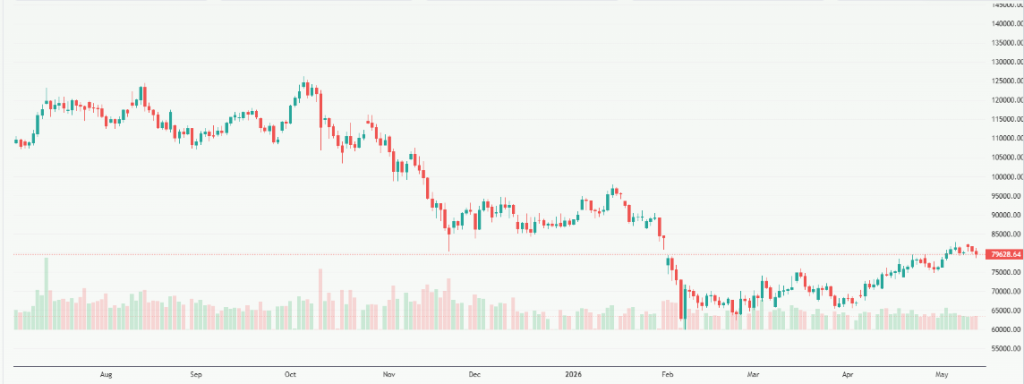
Inflation data plays a major role in crypto pricing because it affects liquidity expectations. When inflation rises, investors often shift toward safer assets like the U.S. dollar and bonds.
At the same time, Bitcoin had recently entered overbought territory on short-term charts. This triggered automatic selling from traders and algorithmic systems.
Despite the drop, the broader trend remains upward compared to early 2026 levels.
How Is U.S. Inflation (PPI) Affecting Crypto Markets?
The Producer Price Index (PPI) measures inflation at the wholesale level. A reading near 6% indicates rising input costs for businesses.
This impacts crypto in three main ways:
- Higher inflation reduces expectations of quick Federal Reserve rate cuts
- Stronger dollar puts downward pressure on Bitcoin
- Institutional investors become more risk-averse in the short term
Historically, Bitcoin reacts negatively to surprise inflation spikes, especially when liquidity conditions tighten. However, the effect is usually temporary.
In previous cycles (2022–2024), Bitcoin often recovered within weeks after inflation shocks once markets adjusted expectations.
Right now, traders are balancing inflation concerns with long-term optimism about crypto adoption.
What Is the CLARITY Act and Why Does It Matter for Crypto Price?
The CLARITY Act is a U.S. legislative proposal designed to define how cryptocurrencies are regulated. It aims to clearly separate responsibilities between the SEC (Securities and Exchange Commission) and the CFTC (Commodity Futures Trading Commission).
As of May 14, 2026, the bill is under active Senate discussion and is expected to undergo a key vote phase soon.
Why it matters:
- It could reduce regulatory confusion for exchanges and investors
- It may encourage more institutional participation in crypto markets
- It could improve long-term market stability in the U.S.
Markets typically react positively to regulatory clarity. However, short-term volatility increases before major votes due to uncertainty.
Investors are closely watching whether bipartisan support will be strong enough to push the bill forward. Any delay or revision could temporarily weigh on sentiment.
Bitcoin Technical Analysis: Key Levels and Market Structure
Bitcoin is currently moving inside a broad consolidation range after its recent rally.
Key levels:
- Support: $78,000 and $75,500
- Resistance: $81,000 and $83,000
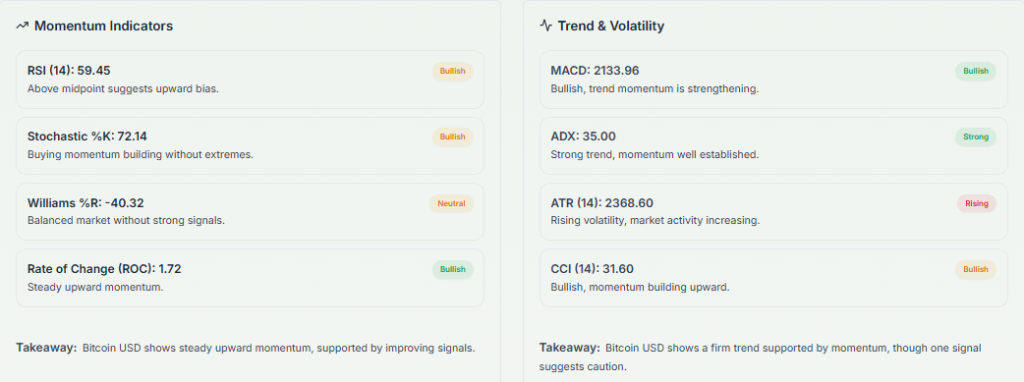
If Bitcoin holds above $78K, it signals strong buyer interest and continuation of the bullish structure. A breakdown below $75.5K may trigger a deeper correction toward lower support zones.
Momentum indicators show cooling buying pressure but not a full trend reversal. Trading volume has also normalized after recent spikes.
According to AI-based stock and crypto analysis tools used by institutional traders, Bitcoin remains in a mid-cycle consolidation phase rather than a bearish reversal. This suggests accumulation is still active at lower levels.
Institutional Trends and Market Outlook
Institutional participation continues to support Bitcoin’s long-term structure. Key observations:
- ETF inflows remain steady despite short-term volatility
- Long-term holders are not significantly reducing exposure
- Corporate crypto adoption continues in select markets
Institutional behavior often stabilizes Bitcoin during macro-driven corrections. Unlike retail traders, institutions tend to accumulate during dips rather than exit.
Market sentiment remains neutral-to-positive. While inflation and regulation create short-term pressure, structural demand for Bitcoin as a digital asset continues to grow.
Analysts from multiple global research desks still expect Bitcoin to maintain higher lows as long as macro conditions do not sharply deteriorate.
Crypto Price: What Should Investors Watch Next?
The next phase of Bitcoin’s movement depends on three key factors:
- Outcome of the CLARITY Act Senate vote
- Upcoming U.S. inflation and Fed policy signals
- ETF inflow trends over the next few weeks
If inflation stabilizes and regulatory clarity improves, Bitcoin could retest the $81K–$83K resistance zone. However, continued macro uncertainty may keep it range-bound between $75K and $81K.
Short-term volatility is expected to remain high. Traders should watch liquidity conditions closely, as they will drive the next breakout or correction phase.
Wrap Up
Bitcoin’s drop toward $79K reflects a mix of inflation pressure and regulatory uncertainty. The rise in U.S. PPI has weakened risk appetite, while the CLARITY Act vote adds uncertainty to market direction. Despite short-term volatility, institutional demand remains steady. The coming days will be critical in determining whether Bitcoin stabilizes above key support or enters a deeper correction phase.
Disclaimer:
The content shared by Meyka AI PTY LTD is solely for research and informational purposes. Meyka is not a financial advisory service, and the information provided should not be considered investment or trading advice.
What brings you to Meyka?
Pick what interests you most and we will get you started.
I'm here to read news
Find more articles like this one
I'm here to research stocks
Ask Meyka Analyst about any stock
I'm here to track my Portfolio
Get daily updates and alerts (coming March 2026)