




Key Points
BNP Paribas reported a record €3.22B Q1 2026 profit, beating analyst estimates.
Strong trading activity and AXA IM integration boosted revenue growth.
Asset management expansion strengthened BNP’s long-term growth strategy.
Rising provisions and weaker investment banking remain key investor concerns.
BNP Paribas reported a record €3.22 billion profit for the first quarter of 2026, highlighting the strength of Europe’s banking sector during volatile markets. The results, announced on April 30, 2026, were fueled by strong trading performance and the integration of AXA Investment Managers. Revenue also climbed above analyst forecasts, showing the bank’s growing focus on asset management and diversified income. Investors are now watching whether BNP Paribas can maintain this momentum through the rest of 2026.
BNP Paribas Q1 2026 Earnings Snapshot
BNP Paribas delivered one of the strongest quarterly performances among European banks in early 2026. The French banking giant reported record first-quarter profit as higher trading activity, retail banking growth, and the integration of AXA Investment Managers boosted revenue.
The results were released on April 30, 2026. Investors closely watched the earnings because European banks are facing rising geopolitical risks and slower investment banking activity worldwide.
Net Profit Beats Market Expectations
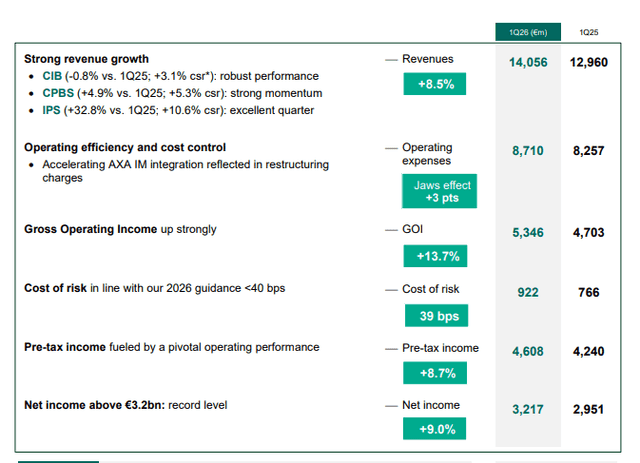
BNP Paribas posted net income of €3.22 billion for Q1 2026. That was a 9% increase from the same period last year. Analysts had expected around €2.93 billion, making the results stronger than forecasts.
Several factors supported the profit growth:
- Strong retail banking momentum in France and Belgium
- Stable fixed-income trading revenue
- Positive revaluation of the bank’s stake in Allfunds
- First full-quarter contribution from AXA IM integration
The bank’s diversified business model helped offset weakness in investment banking. This remains a key advantage over banks that depend heavily on dealmaking revenue.
Revenue Climbs Above Forecasts
Group revenue rose 8.5% year over year to €14.06 billion. Gross operating income increased 13.7% to €5.35 billion. Both figures came in ahead of analyst estimates.
The bank also reported:
- Operating expenses of €8.71 billion
- Cost-income ratio of 62%
- Positive “jaws effect” of 3 percentage points
These numbers showed that revenue growth outpaced expense growth despite rising integration costs linked to AXA IM.
Why Did BNP Shares Still Fall?
Despite the earnings beat, BNP Paribas shares moved lower after the announcement. Investors remained cautious because some business units underperformed expectations.
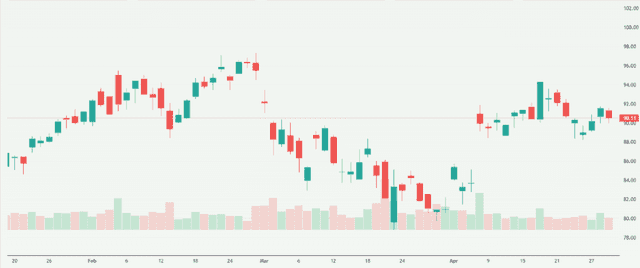
Key concerns included:
- Slower investment banking activity
- Rising provisions for potential bad loans
- Weak performance in auto leasing operations
- Geopolitical uncertainty linked to Middle East tensions
Analysts also noted that one-off accounting items helped lift headline profit figures.
How Trading Activity Powered BNP Paribas’ Record Quarter?
Trading revenue played a major role in BNP Paribas’ strong Q1 performance. Market volatility during early 2026 increased client activity across global financial markets.
Did BNP Benefit From Market Volatility?
Yes. The bank benefited from active client trading during uncertain market conditions. However, BNP’s trading growth was still lower than that of major Wall Street banks and Swiss rival UBS.
BNP Paribas reported:
- 2.5% growth in trading revenues
- Stable fixed income, currencies, and commodities activity
- Stronger equities and securities services performance
The Iran-related geopolitical crisis increased market swings in March 2026. That pushed institutional investors to trade more actively.
Investment Banking Performance Lagged
While trading stayed stable, investment banking was weaker.
Global banking revenue dropped nearly 10% because many corporate transactions were delayed during geopolitical tensions. Companies became more cautious about mergers, acquisitions, and financing activity.
This slowdown affected:
- Corporate lending
- Advisory deals
- Capital market activity
Still, BNP’s diversified structure helped balance weaker investment banking results with stronger retail and asset-management revenue.
Why Is Trading Revenue Important in 2026?
European banks are relying more on trading and fee-based businesses as lending margins become less predictable.
Higher interest rates and volatile markets continue to support trading desks across Europe. Investors are now comparing BNP Paribas with rivals such as:
- Deutsche Bank
- Société Générale
- Lloyds Banking Group
Many analysts believe banks with diversified income streams are better positioned for long-term growth in uncertain economic conditions.
AXA Investment Managers Integration Becomes a Major Growth Catalyst
The integration of AXA Investment Managers became one of the biggest growth drivers in BNP Paribas’ Q1 results.
How Much Did AXA IM Contribute?
The first full-quarter consolidation of AXA IM significantly boosted revenue growth. BNP Paribas said the acquisition strengthened its investment and protection services division.
The division saw:
- Revenue growth above 30%
- Higher recurring fee income
- Expansion in wealth and institutional asset management
The acquisition also increased BNP’s exposure to long-term savings and pension assets.
BNP Paribas Expands Its Asset Management Scale
The AXA IM deal transformed BNP into one of Europe’s largest asset-management groups. The combined business now manages more than €1.5 trillion in assets, according to Reuters.
The acquisition strengthened BNP’s position in:
- Exchange-traded funds (ETFs)
- Private assets
- Insurance-related investments
- Pension fund management
This move supports the bank’s strategy to generate more stable, fee-based income rather than relying only on lending.
Why Is Asset Management Becoming More Important?
Global banks are increasingly focusing on asset management because it produces recurring revenue and lowers earnings volatility.
BNP Paribas Asset Management expects alternative investments and private credit markets to grow strongly through 2030. Moody’s estimates that private credit assets could exceed $2 trillion globally in 2026.
CEO Jean-Laurent Bonnafé said the bank is already preparing its 2027–2030 strategic growth plan.
Weak Spots Hidden Behind the Strong Headline Numbers
Although headline earnings were strong, several areas showed weakness.
Rising Loan Loss Provisions Raise Concerns
BNP Paribas increased provisions for credit losses to €922 million in Q1 2026. That was up from €766 million a year earlier. The bank said the increase reflected macroeconomic uncertainty linked to Middle East tensions and global economic risks.
Other European lenders also raised provisions this quarter, including:
- Deutsche Bank
- Lloyds Banking Group
This suggests banks remain cautious about future defaults and slowing economic growth.
Auto Leasing Business Struggled
BNP Paribas also faced pressure in vehicle leasing and financing operations. Weak used-car values affected profitability in parts of its leasing business. Investors viewed this as a sign that consumer-related businesses may face tougher conditions during 2026.
AXA IM Integration Costs Continue
While AXA IM boosted revenue, the acquisition also increased restructuring costs.
BNP previously estimated around €800 million in restructuring charges for 2026, including roughly €400 million linked to AXA IM integration.
Reports earlier this year also suggested the bank could cut around 1,200 jobs as part of the integration process.
BNP Paribas Strategy Outlook Through 2028
BNP Paribas maintained a confident long-term outlook despite economic uncertainty.
What are BNP’s Main Financial Targets?
The bank reaffirmed its key capital and growth targets for the coming years.
Key goals include:
- CET1 capital ratio target of 13% by 2027
- Continued profit growth through 2028
- Expansion in fee-based businesses
- Growth in wealth and asset management
The CET1 ratio stood at 12.8% at the end of March 2026.
Focus Shifts Toward Diversified Revenue
CEO Jean-Laurent Bonnafé has spent years building BNP into a diversified financial group.
Today, the bank earns revenue from:
- Retail banking
- Investment banking
- Insurance
- Asset management
- Securities services
This strategy helped BNP remain resilient even when some divisions slowed.
BNP Paribas Stock Forecast and Technical Analysis
BNP Paribas stock remains closely watched by European banking investors. Short technical analysis summary:
- Trend remains positive long term after strong 2025 gains
- Earnings beat supports investor confidence
- Short-term pressure may continue due to geopolitical uncertainty
- Support comes from strong capital ratios and diversified revenue
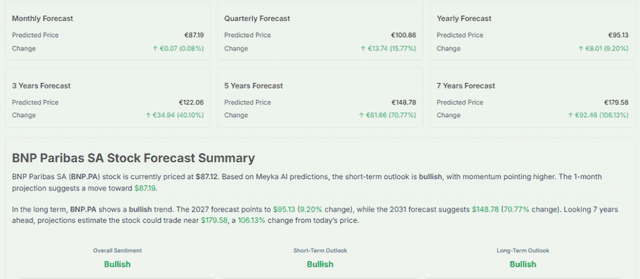
Analysts from Jefferies maintained a “Buy” rating and highlighted stronger-than-expected pre-tax performance in the corporate center division.
What Meyka Says?
Meyka’s outlook would likely view BNP Paribas as a strong long-term European banking play because of:
- Stable retail banking operations
- Expanding asset-management business
- Strong capital position
- Strategic shift toward recurring fee income
However, risks remain tied to global economic uncertainty, slower investment banking activity, and rising credit-loss provisions.
What BNP Paribas Earnings Mean for European Banks and Investors?
BNP Paribas’ results show how European banks are adapting to changing market conditions.
Banks with diversified business models are outperforming peers that rely heavily on traditional lending or investment banking alone. Asset management, trading, and wealth services are becoming more important profit drivers.
The AXA IM integration also highlights a growing consolidation trend in Europe’s financial sector. Large banks are racing to expand their investment and wealth-management businesses to secure long-term growth.
For investors, BNP Paribas remains one of Europe’s most important banking stocks to watch in 2026 because of its scale, strong capital position, and expanding fee-based revenue model.
Final Words
BNP Paribas delivered a strong Q1 2026 performance with record profit, solid trading revenue, and major growth from the AXA IM integration. While investment banking weakness and rising provisions remain risks, the bank’s diversified business model and strong capital position continue to support long-term growth. Investors will now watch whether BNP Paribas can maintain this momentum through the rest of 2026.
Disclaimer:
The content shared by Meyka AI PTY LTD is solely for research and informational purposes. Meyka is not a financial advisory service, and the information provided should not be considered investment or trading advice.
What brings you to Meyka?
Pick what interests you most and we will get you started.
I'm here to read news
Find more articles like this one
I'm here to research stocks
Ask Meyka Analyst about any stock
I'm here to track my Portfolio
Get daily updates and alerts (coming March 2026)