




Key Points
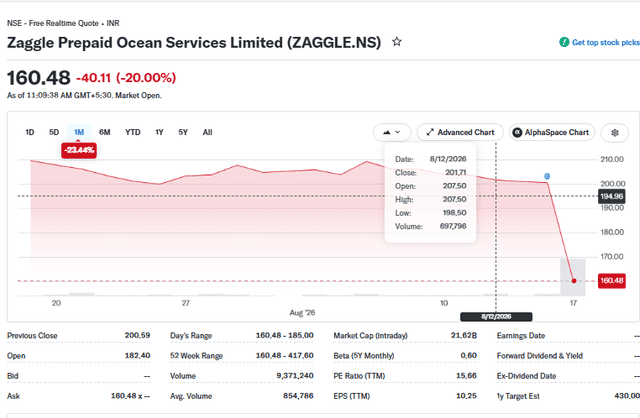
Zaggle Prepaid shares crashed 20% to ₹160.48 on August 17, 2026, hitting the lower circuit and a fresh 52-week low.
Q1 FY27 revenue rose 27.5% to ₹423 crore, but net profit fell about 33% year on year.
Profit margins weakened due to acquisition, employee, and expansion-related costs.
Meyka’s 46.3/100 fundamental score and cautious technical signals point to continued investor concerns.
Zaggle Prepaid shares came under heavy selling pressure on August 17, 2026, falling 20% to the lower circuit at ₹160.48. The sharp drop came after the company reported its Q1 FY27 results, which showed strong revenue growth but weaker profitability. Revenue increased 27.5% year on year to ₹423.26 crore, while net profit declined 32.9% to ₹17.53 crore. EBITDA margins also narrowed, adding to concerns over rising costs and earnings growth.
Why Did Zaggle Prepaid Shares Fall 20% Today?
₹160.48 Lower Circuit From ₹200.59
Zaggle Prepaid shares dropped 20% to ₹160.48 on Monday, August 17, 2026. The stock hit its lower circuit after closing at ₹200.59 in the previous session. Trading remained heavy, with volumes crossing 20 lakh shares during the morning session. The fall also pushed the stock to a fresh 52-week low of ₹160.48.
Q1 FY27 Profit Falls Despite Revenue Growth
The sell-off came after Zaggle released its Q1 FY27 results in after-hours trading on August 14. Revenue from core operations increased by 27.5% year-on-year to about ₹423 crore. Net profit attributable to owners, though, fell about 33% to ₹18 crore, compared with ₹26 crore a year earlier. EBITDA increased only marginally to ₹31 crore, showing that profit growth remained well below the pace of revenue growth.
Zaggle Q1 FY27 Results: Revenue Growth Fails to Offset Margin Pressure
Adjusted EBITDA Margin Drops to 8.2%
Profitability was the main concern in the latest results. The company’s reported operational EBITDA margin declined to 7.29% from 9.18% a year earlier. Revenue continued to grow, but the increase did not lead to similar growth in operating profit. Investors also focused on higher expenses linked to Zaggle’s expanding business and recent acquisitions.
Acquisition and Investment Costs Weigh on Earnings
Management said costs related to the Dice acquisition affected margins. These expenses included transaction costs, one-time vendor payments, and relocation costs for more than 100 professionals. Employee increments and expenses linked to Zagg. Money also added to the pressure. Zaggle has said it expects operating leverage and AI-driven efficiency to support margins as the business scales.
Zaggle Prepaid Stock: What Meyka’s Analysis Shows
Fundamental Health and Profitability Signals
Meyka currently gives ZAGGLE.NS a Fundamental Health Score of 46.3/100, rated D. Its analysis shows a P/E of 19.51, ROE of 10.43%, and net margin of 7.24%. Debt-to-equity remains low at 0.04, while the current ratio stands at 8.72.
Technical Trend After the 20% Crash
Meyka’s technical dashboard points to a cautious setup. RSI stands at 41.40, while MACD is negative at -1.52 and CCI is at -164.48. Money-flow indicators also favour sellers. Meyka describes the technical setup as mixed and suggests a hold or wait-and-see approach.
What Investors Should Watch After the Zaggle Share Price Crash?
Margin Recovery vs Revenue Growth
Investors will need to watch whether Zaggle can improve margins while keeping its revenue growth on track. The company’s FY27 guidance targets 25% to 30% standalone growth and around 40% consolidated growth.
FY27 Growth, AI and Acquisitions
The integration of recent acquisitions will remain an area to watch. Zaggle also plans to use AI to improve efficiency. Its ability to manage costs while expanding these businesses could affect earnings over the next few quarters.
Key Support and Risk Factors
The immediate price reference is ₹160.48, which is now the stock’s 52-week low. Margin pressure, acquisition costs, weaker earnings conversion, and continued selling remain risks. Investors should not assume that ₹160.48 will automatically act as support.
Zaggle Prepaid Share Price Outlook: Can ZAGGLE Recover?
Zaggle’s recovery will depend largely on execution. Strong revenue growth and the company’s FY27 expansion plans remain positives. At the same time, investors will want to see whether acquisition and technology spending can translate into better margins. The sharp sell-off shows that the market is placing more focus on earnings quality.
Conclusion: Zaggle’s Growth Story Faces a Profitability Test
Zaggle Prepaid’s 20% fall to ₹160.48 has shifted investor attention from revenue growth to profitability. The company still expects strong expansion in FY27, but it now needs to show better cost control and margin recovery. Meyka’s weak fundamental score and cautious technical signals add to those concerns. The next few quarters should provide a clearer picture of whether Zaggle can turn acquisition-led growth and AI investment into stronger, sustainable earnings.
Frequently Asked Questions (FAQs)
The stock fell after Q1 FY27 results showed a sharp decline in net profit and weaker EBITDA margins, despite strong revenue growth.
Zaggle Prepaid hit its lower circuit at ₹160.48 on August 17, 2026, which also became a new 52-week low.
Net profit attributable to owners fell about 33% year on year to ₹18 crore, while revenue increased 27.5% to about ₹423 crore.
Meyka’s current analysis shows weak fundamentals, with a 46.3/100 score. Its technical dashboard points to bearish momentum, although some indicators suggest the stock may be approaching oversold levels.
Disclaimer:
The content shared by Meyka AI PTY LTD is for research and informational purposes only. Meyka is not a financial advisory service, and the information provided should not be treated as investment or trading advice.
What brings you to Meyka?
Pick what interests you most and we will get you started.
I'm here to read news
Find more articles like this one
I'm here to research stocks
Ask Meyka Analyst about any stock
I'm here to track my Portfolio
Get daily updates and alerts (coming March 2026)