
Key Points
Union Bank share price fell nearly 5% after its Q1 FY27 business update.
Gross advances rose 12.5% YoY, showing healthy loan growth.
Sequential decline in global business weighed on investor sentiment.
Q1 FY27 earnings and management guidance will be the next key triggers for the stock.
On July 3, 2026, Union Bank of India shares dropped about 5% after the public sector lender released its Q1 FY27 business update. The fall came despite healthy year-on-year growth in loans and overall business. Investors were more concerned about weaker quarter-on-quarter trends in global business and deposits, which raised questions about short-term growth. Below is a closer look at the numbers behind the selloff and what they could mean for the stock in the coming weeks.
Why Did Union Bank Share Price Fall 5% Today?
Market Reacts to Sequential Slowdown
Union Bank of India shares lost nearly 5% on July 3, 2026, after the bank published its provisional Q1 FY27 business update. Although the annual growth figures were solid, the market paid more attention to the slowdown from the previous quarter. Global business edged lower on a sequential basis, while total deposits also slipped compared with the March 2026 quarter.
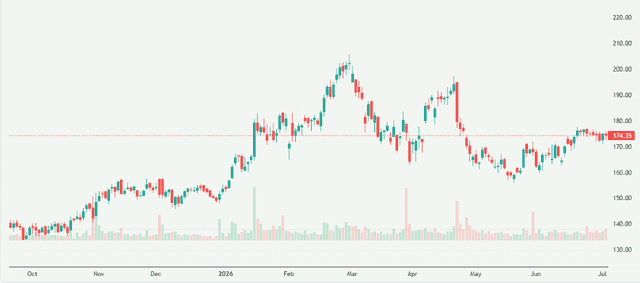
That was enough to dampen investor sentiment. With the Q1 earnings season approaching, many investors are reacting more strongly to quarter-on-quarter performance than year-on-year growth, particularly in PSU banking stocks.
Key Highlights From Union Bank’s Q1 FY27 Business Update
Advances Continue to Grow
Even after the sharp fall in the share price, Union Bank reported steady growth in lending across its major business segments.
The latest figures include:
- Gross advances increased 12.5% year over year to ₹10.96 lakh crore.
- Domestic advances rose 13.11% year over year to ₹10.61 lakh crore.
- Retail, Agriculture and MSME (RAM) advances climbed 11.56% year over year to ₹6.08 lakh crore.
These numbers suggest that demand for credit remained healthy across the bank’s core lending businesses.
Deposits Stay Healthy
The deposit business also posted annual growth, although the quarterly trend disappointed investors.
- Total deposits rose 3.5% year over year to ₹12.83 lakh crore.
- Domestic CASA deposits increased 11.72% year over year to ₹4.50 lakh crore.
- The CASA ratio improved to 35.10%, which supports lower funding costs and helps protect margins.
Despite those gains, deposits declined from the previous quarter. That became one of the biggest reasons behind the stock’s decline.
Global Business Shows Sequential Weakness
Union Bank’s global business reached ₹23.80 lakh crore, an increase of 7.46% from a year earlier. Even so, the figure was slightly below the level reported at the end of March 2026. Investors focused on that sequential decline rather than the annual growth, leading to profit booking in the stock.
Why Investors are Concerned Despite Positive Annual Growth?
Market Expectations Were Higher
The market had expected stronger quarterly growth after several PSU banks reported stable business expansion. Instead, Union Bank’s update pointed to slower deposit growth and a modest decline in overall business compared with the previous quarter.
Stock prices usually reflect expectations about future earnings, not just historical performance. As a result, even double-digit loan growth was not enough to offset concerns about slowing momentum.
Focus Shifts to Q1 FY27 Earnings
The upcoming Q1 FY27 results should provide a clearer picture of the bank’s operating performance. Investors will be watching several areas closely:
- Net Interest Margin (NIM)
- Asset quality and bad loan trends
- Credit costs
- Profit growth
- Management’s guidance on deposits and loan demand
These metrics will help investors judge whether the recent weakness is temporary or likely to continue over the coming quarters.
What Should Investors Watch Next?
The next major trigger for Union Bank shares will be its Q1 FY27 earnings announcement. Investors will be looking for updates on margins, deposit growth, and credit expansion, along with management’s comments on funding costs and loan demand.
According to Meyka’s AI stock analysis tool, the recent decline appears to be driven more by short-term sentiment than by a meaningful change in the bank’s fundamentals. Other analysts, including Motilal Oswal, continue to expect profit growth, although they remain cautious about near-term business trends.
Conclusion
Union Bank’s 5% decline shows that investors are paying closer attention to quarterly momentum than annual growth. Loan growth remained strong, and the bank continued to improve its CASA ratio.
Even so, softer sequential deposits and a slight decline in global business weighed on sentiment. The Q1 FY27 earnings report will give investors a better sense of whether these concerns are temporary or point to a slower pace of growth in the months ahead.
Disclaimer:
The content shared by Meyka AI PTY LTD is solely for research and informational purposes. Meyka is not a financial advisory service, and the information provided should not be considered investment or trading advice.
What brings you to Meyka?
Pick what interests you most and we will get you started.
I'm here to read news
Find more articles like this one
I'm here to research stocks
Ask Meyka Analyst about any stock
I'm here to track my Portfolio
Get daily updates and alerts (coming March 2026)