
Key Points
Vedanta's 2026 demerger aims to unlock shareholder value and improve business transparency.
Record FY26 earnings and lower debt have strengthened the company's financial position.
Expansion plans worth $5 billion could support long-term growth across metals and energy.
Commodity prices and execution risks remain the biggest factors influencing Vedanta's future performance.
Vedanta Limited has stayed in focus after completing its major business demerger in 2026 and announcing expansion plans across its metals, mining, and energy businesses. At the same time, the company is strengthening its balance sheet while benefiting from steady demand for aluminium, zinc, and oil.
Those developments have brought fresh attention to Vedanta shares. The question now is whether the stock can continue rewarding investors or if the risks deserve equal attention.
Why is Vedanta stock back in focus in 2026?
Vedanta Limited has attracted investors again following the completion of its five-way demerger in 2026. The restructuring separated its aluminium, oil and gas, power, iron and steel, and parent businesses into individual entities. Management expects the simpler structure to improve transparency and help shareholders better recognise the value of each business.
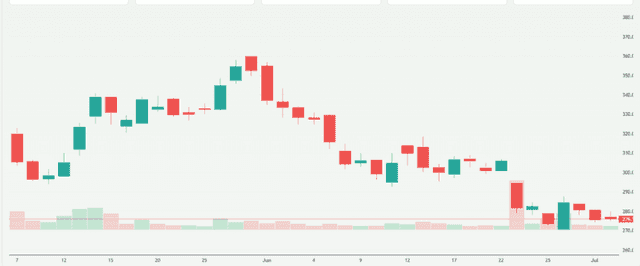
At the company’s Annual General Meeting in July 2026, Chairman Anil Agarwal outlined expansion plans across metals and energy. The company also announced a $5 billion investment to expand its oil and gas business. Together, these announcements have supported investor sentiment, even as market conditions remain uncertain.
Key Growth Drivers Supporting Vedanta Shares
What is driving Vedanta’s growth?
A number of factors continue to support Vedanta’s long-term investment case.
The company reported its strongest FY26 financial performance to date. Revenue reached ₹1.74 lakh crore, while annual profit climbed to ₹25,096 crore. EBITDA increased to ₹55,976 crore, reflecting better operating performance across its aluminium, zinc, and oil businesses. Net debt-to-EBITDA improved to 0.95x, its lowest level in more than three years.
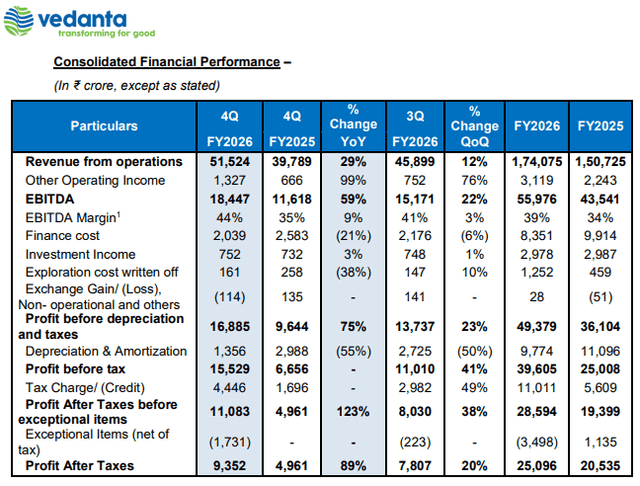
According to Meyka, stronger cash flow and lower debt remain positive signs for investors. Its AI stock analysis tool also points to improving long-term fundamentals, although movements in commodity prices could still create short-term volatility.
Demand for aluminium, zinc, copper, and energy also remains healthy, supported by infrastructure projects, renewable energy investments, and growing electric vehicle production around the world.
CRISIL’s recent rating upgrades indicate stronger financial and business profiles after the demerger. Other market analysts also maintain a positive view but believe future earnings will largely depend on commodity prices and how efficiently Vedanta delivers its expansion projects.
Biggest Risks Investors Should Watch
Could these risks limit future returns?
Yes. Vedanta still faces several challenges that investors should keep in mind.
Commodity prices remain the company’s biggest risk. A decline in aluminium, zinc, or crude oil prices would likely reduce earnings. At the same time, the company’s expansion projects require significant capital, making debt management an area worth watching.
Mining regulations, environmental approvals, and licence renewals could also delay projects or increase costs. Global economic conditions add another layer of uncertainty. Slower industrial activity in China or higher interest rates could weaken demand for industrial metals.
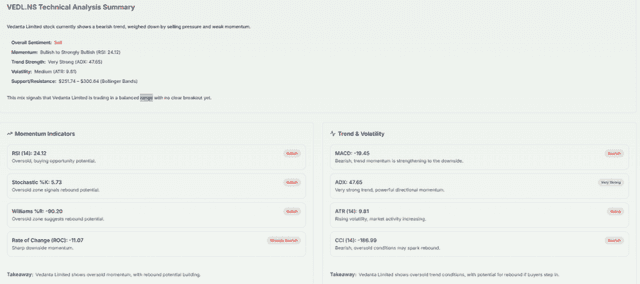
Technical analysis from Meyka suggests the stock’s price trend remains positive as long as it stays above major support levels. Still, short-term volatility may continue until the company reports its next earnings and provides more updates on post-demerger execution.
Is Vedanta Stock Worth Buying for the Long Term?
Vedanta may appeal to long-term investors because of its diversified business portfolio, healthy cash generation, and expansion strategy. Continued progress in reducing debt, along with its long record of paying dividends, also supports the investment case.
That said, the stock is better suited to investors who understand commodity cycles and are comfortable with periods of higher volatility.
According to Meyka, the overall view remains cautiously positive. The platform points to stronger fundamentals, improving debt levels, and growth opportunities following the demerger. Several analysts share that view and believe the stock could move higher if commodity markets remain supportive and the company delivers on its expansion plans.
Conclusion
Vedanta enters the second half of 2026 with stronger earnings, better credit quality, and clear expansion plans across its core businesses. The demerger has opened new opportunities, but commodity prices and project execution will continue to influence performance.
Investors should keep an eye on quarterly earnings, debt reduction, and global demand for metals. For those looking at the mining and metals sector over the long term, Vedanta remains a stock worth following.
Disclaimer:
The content shared by Meyka AI PTY LTD is for research and informational purposes only. Meyka is not a financial advisory service, and the information provided should not be treated as investment or trading advice.
What brings you to Meyka?
Pick what interests you most and we will get you started.
I'm here to read news
Find more articles like this one
I'm here to research stocks
Ask Meyka Analyst about any stock
I'm here to track my Portfolio
Get daily updates and alerts (coming March 2026)