




Key Points
Tesla shares fell as much as 5.6% after missing Q2 EPS estimates badly.
Automotive gross margin narrowed to 16.9%, below the 19.4% forecast.
Free cash flow turned negative at $1.09 billion amid soaring AI capex.
Record deliveries of 480,126 vehicles still trailed BYD's 557,090 units.
Tesla shares fell as much as 5.6% on July 23, 2026, a day after a disappointing Q2 earnings report. The stock touched an intraday low of $353.23, down from Wednesday’s close of $374.01. Tesla posted record second-quarter revenue of $28.24 billion, up 26% year-over-year, but adjusted earnings per share of $0.33 badly missed the $0.53 consensus estimate. Automotive gross margin narrowed to 16.9%, well below the 19.4% analysts had expected.
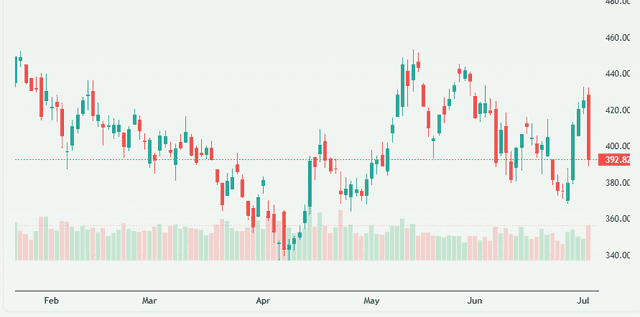
Tesla’s Revenue Beat Couldn’t Offset the Profit Miss
Tesla (NASDAQ: TSLA) delivered a record 480,126 vehicles during Q2 2026, up 25% year-over-year and far above the 406,600-unit estimate. That volume strength, though, didn’t translate into stronger profitability.
- GAAP net income fell 5% year-over-year to $1.11 billion, or $0.32 per share.
- GAAP operating income dropped 57% to just $398 million.
- Operating margin collapsed to 1.4%, down sharply from the prior year.
Automotive revenue rose 23% to $20.52 billion, Tesla’s largest single segment by far. Regulatory credit revenue fell to $146 million, down from $439 million a year earlier.
Why Automotive Margins Are the Real Story
Tesla’s automotive gross margin came in at 16.9%, down from 17.2% in the same quarter last year. Excluding regulatory credits entirely, that margin drops further to 16.3%.
- Analysts had projected roughly 18-19.4% gross margin on a credit-excluded basis.
- Aggressive price cuts and promotional financing appear to have driven the shortfall.
- CFO Vaibhav Taneja confirmed operating expenses will keep rising through 2026 and beyond.
This margin compression suggests Tesla bought its record delivery volume with discounting, not efficiency gains.
Cash Burn Deepens as AI Spending Accelerates
Tesla’s free cash flow swung sharply negative during the quarter, reversing a strong start to 2026. The company posted a free cash flow deficit of $1.09 billion.
- That compares with a $1.44 billion free cash flow surplus in Q1 2026.
- Capital expenditures jumped 142% year-over-year to $5.79 billion.
- Operating expenses rose 47% to $4.35 billion, driven by AI infrastructure and R&D spending.
CEO Elon Musk called 2026 a “massive capex year” during the earnings call, citing robotaxi, Optimus, and AI investments.
Other Segments Showed Genuine Strength
Not every part of Tesla’s business disappointed investors this quarter. The energy and services segments both posted solid, in some cases record, results.
- Energy generation and storage revenue rose 13% to $3.14 billion.
- Energy storage deployments hit a record 13.5 GWh, up from 8.8 GWh in Q1 2026.
- Services and other revenue jumped 50% to $4.58 billion, with record gross margin.
These segments partially offset automotive weakness, but they remain too small to move Tesla’s overall profitability picture meaningfully.
Competitive and Regulatory Pressure Adds to Concerns
Tesla’s delivery record still trails its largest global rival by a wide margin. BYD delivered 557,090 fully electric vehicles during the same quarter.
- That gap highlights intensifying competition in the global EV market.
- The National Highway Traffic Safety Administration is actively probing Tesla’s Full Self-Driving software.
- Tesla entered earnings trading at 177 times forward earnings, the richest multiple among the Magnificent Seven.
TipRanks maintained a Hold rating on Tesla with an unchanged $417 price target, citing robotaxi expansion against near-term financial risks.
What Comes Next for Tesla
Tesla’s Q2 2026 results confirm what bears have argued for months: record deliveries alone can’t offset shrinking automotive margins. A 1.4% operating margin and a $1.09 billion cash flow deficit raise real questions about how long AI and robotaxi bets can be funded without further margin pressure.
Musk’s framing of 2026 as a heavy investment year may prove correct long-term, but investors clearly wanted profitability alongside growth this quarter. With shares now down sharply from Wednesday’s close, the next test for Tesla will be whether Q3 shows any stabilization in automotive gross margin.
Disclaimer:
The content shared by Meyka AI PTY LTD is for research and informational purposes only. Meyka is not a financial advisory service, and the information provided should not be treated as investment or trading advice.
What brings you to Meyka?
Pick what interests you most and we will get you started.
I'm here to read news
Find more articles like this one
I'm here to research stocks
Ask Meyka Analyst about any stock
I'm here to track my Portfolio
Get daily updates and alerts (coming March 2026)