
Key Points
Tesla stock hits $417.85 amid strong market momentum and volatility.
Institutional investors hold 66.20% of TSLA shares, signaling strong confidence.
AI, autonomous driving, and energy storage drive Tesla’s long-term growth story.
Key risks include EV competition, margin pressure, and macroeconomic sensitivity.
Tesla Inc (NASDAQ: TSLA) traded at $417.85 on May 22, 2026, drawing strong attention from global investors. The stock remains heavily owned by institutions, which now hold 66.20% of total shares. This signals growing confidence despite market volatility and shifting tech sector trends. Investors are now watching whether momentum can hold in the coming sessions. Key questions remain about valuation strength, AI growth impact, and long-term upside potential in Tesla stock.
Tesla Stock Performance Overview and Recent Price Action
The Tesla hits $417.85 amid strong market positioning
Tesla Inc (NASDAQ: TSLA) has shown renewed strength in recent trading sessions, with the stock reaching $417.85 on May 22, 2026. This move reflects steady demand from institutional investors and improving sentiment around the EV and AI sectors.
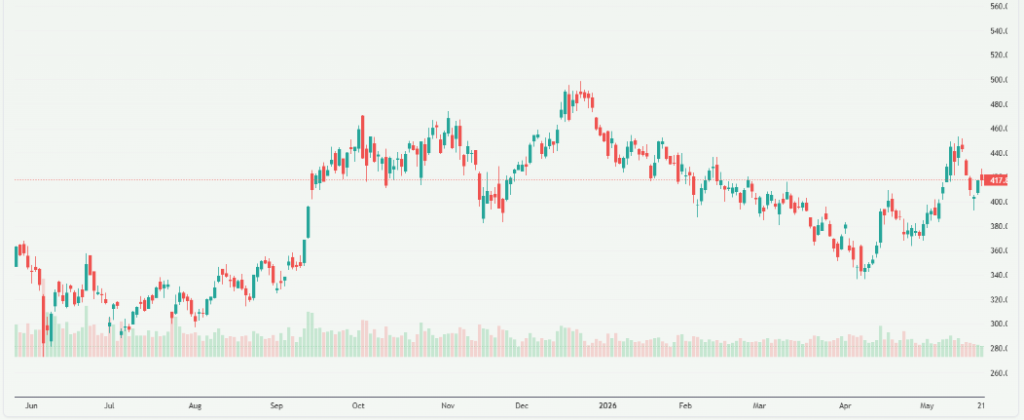
Trading activity has stayed volatile within a broad range of $380 to $430, showing that the market is still in a price discovery phase. Investors are reacting to shifting expectations around interest rates, tech valuations, and future growth in autonomous driving.
Tesla’s market capitalization remains firmly above the $1 trillion level, keeping it in the elite group of global mega-cap stocks. This level continues to attract both passive index inflows and active institutional rebalancing.
What is driving Tesla’s recent price movement?
Tesla’s short-term moves are mainly driven by three factors:
- AI-driven software revenue expectations
- Delivery and margin stability in automotive sales
- Strong institutional accumulation during dips
Market sentiment remains reactive to macroeconomic signals, especially U.S. Federal Reserve rate expectations.
Institutional Ownership Hits 66.20%: What It Means for TSLA
Why are institutions controlling most Tesla shares?
This level of ownership signals strong confidence in Tesla’s long-term business model, especially in AI, robotics, and energy storage. Institutions prefer Tesla due to its liquidity, global brand strength, and exposure to high-growth technology themes.
However, high institutional concentration also increases sensitivity to portfolio rebalancing. When large funds adjust exposure, Tesla often experiences sharp intraday volatility.
Is high institutional ownership good or risky for Tesla?
It is both.
Positive effects:
- Strong long-term price stability
- Steady inflows from index funds
- Lower emotional retail-driven swings
Risks:
- Sudden large-scale sell-offs during market stress
- High correlation with Nasdaq movements
- Reduced independence from macro trends
Breakdown of Tesla Shareholder Structure
Who owns the most Tesla shares in 2026?
Tesla’s ownership remains a mix of institutional giants, insiders, and retail investors. The structure is heavily weighted toward large financial institutions.
Major holders include:
- Vanguard Group
- BlackRock Inc.
- State Street Corporation
Combined institutional ownership dominates trading flows and passive index exposure. According to publicly reported filings, Elon Musk remains the largest individual shareholder with an estimated stake of around 20%–30%, depending on dilution and options adjustments
Retail investors still play a meaningful role, especially during volatility spikes and news-driven rallies.
How has ownership changed over time?
Over the past few years:
- Institutional ownership has steadily increased
- Retail participation rises during hype cycles
- Long-term funds now dominate trading volume
This shift reflects Tesla’s transition from a growth story to a core institutional holding.
Key Drivers Behind Tesla’s Market Valuation
Is AI the biggest growth engine for Tesla now?
Yes, AI is now central to Tesla’s valuation story. The company is no longer viewed only as an EV manufacturer. It is increasingly priced as an AI and robotics company.
Key drivers include:
- Full Self-Driving (FSD) software development
- Robotaxi network expectations
- Dojo supercomputer training infrastructure
Energy storage is another strong growth pillar. Tesla’s Megapack deployments continue expanding globally, especially in utility-scale projects.
Market sentiment is also supported by broader tech optimism, where AI-related stocks continue to attract capital inflows.
Risks and Volatility Factors for TSLA Investors
What are the biggest risks facing Tesla stock today?
Despite strong momentum, Tesla faces several structural risks. Competition in the EV market is intensifying, especially from Chinese manufacturers like BYD. Pricing pressure in global EV markets continues to affect margins.
Other risks include:
- Regulatory scrutiny around autonomous driving claims
- High sensitivity to interest rate changes
- Demand fluctuations in key markets like Europe and China
Tesla’s high valuation also means expectations are already elevated. Any earnings miss or weaker delivery numbers can trigger sharp corrections.
Final Words
Tesla’s strong position at $417.85 reflects ongoing institutional confidence and growing belief in its AI-driven future. However, the stock remains highly sensitive to macro conditions and competitive pressures. With 66.20% institutional ownership, price movements can be amplified in both directions. Going forward, Tesla’s performance will depend on execution in autonomy, energy expansion, and sustained investor trust in its long-term growth story.
Disclaimer:
The content shared by Meyka AI PTY LTD is solely for research and informational purposes. Meyka is not a financial advisory service, and the information provided should not be considered investment or trading advice.
What brings you to Meyka?
Pick what interests you most and we will get you started.
I'm here to read news
Find more articles like this one
I'm here to research stocks
Ask Meyka Analyst about any stock
I'm here to track my Portfolio
Get daily updates and alerts (coming March 2026)