



SK Hynix Inc. Linked Leveraged ETF Sees 40% Wrong-Way Moves as Tracking Error Widens for 2 Days

Key Points
SK Hynix stock fell 7.68%, but its leveraged ETF surged nearly 50% in a rare market anomaly.
The ETF's premium jumped to about 85.6%, raising concerns about severe tracking errors.
South Korea's newly launched single-stock leveraged ETFs are attracting strong retail investor interest.
Regulators and analysts warn that leverage, liquidity issues, and volatility can amplify investor risks.
South Korea’s fast-growing leveraged ETF market faced a major test in early June 2026 when an SK Hynix-linked fund posted a dramatic gain while the chipmaker’s shares moved sharply lower. The unusual price action raised fresh questions about tracking errors, market efficiency, and investor risk.
Coming just days after the launch of Korea’s new single-stock leveraged ETFs, the event has drawn attention from traders, analysts, and regulators alike. So what exactly caused this market anomaly?
What Happened to the SK Hynix Leveraged ETF?
The 40%+ Wrong-Way Move That Shocked Traders
South Korean investors witnessed one of the most unusual ETF trading events of 2026 on June 8. While SK Hynix shares fell 7.68% during a broader semiconductor selloff, the ACE SK Hynix Single-Stock Leveraged ETF unexpectedly surged 49.7% by the market close.
The move surprised traders because the ETF is designed to deliver twice the daily performance of SK Hynix stock. Instead of declining alongside the underlying share price, it moved sharply in the opposite direction. The incident quickly attracted attention across Korea’s financial markets and raised concerns about pricing efficiency and investor protection.
Suspected Trading Error and Premium Distortion
Market participants believe a liquidity provider (LP) order may have been executed incorrectly during the closing auction. According to ChosunBiz, nearly 46,813 shares traded at 30,000 won shortly before the close, creating a sharp disconnect between the ETF’s market price and its net asset value (NAV).
As a result, the ETF’s premium soared to approximately 85.6%. Such a gap means investors were paying far more than the underlying assets were worth, creating significant downside risk if prices normalized the next day.
Understanding Tracking Error in Leveraged ETFs
What Is a Tracking Error?
Tracking error measures the difference between an ETF’s expected performance and its actual market performance. In a leveraged ETF, investors expect returns to closely follow a predetermined multiple of the underlying asset’s daily movement.
When a fund fails to mirror that objective, tracking error increases. Small differences are normal. However, large gaps can expose investors to unexpected gains or losses.
The SK Hynix Inc. incident became an extreme example of how market prices can temporarily disconnect from fundamental value.
Why Single-Stock Leveraged ETFs are More Vulnerable?
Single-stock leveraged ETFs face greater risks than broad market ETFs because they rely on one company. Volatility in the underlying stock directly affects fund performance.
Several factors can increase tracking errors:
- Thin liquidity during volatile sessions
- Aggressive retail trading activity
- Daily leverage rebalancing
- Premium and discount distortions
- Large closing-auction orders
These risks become even greater when investors rush into popular AI and semiconductor-related trades.
Korea’s New Single-Stock ETF Boom Is Fueling Volatility
Massive Retail Demand Since Launch
South Korea officially launched 16 single-stock leveraged and inverse ETFs on May 27, 2026. The products focus primarily on market leaders such as Samsung Electronics and SK Hynix.
Retail participation surged immediately. Hundreds of thousands of investors completed mandatory education programs before trading these products. The launch reflected growing enthusiasm for Korea’s AI-driven semiconductor sector.
Trading Volumes and Speculation Reach Record Levels
The popularity of leveraged products has dramatically increased trading activity. Reuters reported that South Korea’s daily stock trading volume reached a record 106.2 trillion won in May 2026.
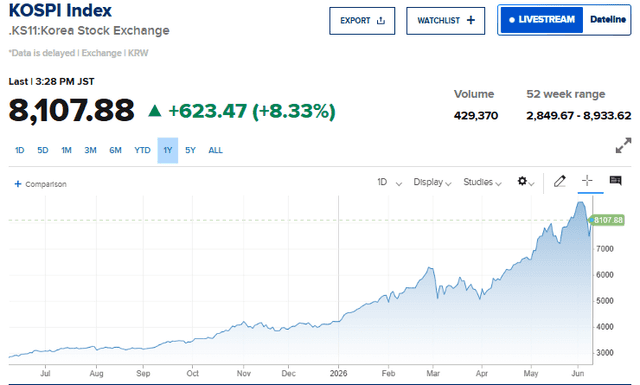
Many investors viewed leveraged ETFs as a faster way to gain exposure to AI-related semiconductor growth. However, regulators and market experts have repeatedly warned that leverage can magnify losses just as quickly as gains.
Why Regulators and Market Experts are Concerned?
Margin Debt and Derivatives Exposure are Climbing
Leverage use has expanded rapidly across South Korea’s stock market. Reuters reported that margin debt reached a record 60 trillion won in May 2026.
At the same time, semiconductor-related derivatives trading has surged. Regulators fear that excessive borrowing and speculative trading could increase volatility during market downturns.
Potential Risks for Retail Investors
The June 8 event highlighted several dangers facing retail traders:
- Large premiums over NAV
- Sudden liquidity shortages
- Compounding effects in leveraged products
- Increased volatility during market stress
Investors who bought the SK Hynix ETF near its closing peak risked losses exceeding 40% if prices returned to fair value the following session.
SK Hynix Inc.: What Investors Should Watch Next?
Key Signals to Monitor
Investors should closely track ETF premiums, NAV deviations, and liquidity conditions in single-stock leveraged products. Semiconductor sector sentiment will also remain important.
SK Hynix Inc. continues to benefit from strong AI memory demand and its close relationship with Nvidia. However, recent volatility shows that ETF pricing can sometimes move independently from company fundamentals.
For investors seeking deeper research, an AI stock analysis tool can help evaluate volatility trends, technical signals, and risk factors before entering leveraged positions.
Market participants should also monitor any response from Korea’s Financial Services Commission and exchange operators following the recent trading anomaly.
Wrap Up
The SK Hynix leveraged ETF episode serves as a reminder that leveraged products can behave unpredictably during periods of extreme market stress. While these funds offer amplified exposure to fast-growing semiconductor stocks, they also carry significant risks tied to liquidity, pricing distortions, and tracking errors.
Investors should focus on NAV premiums, market conditions, and risk management rather than chasing short-term price spikes. In volatile markets, understanding how a leveraged ETF works can be just as important as choosing the right stock.
Disclaimer:
The content shared by Meyka AI PTY LTD is solely for research and informational purposes. Meyka is not a financial advisory service, and the information provided should not be considered investment or trading advice.
What brings you to Meyka?
Pick what interests you most and we will get you started.
I'm here to read news
Find more articles like this one
I'm here to research stocks
Ask Meyka Analyst about any stock
I'm here to track my Portfolio
Get daily updates and alerts (coming March 2026)