



OpenAI Launches GPT-5.6, Next-Generation AI Model Built for Enterprise-Scale Intelligence and Performance

GPT-5.6 has arrived as OpenAI’s newest enterprise-scale AI model family, and the launch signals a sharper race in advanced workplace intelligence. OpenAI introduced three tiers: Sol, Terra, and Luna. Sol leads as the flagship model, Terra targets balanced daily work, and Luna focuses on lower-cost performance.
The rollout began globally today across ChatGPT, Codex, and the OpenAI API.
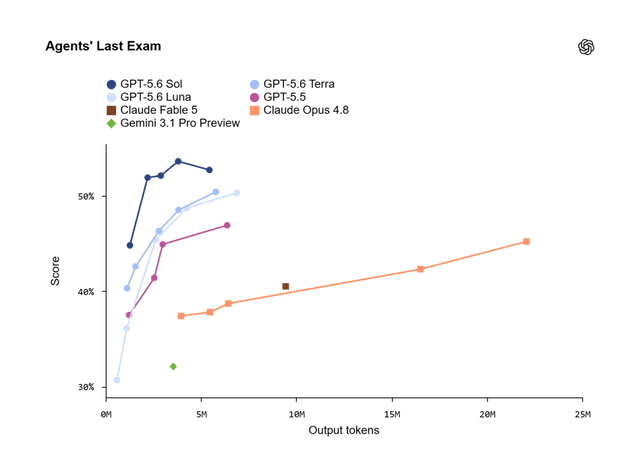
The market message is clear: OpenAI wants faster output, lower token waste, and stronger tool use. Sol scored 53.6 on Agents’ Last Exam, beating Claude Fable 5 by 13.1 points in the company’s comparison. It also finished Artificial Intelligence Index tasks in 61% less time at roughly half the estimated cost.
For enterprises, this launch matters because AI spending now depends on usable work per dollar. GPT-5.6 offers broader model choice, stronger safeguards, and more predictable caching. That makes the product more relevant for teams handling coding, documents, cybersecurity, research, and workflow automation.
GPT-5.6 Sets a New Benchmark for Enterprise AI
Sol, Terra, and Luna Target Different Workloads
OpenAI positioned GPT-5.6 as a family rather than a single model. Sol is the premium tier for complex tasks. Terra supports everyday enterprise work at a lower cost. Luna is the fastest and most affordable option. This three-tier approach helps businesses match capability to workload, instead of using one expensive model for every task.
Pricing also supports that structure. Sol costs $5 per 1 million input tokens and $30 per 1 million output tokens. Terra costs $2.50 input and $15 output. Luna costs $1 input and $6 output. OpenAI’s API model comparison page also lists Sol with a 1,050,000-token context window and 128,000 maximum output tokens.
Coding and Agent Performance Lead the Launch Story
Sol Scores 80 on the Coding Agent Index
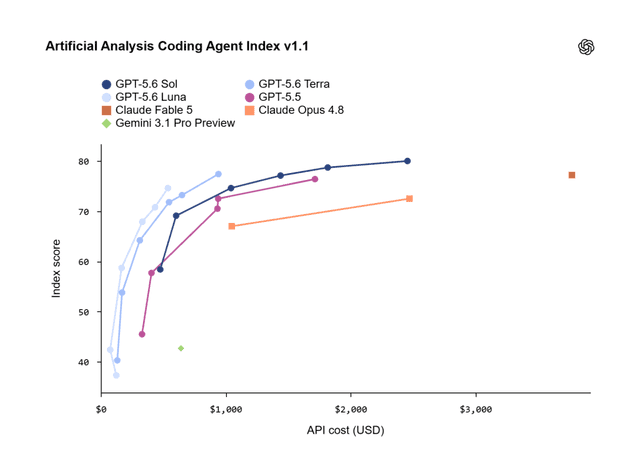
Coding is one of the strongest signals in the GPT-5.6 launch. Sol reached 80 on the Artificial Analysis Coding Agent Index v1.1. That score placed it 2.8 points above Claude Fable 5 in OpenAI’s reference data. Terra scored 77.4, while Luna reached 74.6, showing that lower tiers still deliver competitive coding performance.
The model also improved long-horizon engineering tasks. Sol scored 88.8% on Terminal-Bench 2.1, while Sol Ultra reached 91.9%. On DeepSWE v1.1, Sol scored 72.7%, Terra scored 69.6%, and Luna scored 67.2%. These results point to stronger command-line handling, better codebase navigation, and fewer wasted tool calls.
Enterprise Knowledge Work Gets a Major Upgrade
Documents, Decks, and Spreadsheets Become Core Use Cases
OpenAI is pushing GPT-5.6 beyond chat and code into daily business output. The model can generate editable presentations, follow reference deck styles, and preserve layout rules. It also handles spreadsheets, equations, and document formatting with stronger consistency. That matters for teams producing reports, proposals, research briefs, and operational dashboards.
The model also connects better with the workflow context. OpenAI highlights support for Slack, Notion, Microsoft 365, and Google Drive workflows. On BrowseComp, Sol Ultra scored 92.2%, while Sol scored 90.4%. On OSWorld 2.0, Sol reached 62.6%, beating GPT-5.5’s 47.5% and Opus 4.8’s 54.8%.
Cybersecurity and Science Scores Show Broader Reach
Safeguards Expand as Capabilities Rise
Cybersecurity gains are another major part of the launch. Sol scored 73.5% on ExploitBench, compared with GPT-5.5 at 47.9%. On SEC-Bench Pro, Sol reached 71.2%, while Sol Ultra reached 74.3%. In ExploitGym, Sol reached 33.7% with six hours, more than double GPT-5.5’s 15.1% peak rate.
OpenAI says its safeguards combine model training, real-time checks, monitoring, and account-level enforcement. The company also reported around 700,000 A100e GPU hours of black-box automated red teaming before launch. The OpenAI Deployment Safety Hub provides additional system-card context for model evaluations and safeguards.
Availability, API Tools, and Cost Controls Matter
Programmatic Tool Calling Aims to Reduce Waste
GPT-5.6 is available across ChatGPT, Codex, and the OpenAI API. Plus, Pro, Business, and Enterprise users get Sol access through medium and higher effort settings. Free and Go users access Terra in ChatGPT Work and Codex. Pro and Enterprise users also receive higher-end options for complex work.
The API adds Programmatic Tool Calling to the Responses API. This feature lets the model run lightweight in-memory programs, coordinate tools, process intermediate results, and keep only useful information. OpenAI also introduced explicit cache breakpoints, a 30-minute minimum cache life, and a 90% cached-input discount for reads.
What brings you to Meyka?
Pick what interests you most and we will get you started.
I'm here to read news
Find more articles like this one
I'm here to research stocks
Ask Meyka Analyst about any stock
I'm here to track my Portfolio
Get daily updates and alerts (coming March 2026)