



Oil Prices: WTI Drops 0.5% to $70.37 Per Barrel as Markets Weigh U.S.-Iran Talks and Supply Threats

Key Points
WTI crude fell 0.5% to $70.37 amid geopolitical uncertainty and shifting supply signals.
U.S.-Iran talks in Doha are easing panic but not removing oil market risk premiums.
Rising global output is balancing supply, limiting strong price gains.
Weak demand from Asia and energy transition trends are capping oil upside momentum.
On June 30, 2026, WTI crude oil fell 0.5% to $70.37 per barrel. Brent also eased as traders reacted to U.S.-Iran talks and renewed supply risks. Market sentiment remains cautious as geopolitics and inventory trends pull prices in both directions. Investors are watching Middle East developments closely, especially around shipping routes and diplomatic signals, which could shift energy prices quickly in the coming days. Volatility is expected to stay high.
Oil Price Update – Why Did WTI Fall to $70.37?
What is driving the latest price drop?
On June 30, 2026, WTI crude slipped 0.5% to $70.37 per barrel, while Brent hovered near $72-73. The decline reflects cautious trading amid mixed signals from global supply and geopolitical developments. Markets reacted quickly to uncertainty around U.S.-Iran diplomatic discussions and shifting energy flows.
Recent trading data shows oil struggling to hold gains above the $70 psychological level. Earlier in June, WTI briefly dipped below this mark before recovering slightly. According to energy market updates, volatility remains high as traders balance supply stability with geopolitical risk premiums.
Key market triggers:
- Mild demand signals from Asia
- Stable but fragile Middle East supply routes
- Profit-taking after recent rallies
U.S.-Iran Talks – How are They Impacting Oil Prices Markets?
Are diplomatic talks reducing risk premiums?
Oil traders are closely watching U.S.-Iran discussions in Doha. The talks aim to reduce tensions, but no final agreement has been reached. This uncertainty keeps risk premiums partially priced into crude oil.
Markets often react sharply to any hint of disruption in the Strait of Hormuz, a key route for nearly 20% of global oil shipments. Even small geopolitical signals can move prices within hours.
Recent reports suggest investors are “pricing in partial de-escalation but not full stability.” This means oil prices remain sensitive to headlines rather than fundamentals. In short:
- Talks ease panic but not uncertainty
- Supply risk remains in the background
- Traders stay defensive in positioning
Supply-Side Pressure – Is the Market Becoming Oversupplied?
Why is global output increasing?
Global oil supply is gradually recovering as major producers restore output and exports. Gulf countries have increased shipments, adding pressure to already balanced markets. Estimates suggest nearly 2 million barrels per day of restored supply across key regions.
At the same time, U.S. crude inventories remain relatively tight, creating a mixed supply picture. This imbalance prevents a strong price trend in either direction.
Key supply factors:
- Rising OPEC+ output
- Improved shipping stability
- Stable refinery operations
Analysts note that supply strength is now limiting upside momentum, even when geopolitical risks rise. AI-based energy tracking tools, including market analytics platforms, are being used to monitor real-time supply shifts.
Demand Outlook – Why Is Oil Consumption Slowing?
Is global demand losing momentum?
Oil demand growth remains uneven in 2026. China’s industrial demand is softer than expected, while Europe shows only a slow recovery. The rise of electric vehicles is also gradually reducing long-term fuel consumption.
Forecasts suggest Brent may stay between $64 and $80 over the next year, reflecting weak demand growth. Key demand pressures:
- Slower Asian consumption
- Energy efficiency gains
- Transition toward clean energy
These factors are capping any strong bullish breakout in crude prices.
Technical Outlook – What are Traders Watching Now?
Will WTI stay above $70 support?
WTI crude is currently hovering near a key support level around $70. This zone acts as a psychological barrier for traders. If prices fall below it consistently, further downside could follow.
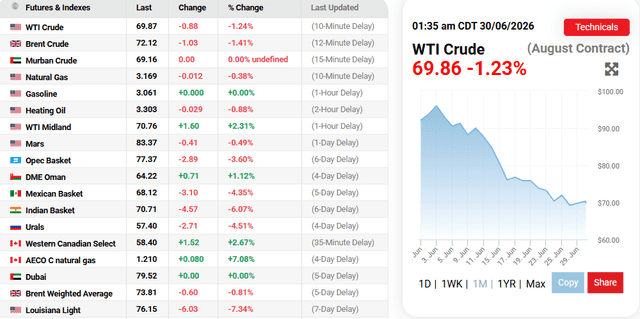
However, short-term rebounds remain possible due to geopolitical news flow. Market volatility is driven more by sentiment than fundamentals right now.
Traders are watching:
- $70 support level is closely
- Intraday volatility spikes
- News-driven price swings
Conclusion – What Comes Next for Oil Prices?
Oil markets remain stuck between supply stability and geopolitical uncertainty. The drop to $70.37 shows how sensitive prices are to U.S.-Iran developments and shifting global output. While supply is improving, demand remains weak, limiting upside strength.
In the short term, oil is likely to stay range-bound with sharp swings triggered by headlines. Until clearer diplomatic outcomes or demand recovery emerges, volatility will remain the defining feature of the crude oil market.
Disclaimer:
The content shared by Meyka AI PTY LTD is solely for research and informational purposes. Meyka is not a financial advisory service, and the information provided should not be considered investment or trading advice.
What brings you to Meyka?
Pick what interests you most and we will get you started.
I'm here to read news
Find more articles like this one
I'm here to research stocks
Ask Meyka Analyst about any stock
I'm here to track my Portfolio
Get daily updates and alerts (coming March 2026)