



Oil Prices Jump 5% as Iran Declares Strait of Hormuz Closed; Brent Nears $80, WTI Tops $74

Key Points
Oil prices jumped nearly 5% after Iran announced the closure of the Strait of Hormuz.
Brent crude approached $80, while WTI climbed above $74 on July 13, 2026.
Supply disruption fears triggered a sharp rally across global energy markets.
Investors are watching geopolitical developments and shipping activity for the next market move.
Oil prices climbed sharply on July 13, 2026, after Iran announced the closure of the Strait of Hormuz, one of the busiest routes for global oil shipments. The announcement raised fresh concerns about possible supply disruptions. As traders reacted, Brent crude moved close to $80 per barrel, while WTI crude rose above $74, posting one of the strongest daily gains in weeks. Investors are now watching closely to see whether rising tensions in the Middle East will keep pressure on oil prices.
Why Did Oil Prices Surge Today?
Iran Announces Strait of Hormuz Closure
Oil markets rallied on July 13, 2026, after Iran said it had closed the Strait of Hormuz following another round of military clashes with the United States. The announcement immediately raised concerns about global oil supplies because this narrow waterway handles a large share of the world’s energy exports. Tanker operators also became more cautious, with some shipping activity slowing as companies reviewed security risks.
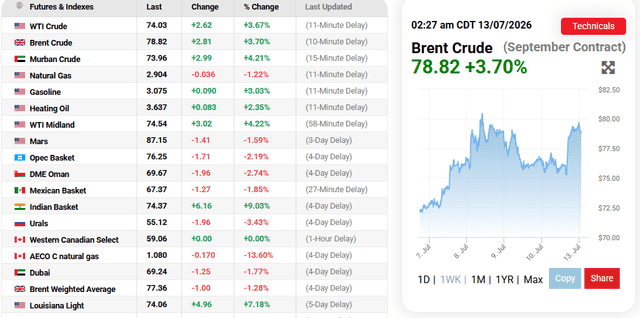
Although the United States said commercial shipping was still moving through the region, the uncertainty alone was enough to push oil prices higher as traders priced in the possibility of supply disruptions.
Brent and WTI Prices React Immediately
The reaction was almost immediate. Brent crude rose about 4.3% to nearly $79.31 per barrel, while West Texas Intermediate (WTI) gained around 4.4% to $74.62 per barrel. It was one of the biggest single-day moves seen in recent weeks. Traders are now focused on whether the disruption will be short-lived or develop into a broader supply problem.
Why the Strait of Hormuz Matters to Global Oil Markets?
Why Is the Strait of Hormuz So Important?
The Strait of Hormuz links the Persian Gulf with the Arabian Sea and is one of the world’s busiest energy shipping routes. Before the latest conflict, about 20% of global crude oil and liquefied natural gas (LNG) passed through this narrow channel.
Major exporters, including Saudi Arabia, Iraq, Kuwait, the UAE, and Qatar, depend on it to supply international markets. Countries across Asia, including India, China, Japan, and South Korea, also rely heavily on these energy shipments.
What Happens When Shipping Is Disrupted?
Even a brief disruption can have a wide impact on global markets. It can lead to:
- Higher crude oil and fuel prices.
- Increased shipping and insurance costs.
- More inflation pressure on businesses and consumers.
- Greater volatility across financial markets.
These concerns explain why oil prices reacted so quickly after Iran’s announcement.
How Global Markets are Reacting?
How are Investors Responding?
The rise in oil prices pushed many investors toward safer assets. Stock markets across Asia came under pressure as worries about inflation and slower economic growth returned. The US dollar strengthened, while Treasury yields moved higher as traders adjusted expectations for future interest rate decisions. Investors are also waiting for upcoming inflation data and corporate earnings, which could shape market sentiment over the coming weeks.
Which Industries Could Benefit?
Companies linked to the energy sector could benefit if crude prices stay elevated. These include:
- Oil producers.
- Exploration companies.
- Oilfield service providers.
- Refining businesses.
At the same time, airlines, transport companies, and other businesses with high fuel costs may come under pressure. Investors can also use an AI stock analysis tool to compare how energy and transportation stocks could perform if oil prices remain volatile.
What Investors Should Watch Next?
What Could Move Oil Prices Next?
The next few days could be decisive for the oil market. Investors will be watching:
- Any update on the status of the Strait of Hormuz.
- New military developments involving Iran and the United States.
- Tanker traffic and shipping activity.
- OPEC+ production decisions.
- Weekly US crude inventory figures.
- Inflation data and comments from central banks.
Oil prices are expected to remain volatile until geopolitical tensions ease and shipping conditions become more certain.
Conclusion
The recent jump in oil prices reflects growing concerns over potential supply disruptions rather than changes in demand. With Brent trading close to $80 and WTI above $74, markets remain focused on developments around the Strait of Hormuz. Military updates, tanker movements, and decisions from major oil producers are likely to drive price movements in the days ahead.
Disclaimer:
The content shared by Meyka AI PTY LTD is solely for research and informational purposes. Meyka is not a financial advisory service, and the information provided should not be considered investment or trading advice.
What brings you to Meyka?
Pick what interests you most and we will get you started.
I'm here to read news
Find more articles like this one
I'm here to research stocks
Ask Meyka Analyst about any stock
I'm here to track my Portfolio
Get daily updates and alerts (coming March 2026)