




Key Points
A power failure hit Manchester's Rail Operating Centre just before 2 pm Thursday.
No trains ran between Piccadilly, Victoria, and Bolton during peak disruption hours.
Staged safety checks delayed full recovery into Friday, August 7, 2026.
Bee Network buses and Metrolink offered free alternative travel during the outage.
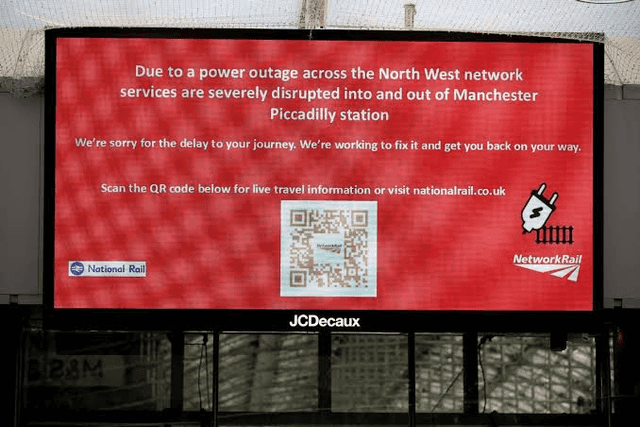
National Rail passengers across Greater Manchester continue facing disruption following Thursday’s major signalling failure. A power fault struck Manchester’s Rail Operating Centre just before 2 pm on August 6, 2026. The outage halted trains between Manchester Piccadilly, Manchester Victoria, and Bolton. Network Rail restored power that evening, but staged safety checks slowed the recovery into Friday, August 7.
What Caused Thursday’s Rail Disruption
The fault originated at the Manchester Rail Operating Centre, a control hub near Ashburys station. This facility houses the signalling systems that safely manage train movements across the region. The failure meant no trains could run through the Piccadilly to Victoria and Bolton corridor.
- The outage began just before 2 pm BST on Thursday, August 6, 2026.
- Multiple operators, including Northern, TransPennine Express, and Transport for Wales, faced cancellations.
- East Midlands Railway also suspended services between Sheffield and Liverpool Lime Street.
Network Rail’s North West route director, Chris Wright, apologized directly to affected passengers that afternoon. He confirmed power issues were causing significant delays across the entire Manchester rail network that day.
Why Recovery Took So Long
National Rail engineers restored power to the affected signalling equipment later Thursday evening. However, safety regulations required each section of track and signal to be individually checked. This staged process significantly slowed the return to normal service levels.
- Trains could not simply restart once power returned to the system.
- Each signal block needed manual verification before trains could safely proceed.
- Network Rail described this incident as among the most serious since a 2019 nationwide power cut.
TransPennine Express issued a formal “do not travel” advisory for passengers throughout Thursday afternoon and evening. This cautious approach, while inconvenient, reflects standard protocol following major signalling infrastructure failures across Britain’s rail network.
Alternative Travel Options For Stranded Passengers
Transport for Greater Manchester extended ticket acceptance across its Bee Network buses and Metrolink tram services. This gave stranded passengers free alternative routes into and around central Manchester during Thursday’s outage. Several rail replacement bus services were also arranged for the worst-affected routes.
- Buses ran between Warrington Bank Quay and Manchester Piccadilly via operator Mario’s.
- Additional buses connected Liverpool Lime Street and Chester through Patts Coaches and Northwich Travel.
- Passengers with Thursday tickets could use them for travel on Friday, August 7, instead.
Northern also lifted ticket restrictions, including Advance and Peak-time limitations, across all affected routes during the disruption. These restrictions are expected to return to normal once National Rail confirms the network has fully stabilized.
Friday Recovery Still Facing Complications
National Rail’s disruption tracker shows lingering effects continuing into Friday morning across the wider network. Separate scheduled engineering work has added further complexity to this week’s recovery efforts. Buses continue replacing certain late-night Transport for Wales services between Chester and Manchester Piccadilly through Friday.
- This scheduled engineering closure runs from Monday, August 3, through Friday, August 7.
- It operates independently of Thursday’s signalling power failure but compounds passenger confusion.
- National Rail continues urging travelers to check individual operator websites before departing.
Passengers heading through Greater Manchester this Friday should verify service status before starting their journey. Overlapping planned works and Thursday’s fault recovery mean some residual delays remain possible into the weekend.
What This Means For Commuters
Greater Manchester’s rail network has faced repeated signalling and power-related disruptions in recent years. Thursday’s incident adds to a pattern of infrastructure strain across this heavily used regional hub. Local officials have previously called for dedicated oversight to address recurring reliability issues.
Manchester Piccadilly remains one of Britain’s busiest interchange stations by passenger volume.
- Network Rail has committed to a full review following Thursday’s power failure.
- Passengers delayed by 15 minutes or more can claim compensation through operator delay-repay schemes.
Network Rail has not yet confirmed a root cause for Thursday’s specific power failure at the Ashburys control centre. Passengers should expect continued monitoring updates as engineers complete their full assessment over the coming days.
Final Words
Thursday’s power failure at Manchester’s Rail Operating Centre triggered one of the region’s most disruptive rail incidents in recent years. The staged safety recovery process, while necessary, extended inconvenience for thousands of commuters into Friday. Transport for Greater Manchester’s flexible ticket acceptance helped ease some pressure during the worst of the disruption. Commuters should continue checking National Rail Enquiries directly, as full network stability may take additional time to confirm.
Disclaimer:
The content shared by Meyka AI PTY LTD is for research and informational purposes only. Meyka is not a financial advisory service, and the information provided should not be treated as investment or trading advice.
What brings you to Meyka?
Pick what interests you most and we will get you started.
I'm here to read news
Find more articles like this one
I'm here to research stocks
Ask Meyka Analyst about any stock
I'm here to track my Portfolio
Get daily updates and alerts (coming March 2026)