




Key Points
Insurance revenue increased as direct premiums written rose 4% year over year.
Q2 profit declined because higher catastrophe losses and claims costs hurt margins.
Combined ratio climbed to 94.9%, reflecting increased underwriting pressure.
Management remains confident in long-term growth through disciplined pricing and strong capital.
On July 28, 2026, Intact Financial Corp. reported lower second-quarter profit even though insurance revenue continued to rise. Higher premium income was not enough to offset increased catastrophe losses and rising claims costs. Investors are paying closer attention to profitability rather than revenue growth alone as the insurer deals with a more challenging claims environment.
Here is a closer look at the company’s latest earnings, management’s comments, and what the results could mean for the business.
Key Highlights from Intact Financial’s Q2 2026 Earnings
Revenue Continued to Grow
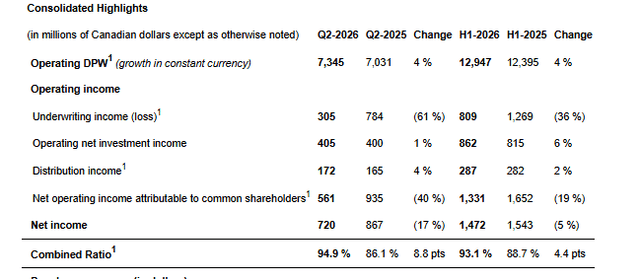
Intact Financial continued to grow its insurance business despite higher claims. Operating direct premiums written (DPW) rose 4% from a year earlier to C$7.345 billion for the quarter ended June 30, 2026. Canada remained the company’s strongest market, with premiums increasing 6%, while the U.S. business recorded 4% growth.
Profit Fell Compared With Last Year
Revenue growth did not lead to stronger earnings. Net operating income attributable to common shareholders fell 40% to C$561 million. Net operating income per share declined to C$3.17 from C$5.23 in the same quarter last year. Diluted earnings per share also dropped, falling to C$3.90 from C$4.70.
Investment Income Stayed Stable
Investment income provided some support as underwriting results weakened. Operating net investment income increased 1% to C$405 million, helped by a larger investment portfolio despite lower floating interest rates. Distribution income also increased 4% compared with the same period last year.
Why Did Intact Financial’s Profit Decline?
Why were catastrophe losses so important?
Catastrophe and large-loss events had the biggest impact on quarterly earnings. According to the company, these claims added about four points to the combined ratio and reduced underwriting income. Severe weather across several regions continued to push claim costs higher during the quarter.
Did claims inflation continue to pressure margins?
Yes. Higher repair, labour, and replacement costs continued to affect the business. Insurance claims became more expensive to settle, putting pressure on underwriting results. Underwriting income fell 61% year over year to C$305 million, even though premium revenue kept growing.
What does the combined ratio show?
The combined ratio increased to 94.9%, up from 86.1% a year earlier. Although a ratio below 100% still indicates an underwriting profit, the increase shows that higher catastrophe losses and claims costs reduced profitability. It remains one of the main measures investors use to assess the performance of an insurance company.
What Management Said About the Business Outlook?
Is management still confident?
Chief Executive Officer Charles Brindamour said the company remains in a strong financial position despite elevated catastrophe losses. He pointed to a 17% operating return on equity, double-digit growth in book value per share, and a solid balance sheet.
Management also said Intact continues to pursue its long-term financial targets while evaluating growth opportunities and potential acquisitions.
What are the company’s growth priorities?
The company plans to maintain disciplined pricing, expand profitable underwriting, and continue investing in digital capabilities. It also expects further growth across Canada, the U.S., the UK, Ireland, and its specialty insurance operations. Management believes technology and AI can improve claims processing and customer service over time.
What Investors Should Watch Next?
Investors will be watching catastrophe losses through the rest of 2026, along with claims inflation, premium pricing, and interest rate trends. These factors are likely to have the biggest influence on future earnings. While TSX: IFC continues to have solid long-term fundamentals, near-term profitability may remain under pressure if weather-related claims stay elevated.
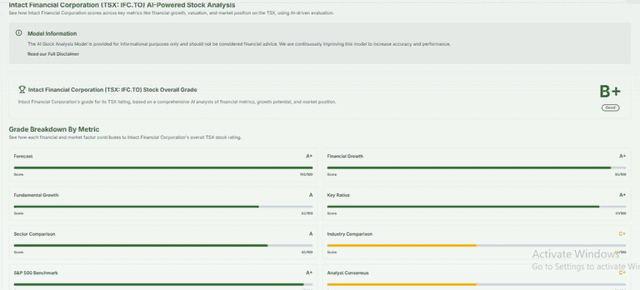
According to Meyka’s AI stock analysis tool, Intact Financial continues to have a positive long-term view because of its resilient insurance business, strong capital position, and steady premium growth. Other market analysts also view the company as one of the stronger property and casualty insurers, although they expect severe weather losses to remain a short-term risk.
Conclusion
Intact Financial’s second-quarter results show that strong premium growth did not fully offset higher catastrophe losses and claims inflation. Even so, the company continues to report healthy capital levels, profitable underwriting, and solid returns on equity. Investors will likely keep a close eye on catastrophe losses, underwriting margins, and pricing decisions, as those factors are expected to shape the company’s performance for the remainder of 2026.
Disclaimer:
The content shared by Meyka AI PTY LTD is for research and informational purposes only. Meyka is not a financial advisory service, and the information provided should not be treated as investment or trading advice.
What brings you to Meyka?
Pick what interests you most and we will get you started.
I'm here to read news
Find more articles like this one
I'm here to research stocks
Ask Meyka Analyst about any stock
I'm here to track my Portfolio
Get daily updates and alerts (coming March 2026)