India VIX at 13.69: 5 Reasons India’s Fear Gauge Keeps Falling Despite Global Market Risks

Key Points
India VIX at 13.69 signals relatively low market volatility despite global uncertainty.
Strong domestic investor inflows continue to support Indian equities.
Stable earnings expectations and seasonal trends are keeping market fear in check.
Geopolitical risks and FII selling remain the biggest triggers for a future VIX spike.
India’s stock market is sending an unusual signal. Even as global investors monitor geopolitical tensions, trade uncertainties, and volatile overseas markets, India VIX, the country’s widely followed fear gauge, has stayed near 13.69 in mid-July 2026, pointing to relatively calm investor expectations. A lower VIX often reflects confidence rather than panic, but what is keeping market volatility in check? Here are five key reasons why India’s fear gauge continues to fall despite growing global risks.
What Does India VIX at 13.69 Tell Investors?
Why Is India VIX Called the ‘Fear Gauge’?
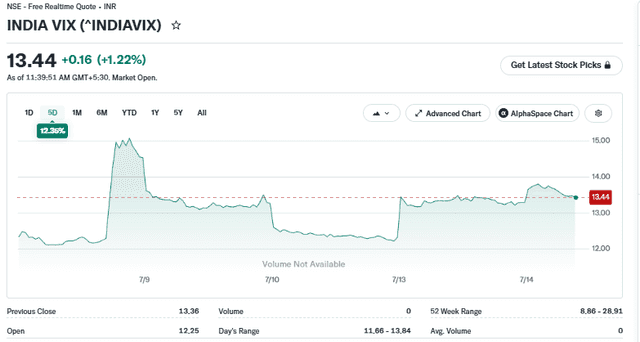
India VIX measures the market’s expected volatility over the next 30 days using Nifty 50 options prices. A lower reading usually signals stronger investor confidence and expectations of smaller market swings. On 1 July 2026, India VIX traded around 13.69, remaining well below panic levels despite global uncertainty. Its recent trading range of 13.38-14.07 reflects relatively stable sentiment across Indian equities.
Strong Domestic Institutional Buying Is Offsetting Global Risks
Why are Domestic Investors Keeping Markets Stable?
Domestic Institutional Investors (DIIs) continue to provide strong support through mutual fund inflows and systematic investment plans (SIPs). Their steady buying has helped absorb periods of foreign investor selling. This strong domestic liquidity has reduced panic and kept volatility under control. As a result, investors remain focused on India’s long-term growth instead of reacting to every global headline. Strong participation from retail investors has also improved overall market resilience.
Global Risks Exist, But Investors Expect Limited Spillover to India
Why Has Global Uncertainty Not Triggered Panic?
Markets continue to watch geopolitical tensions, trade disputes, and crude oil prices. However, investors believe India’s economic fundamentals remain comparatively strong. Healthy GDP growth expectations, stable banking conditions, and government spending have supported confidence.
Although overseas markets have seen sharp swings, Indian investors expect only limited direct impact unless global risks become significantly worse. This confidence has reduced demand for expensive hedging through options.
Smooth June F&O Expiry Reduced Short-Term Hedging Demand
How Did the Monthly Expiry Calm Volatility?
India VIX briefly moved higher before the June Futures & Options expiry because traders increased hedging activity. Once the expiry passed without major surprises, demand for protective options eased. That quickly pushed volatility lower. This post-expiry normalization explains why India VIX remained close to 13.69, even while investors continued tracking global developments.
Healthy Corporate Earnings Expectations are Supporting Sentiment
Are Earnings Keeping Investors Optimistic?
Investors are entering the quarterly earnings season with cautious optimism. Banking, financial services, and several large-cap companies are expected to report stable results. Positive earnings expectations reduce uncertainty and limit panic buying of options. When businesses continue delivering steady profits, investors generally stay invested instead of expecting sharp market declines, helping India VIX remain subdued.
Historical Trends Show July Often Sees Lower Volatility
Does Seasonality Influence India VIX?
Historical patterns suggest July is often a calmer month for Indian equities. Market data shows India VIX has declined in 14 of the last 17 Julys, with an average monthly fall of about 8.6%. While history never guarantees future performance, seasonal trends often influence trading behavior and reinforce lower volatility during this period.
What Could Push India VIX Higher Again?
Several events could quickly change market sentiment. These include:
- Rising geopolitical conflicts
- Sharp foreign institutional investor (FII) selling
- Weak corporate earnings
- RBI policy surprises
- Higher crude oil prices
- Global recession concerns
India VIX Technical Analysis Summary
According to Meyka, India VIX remains in a low-volatility zone, indicating a range-bound market rather than panic selling. Immediate support lies near 13, while sustained moves above 15 could signal increasing uncertainty. Traders should monitor crude oil prices, foreign flows, and options positioning closely. An AI stock analysis tool can also help investors track changing volatility signals alongside technical indicators.
What Meyka Says?
Meyka believes the current decline in India VIX reflects improving liquidity and healthier market sentiment rather than excessive optimism. However, it cautions that geopolitical events and sudden macroeconomic shocks could quickly reverse the trend.
Supporting Insights From Other Analysts
Market experts at HDFC Sky and The Economic Times also note that post-expiry easing, strong domestic liquidity, and resilient investor confidence have kept volatility contained despite global risks. However, they warn that unexpected external events can trigger sharp spikes in India VIX within a short period.
Conclusion
India VIX at 13.69 shows that investors remain confident even as global uncertainties persist. Strong domestic buying, stable economic fundamentals, easing post-expiry pressure, and supportive seasonal trends have all helped keep volatility low. Still, market conditions can change quickly. Investors should continue monitoring global developments, corporate earnings, and institutional flows, as these factors will determine whether India’s fear gauge stays calm or begins climbing again.
Disclaimer:
The content shared by Meyka AI PTY LTD is for research and informational purposes only. Meyka is not a financial advisory service, and the information provided should not be treated as investment or trading advice.
What brings you to Meyka?
Pick what interests you most and we will get you started.
I'm here to read news
Find more articles like this one
I'm here to research stocks
Ask Meyka Analyst about any stock
I'm here to track my Portfolio
Get daily updates and alerts (coming March 2026)