




Key Points
FTSE 100 gained 0.18% on renewed Iran deal optimism.
DAX and CAC also moved higher amid improving market sentiment.
Gulf tensions kept oil prices and global markets volatile.
Analysts expect European markets to stay headline-driven in the short term.
European stock markets opened higher on June 4 as investors reacted to renewed hopes for a possible Iran nuclear deal despite rising tensions in the Gulf region. The FTSE 100 gained 0.18%, while Germany’s DAX and France’s CAC also moved into positive territory.
Traders balanced geopolitical risks with improving market sentiment, pushing major indexes upward. The latest rally highlights how global markets continue to respond quickly to both political developments and economic uncertainty.
Why Did the FTSE 100 Rise Despite Gulf Tensions?
The FTSE 100 gained 0.18% on June 4, 2026, as investors focused on renewed hopes for a possible U.S.-Iran diplomatic deal. The positive mood helped offset concerns about recent military strikes and rising tensions in the Gulf region. Germany’s DAX climbed around 0.33%, while France’s CAC 40 added nearly 0.51% during early European trading.
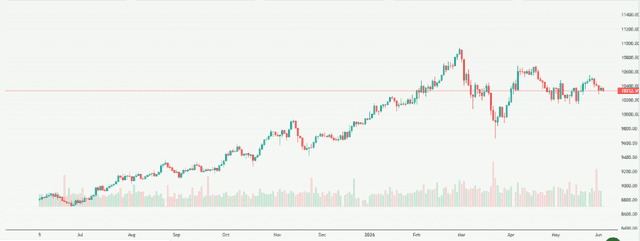
Markets reacted after reports suggested that negotiations between Washington and Tehran could move forward in the coming days. Investors viewed the development as a possible step toward easing pressure on oil supply routes and global trade.
At the same time, traders remained cautious because geopolitical risks in the Middle East continue to affect energy prices and market sentiment.
How are Middle East Tensions Affecting European Markets?
European stocks have moved sharply over the past two weeks as investors respond to every update from the Gulf region. Oil prices remain highly sensitive to developments around the Strait of Hormuz, one of the world’s most important shipping routes.
Recent reports showed:
- Brent crude briefly approached $97 per barrel
- UK mining and banking stocks supported the FTSE 100
- Defensive sectors outperformed during periods of uncertainty
- European indexes stayed volatile due to war concerns
Analysts say investors are balancing two major forces. The first is fear of supply disruption and inflation. The second is optimism that diplomatic talks may prevent a larger regional conflict.
FTSE 100 Technical Analysis Summary
The FTSE 100 continues to trade in a strong long-term uptrend despite short-term volatility linked to geopolitical events.
Key Technical Levels
- Immediate resistance: 10,500
- Near-term support: 10,320
- Momentum outlook: Mildly bullish
- Market sentiment: Cautiously positive
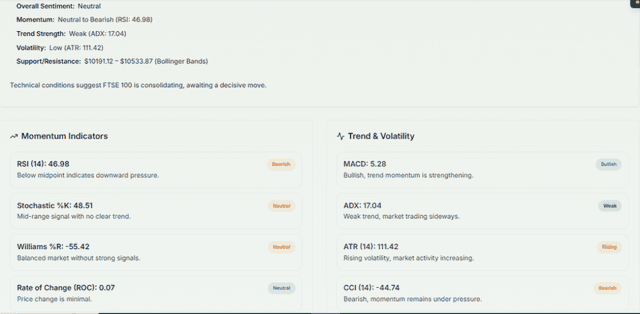
Short-term charts show buyers returning after recent weakness earlier this week. Trading volumes also improved after reports of possible progress in Iran negotiations.
Several analysts believe the index may remain range-bound until investors receive clearer updates on oil markets and global central bank policy.
What Meyka Says About the Market Outlook?
According to market observations highlighted on Meyka, European indexes are showing resilience despite geopolitical uncertainty. Strong performances in energy, mining, and financial stocks continue to support the broader market.
Meyka’s market outlook suggests that:
- Diplomatic progress between the U.S. and Iran could reduce market fear
- Lower oil volatility may support equities further
- Investors should watch inflation and bond yields closely
- European markets may stay sensitive to headline-driven trading
Meyka also notes that traders increasingly rely on AI stock analysis tools to track real-time market sentiment, volatility patterns, and macroeconomic risks more efficiently.
FTSE100: What Other Analysts Are Saying?
Reuters reported that investor confidence improved after renewed optimism surrounding U.S.-Iran negotiations. However, analysts warned that the market remains vulnerable to sudden geopolitical escalation.
Investing.com analysts noted that cyclical sectors such as mining and banking helped lift the FTSE 100, while broader European indexes also benefited from easing fears over energy disruption.
Some market strategists believe the DAX could outperform other European indexes if Germany’s industrial data improves in the second half of 2026.
Conclusion
The FTSE 100’s 0.18% rise shows that investors are still willing to buy risk assets when diplomatic optimism improves. Hopes for a U.S.-Iran agreement helped offset concerns about Gulf strikes and energy market disruptions. At the same time, volatility remains elevated, and markets could react quickly to new geopolitical developments. For now, European indexes continue to hold firm, supported by strong sector performance and improving investor sentiment across the region.
Disclaimer:
The content shared by Meyka AI PTY LTD is solely for research and informational purposes. Meyka is not a financial advisory service, and the information provided should not be considered investment or trading advice.
What brings you to Meyka?
Pick what interests you most and we will get you started.
I'm here to read news
Find more articles like this one
I'm here to research stocks
Ask Meyka Analyst about any stock
I'm here to track my Portfolio
Get daily updates and alerts (coming March 2026)