
Key Points
Crude oil surged above $111/bbl due to US-Iran tensions and supply disruption fears.
Gold slipped 0.6% as rising yields and inflation expectations reduced safe-haven demand.
Markets are pricing higher inflation and a tighter global energy supply outlook.
Volatility is expected to continue as geopolitical risks drive short-term price moves.
On May 18, 2026, crude oil prices jumped above $111 per barrel as tensions between the US and Iran escalated. Markets reacted quickly to fears of supply disruption in key shipping routes. At the same time, gold prices slipped around 0.6%, showing a shift in investor sentiment. Energy markets turned highly volatile, and traders rushed to adjust positions. The sudden price movement reflects growing geopolitical risk and uncertainty across global financial markets.
Why Did Crude Oil Jump Above $111 per Barrel on May 18, 2026?
Crude oil prices surged above $111 per barrel on May 18, 2026, mainly due to rising geopolitical tension between the United States and Iran. Markets reacted strongly to fears of supply disruption in the Strait of Hormuz, one of the world’s most important oil transit routes. Even a small risk in this region usually creates a sharp “risk premium” in oil prices.
Reports from global financial coverage such as Reuters and AP News highlight that traders are pricing in possible shipping delays and reduced supply flows. This uncertainty has pushed buyers into aggressive short-term positions, increasing volatility across energy markets.
What is driving the risk premium in oil markets?
The current surge is not only about supply but also fear.
- Ongoing US-Iran tensions have increased military and political uncertainty
- The Strait of Hormuz handles nearly 20% of global oil shipments
- Any disruption can immediately tighten global supply
- Hedge funds are increasing long positions in crude futures
As uncertainty rises, oil markets tend to react faster than actual supply changes.
Oil Price Movement and Market Data Snapshot
What are the current Brent and WTI price levels?
On May 18, 2026:
- Brent crude traded above $111 per barrel
- WTI crude hovered near $107-108 per barrel
- Weekly gains ranged between 2% and 7%, depending on the benchmark
This rally reflects strong momentum after several weeks of sideways movement. Traders are now focusing on geopolitical triggers rather than demand fundamentals.
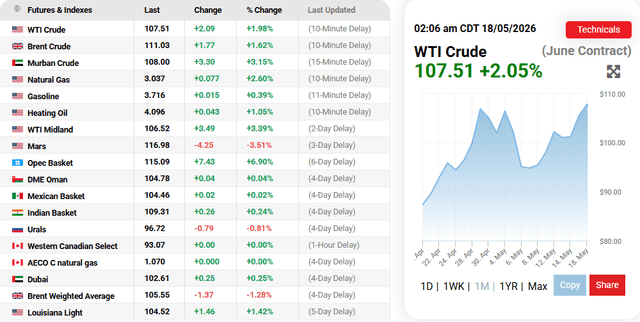
According to energy market data shared by major exchanges and financial news platforms, volatility has increased sharply in short-term contracts, showing aggressive speculative activity.
How is the supply-demand balance affecting prices?
- OPEC+ output cuts are keeping supply tight
- Global demand remains stable despite inflation pressure
- Strategic reserves are not being released at a large scale
- Shipping insurance costs in the Middle East have increased
This combination is supporting higher crude prices even without major demand growth.
Why are Gold Prices Falling Despite Global Tension?
Gold usually rises during geopolitical stress, but this time it slipped around 0.6%. The reason is a shift in inflation expectations and interest rate outlook.
Is gold losing safe-haven demand?
Not exactly. The decline is driven more by macro pressure than by loss of trust.
- Higher oil prices increase inflation expectations
- Central banks may keep interest rates higher for longer
- Rising yields reduce the appeal of non-yielding assets like gold
- Investors are rotating into energy-linked assets
Market analysts from Reuters note that gold often weakens when inflation fears dominate over recession fears.
How is the oil surge impacting global inflation?
Will higher oil prices push inflation further?
Yes, and this is already being priced into markets.
- Fuel and transport costs rise almost immediately
- Food prices increase due to logistics cost spikes
- Import-dependent economies face currency pressure
- Central banks may delay rate cuts
Even a sustained move above $110 per barrel can keep global inflation elevated for months.
According to World Bank energy outlook reports, oil spikes of this scale often create a lagged inflation effect across emerging markets.
What is the market outlook for oil and gold?
Where could oil prices go next?
Market direction now depends heavily on geopolitical developments:
- If tensions escalate further, oil may move toward $115-120
- If diplomatic talks resume, prices could fall back near $100
- Short-term volatility is expected to remain high
Energy traders are closely watching news flow rather than technical levels. An AI stock analysis tool used by institutional traders also shows increased probability of continued short-term bullish momentum in crude futures, driven mainly by sentiment indicators rather than fundamentals.
What about gold in the coming weeks?
- Gold may stabilize if inflation expectations peak
- A pause in rate hike expectations could support recovery
- Safe-haven demand may return if the conflict escalates further
For now, gold remains sensitive to U.S. dollar strength and bond yields.
Final Outlook
The sharp rise in crude oil above $111 reflects deep geopolitical stress and supply risk fears, while gold is under pressure due to shifting macroeconomic expectations. The market is not just reacting to facts but also to fear and uncertainty. In the coming days, headlines from the US-Iran situation will likely decide whether energy prices continue higher or reverse sharply.
Disclaimer:
The content shared by Meyka AI PTY LTD is solely for research and informational purposes. Meyka is not a financial advisory service, and the information provided should not be considered investment or trading advice.
What brings you to Meyka?
Pick what interests you most and we will get you started.
I'm here to read news
Find more articles like this one
I'm here to research stocks
Ask Meyka Analyst about any stock
I'm here to track my Portfolio
Get daily updates and alerts (coming March 2026)