



CEAT (NSE: CEATLTD) Shares Sink 9% as Q1 FY27 Profit Crashes 96% Amid West Asia Crisis

Key Points
CEAT shares fell 9.3% to ₹3,471.10 after Q1 FY27 net profit crashed 96.43% to ₹4 crore.
Revenue still grew 22.36% year-on-year to ₹4,318 crore, driven by strong demand across segments.
A ₹50 crore forex hit from Sri Lankan rupee depreciation added to the profit pressure.
CEAT approved a ₹1,205 crore Nagpur plant expansion despite the weak quarterly performance.
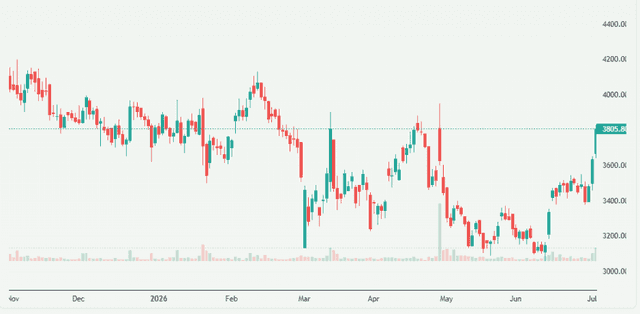
CEAT shares sank as much as 9.3% Friday after a dismal Q1 FY27 profit report. The tyre maker’s net profit crashed 96% to just ₹4 crore. That compares with ₹112 crore reported in the same quarter last year. Revenue still grew 22.36% year-on-year to ₹4,318 crore during the quarter. CEAT shares touched an intraday low of ₹3,471.10 on the NSE on Friday. That’s down sharply from Thursday’s close of ₹3,829.60 per share.
CEO Arnab Banerjee blamed the West Asia crisis for surging input costs. Rubber and crude derivative prices rose sharply, squeezing CEAT’s margins hard.
CEAT’s Q1 FY27 Results in Detail
CEAT (CEATLTD.NS) reported consolidated net profit of just ₹4 crore for the June quarter. That marked a 96.43% decline from ₹112 crore in the year-ago period. Revenue from operations climbed 22.36% year-on-year to ₹4,318 crore. Sequentially, revenue grew a modest 2.35% over Q4 FY26’s ₹4,219 crore.
CEAT’s key Q1 FY27 financial figures:
- Net profit crashed 96.43% year-on-year to just ₹4 crore.
- Revenue rose 22.36% to ₹4,318 crore, up from ₹3,529 crore.
- EBITDA fell 5.68% year-on-year to ₹365 crore for the quarter.
- Operating margin dropped to 8.45%, down from 11% a year earlier.
Why CEAT’s Profit Collapsed Despite Strong Revenue
CEAT’s profit crash stemmed from currency losses and rising input costs together. A nearly ₹50 crore hit came from Sri Lankan rupee depreciation on overseas debt. Newly acquired businesses added further losses from new warehouses and infrastructure investments. Rising rubber and crude-derivative prices compounded the pressure throughout the quarter.
The West Asia Crisis Hit CEAT’s Raw Material Costs
CEAT’s CFO Kumar Subbiah said gross margin dropped by about 5.8%. The company could only partially pass on higher raw material costs to customers. Rubber and crude derivative prices, key tyre inputs, rose sharply on West Asia tensions. CEAT raised tyre prices by a total of 5% this quarter to compensate.
Management’s outlook on raw material costs going forward:
- CFO Subbiah expects raw material costs to rise 6-7% sequentially in Q2.
- Prices could stabilize from Q3 if geopolitical conditions improve globally.
- CEO Banerjee called Q1 “a challenging quarter” for the entire industry.
- CEAT stayed focused on preserving demand and market share despite cost pressure.
CEAT Shares Extend a Rough Week
CEAT shares fell as much as 9.3% Friday to an intraday low of ₹3,471.10. That compares with Thursday’s close of ₹3,829.60 on the NSE. The stock has now fallen more than 8% over the past week alone. CEAT shares remain down 6.4% since the start of 2026.
CEAT’s broader stock performance context:
- The stock’s 52-week high stands at ₹4,438, reached in October 2025.
- CEAT’s 52-week low sits at ₹3,000.50, recorded in August 2025.
- Shares have declined roughly 1% over the trailing twelve months.
- CEAT had closed 1% higher on Thursday, just before the results.
Expansion Plans Continue Despite the Setback
CEAT’s board approved a ₹1,205 crore expansion at its Nagpur manufacturing plant. That investment will add 53,000 two-wheeler tyres in daily production capacity. The expansion project is expected to reach completion by fiscal year 2031. CEAT invested ₹300 crore in capital expenditure during the June quarter alone.
Other strategic moves shaping CEAT’s near-term outlook:
- CEAT expects to close its Camso acquisition by September 2026.
- Integration work on the Camso deal will begin in the second half.
- Demand across CEAT’s replacement market segment has remained robust so far.
- Management does not expect a near-term hit to overall demand.
How CEAT Compares to Other Tyre Makers This Quarter
Rising rubber and crude costs are squeezing margins across India’s tyre industry broadly. Rivals Apollo Tyres, MRF, and JK Tyre face similar West Asia-driven cost pressure. CEAT’s 22.36% revenue growth outpaces many peers despite this quarter’s profit collapse. Sector-wide pricing power will likely determine how quickly margins recover industry-wide.
Final Word
CEAT’s 96% profit crash overshadowed genuinely strong 22.36% revenue growth this quarter. Currency losses and West Asia-driven input costs explain most of the damage. Management’s price hikes and expansion plans suggest confidence in a recovery ahead. Raw material pressure should persist through Q2 before easing from Q3 onward. CEAT’s Nagpur expansion and Camso acquisition remain key catalysts to watch next.
What brings you to Meyka?
Pick what interests you most and we will get you started.
I'm here to read news
Find more articles like this one
I'm here to research stocks
Ask Meyka Analyst about any stock
I'm here to track my Portfolio
Get daily updates and alerts (coming March 2026)