



Brent Crude Slides 2.2% and WTI Falls 2.5% After U.S.-Iran Agreement Reopens Strait of Hormuz

Key Points
Brent crude fell 2.2% and WTI dropped 2.5% after the U.S.-Iran peace agreement.
Reopening the Strait of Hormuz could release more than 160 million barrels into global markets.
Traders shifted focus from supply disruption fears to potential oversupply risks.
Lower oil prices may benefit consumers, airlines, and major oil-importing countries.
Brent crude dropped 2.2% and WTI crude fell 2.5% on June 18, 2026, after a breakthrough U.S.-Iran agreement raised expectations that the Strait of Hormuz would reopen to global shipping. The move quickly eased concerns about oil supply disruptions that had pushed prices higher in recent weeks.
As traders reassess the balance between supply and demand, the latest market reaction could have major implications for energy prices, inflation, and the global economy in the months ahead.
Why Brent and WTI Crude Prices Fell Sharply Today?
Details of the U.S.-Iran Agreement
Oil markets moved lower on June 18, 2026, after the United States and Iran signed an interim peace agreement aimed at ending months of conflict. The deal includes a commitment to reopen the Strait of Hormuz within 30 days and restore normal maritime traffic through one of the world’s most important energy corridors.
The agreement also starts a 60-day negotiation period and includes steps toward easing restrictions on Iranian oil exports. These developments reduced fears of prolonged supply disruptions and triggered a broad selloff in crude futures.
Immediate Market Reaction
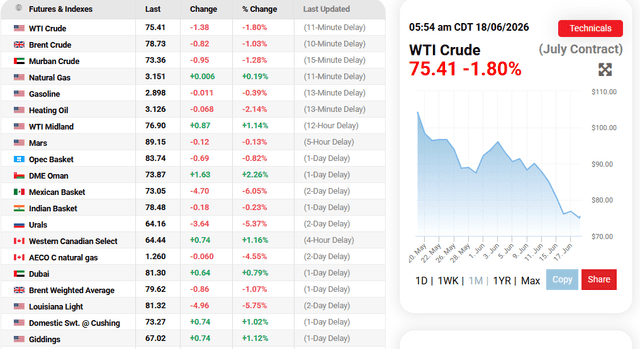
Brent crude dropped 2.2% to around $77.96 per barrel, while West Texas Intermediate (WTI) fell 2.5% to about $74.96. Both benchmarks reached their lowest levels since the Iran conflict began. Traders quickly removed much of the geopolitical risk premium that had pushed prices above $100 earlier this year. The market is now focused on increased supply rather than shortages.
Strait of Hormuz Reopening Could Release Millions of Barrels Into Global Markets
Why the Waterway Matters?
The Strait of Hormuz is one of the most critical oil transit routes in the world. Around one-fifth of global oil shipments pass through this narrow channel connecting the Persian Gulf to international markets. During the conflict, the closure of the strait disrupted more than 14 million barrels per day of Middle Eastern oil output, according to the International Energy Agency.
Supply Surge Expected
Analysts estimate that approximately 165 million barrels of oil are currently stranded in the Gulf region. Reuters reports that around 93 million non-Iranian barrels and 72 million Iranian barrels could enter global markets once shipping fully resumes.
More than 50 supertankers are still waiting for normal operations to restart. This sudden increase in supply is expected to keep pressure on oil prices in the short term.
How the 2026 Iran Conflict Drove Oil to Multi-Year Highs?
From Supply Shock to Peace Deal
The conflict created one of the largest energy disruptions in modern history. Concerns over blocked shipping lanes and reduced exports pushed Brent crude above $100 per barrel during several periods in 2026. Markets feared prolonged shortages as Gulf producers struggled to move oil to customers across Asia, Europe, and North America.
The Rapid Reversal
The peace agreement changed market sentiment almost overnight. Investors shifted from worrying about supply shortages to evaluating the impact of additional barrels entering the market. Oil prices have fallen roughly 15% from recent highs as expectations for restored exports continue to grow.
Winners and Losers From Lower Oil Prices
Potential Beneficiaries
Several industries stand to benefit from cheaper crude oil:
- Airlines facing lower fuel costs.
- Transportation and logistics companies.
- Manufacturing firms with high energy consumption.
- Oil-importing countries such as India, Japan, and South Korea.
Lower energy prices can also help reduce inflation and improve consumer spending power.
Sectors Under Pressure
Energy companies are among the biggest losers. Shares of major oil producers declined after crude prices dropped. Lower oil prices may reduce profit margins for exploration and production firms. Countries that depend heavily on oil export revenues could also face budget pressure if prices remain weak.
What Analysts Expect Next for Brent and WTI Prices?
Short-Term Outlook
Many analysts expect continued volatility. Goldman Sachs forecasts that Iranian oil exports could normalize by late July 2026, while production may return to normal levels by October. Some experts believe Brent could remain in the mid-$70 range if supply recovery proceeds smoothly.
An AI stock analysis tool and market-monitoring platforms are increasingly tracking shipping data, inventory levels, and refinery activity to identify early signals for oil price movements.
Key Risks to Watch
Several factors could change the outlook:
- Delays in reopening shipping routes.
- Breakdowns in peace negotiations.
- Weak demand from China due to slower refinery activity.
- Future Federal Reserve rate decisions that could affect economic growth and fuel consumption.
These risks mean oil prices may remain sensitive to both geopolitical and economic developments.
Conclusion
The sharp decline in Brent crude and WTI reflects a major shift in market expectations following the U.S.-Iran agreement. With the Strait of Hormuz moving toward full reopening, traders are preparing for a significant increase in global oil supply.
While lower prices could benefit consumers and importing nations, uncertainty remains around implementation of the deal and the pace of export recovery. The next few weeks will be critical in determining whether oil markets stabilize or face another round of volatility.
Disclaimer:
The content shared by Meyka AI PTY LTD is solely for research and informational purposes. Meyka is not a financial advisory service, and the information provided should not be considered investment or trading advice.
What brings you to Meyka?
Pick what interests you most and we will get you started.
I'm here to read news
Find more articles like this one
I'm here to research stocks
Ask Meyka Analyst about any stock
I'm here to track my Portfolio
Get daily updates and alerts (coming March 2026)