




Key Points
Australia added 76,000 jobs in June 2026, beating market expectations.
Unemployment remained at 4.4% as more people entered the workforce.
Labour force participation rose to 67.0%, reflecting strong job market activity.
Investors are watching RBA policy and inflation data for clues on future interest rate decisions.
Australia’s labour market remained resilient in June 2026, even as the latest labour force data prompted fresh questions about the strength of the jobs recovery. According to the Australian Bureau of Statistics (ABS) report released on July 23, 2026, employment rose by 76,000 jobs while the unemployment rate stayed at 4.4%.
The combination of strong hiring and steady unemployment has left economists and investors looking beyond the headline figures. The latest report offers a closer look at what is happening in Australia’s labour market and what it could mean for workers, businesses, and interest rates.
Australian Employment Remains Strong Despite Labour Force Concerns
Key highlights from the June 2026 ABS report
Australia created 76,000 jobs in June 2026, making it one of the strongest monthly employment gains of the year. The Australian Bureau of Statistics (ABS) published the data on July 23, 2026, showing that employers continued to hire despite slower economic growth and higher borrowing costs. Part-time employment accounted for 47,000 of the new positions, while full-time jobs also increased. Even with that hiring, the unemployment rate remained unchanged at 4.4% for the second consecutive month.
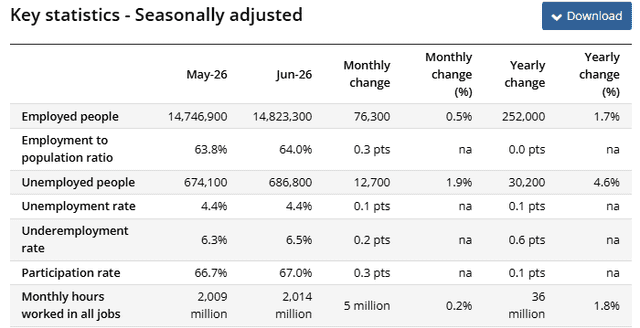
The stable unemployment rate does not suggest that hiring slowed. More people entered the workforce during June and started looking for jobs, which kept the unemployment rate steady. The labour force participation rate climbed to 67.0%, close to a record level, while the employment-to-population ratio rose to 64.0%. That means a larger share of Australians was employed than in the previous month.
The figures suggest employers are still recruiting despite weaker consumer spending and higher interest rates. At the same time, many businesses remain cautious about the economic outlook.
Why are Economists Questioning the Labour Force Data?
Why did the unemployment rate stay unchanged?
Many economists expected unemployment to decline after such a strong increase in employment. Instead, it held at 4.4% because more Australians joined the labour force in June. As participation rises, more people are counted as either working or actively searching for work. That can leave the unemployment rate unchanged even when employers are adding jobs.
For that reason, economists rarely rely on the unemployment rate alone. They usually examine several labour market indicators before deciding how strong the employment picture really is.
Is the labour market as strong as it appears?
The latest labour force report has prompted a closer look at the quality of the employment gains. Some of the areas attracting attention include:
- Most of June’s job growth came from part-time employment.
- Monthly labour force surveys often fluctuate because of sampling differences.
- Seasonal adjustments can affect monthly results.
- Underemployment and total hours worked continue to provide a better picture of labour demand.
Most economists still view Australia’s labour market as relatively healthy. Even so, they want to see whether employment growth remains consistent over the coming months. Wage growth, business confidence, and employer hiring plans will help confirm whether June’s gains reflect a lasting trend or a temporary spike.
What Does the Employment Report Mean for the RBA and Interest Rates?
Could strong jobs data delay interest rate cuts?
Australia’s strong employment market leaves the Reserve Bank of Australia (RBA) with a difficult policy decision. A healthy labour market supports consumer spending and economic activity. It can also keep wage growth elevated, making it more difficult for inflation to return to the RBA’s target range.
After the June employment report, financial markets continued to assess whether the RBA would wait for more inflation data before making any changes to interest rates. Many economists believe the next quarterly Consumer Price Index (CPI) report will carry more weight than a single month of employment figures when the central bank meets again.
Investors are following labour market trends closely because they influence company earnings, consumer spending, and market sentiment. An AI stock analysis tool can help investors combine employment data, inflation trends, and company fundamentals when researching investment opportunities, although it should support independent research rather than replace it.
What Businesses, Investors, and Workers Should Watch Next?
Several economic indicators will show whether Australia’s labour market can maintain its pace through the second half of 2026. Investors, businesses, and policymakers should keep an eye on:
- Future ABS labour force reports.
- Quarterly inflation figures.
- Wage Price Index releases.
- Growth in full-time employment.
- Underemployment levels.
- Business hiring intentions across major industries.
Together, these indicators will provide a better picture of whether June’s employment growth reflects sustained demand for workers or short-term changes in the monthly survey.
Conclusion
Australia’s latest employment report points to a labour market that continues to perform well, even as economists question some of the underlying labour force data. Job growth remained strong, workforce participation increased, and unemployment stayed steady. Even so, the rise in part-time employment and the usual month-to-month survey volatility mean there is still reason for caution.
The next inflation figures and future ABS employment reports are likely to shape expectations for the RBA’s next interest rate decision and provide a clearer picture of where Australia’s economy is heading.
Disclaimer:
The content shared by Meyka AI PTY LTD is for research and informational purposes only. Meyka is not a financial advisory service, and the information provided should not be treated as investment or trading advice.
What brings you to Meyka?
Pick what interests you most and we will get you started.
I'm here to read news
Find more articles like this one
I'm here to research stocks
Ask Meyka Analyst about any stock
I'm here to track my Portfolio
Get daily updates and alerts (coming March 2026)