




Key Points
Q1 FY27 net loss reached ₹1,160 crore, mainly due to a one-time ₹2,644 crore OFAC settlement.
Revenue surged 50% YoY to nearly ₹32,924 crore, driven by airports and copper businesses.
Higher finance and operating costs also weighed on quarterly earnings.
Long-term growth projects remain on track, supported by infrastructure expansion and a ₹15,000 crore QIP.
On July 31, 2026, Adani Enterprises reported a ₹1,160 crore net loss for the first quarter of FY27. While the headline number looks disappointing, it was largely driven by a one-time ₹2,644 crore settlement payout. At the same time, the company’s core businesses continued to expand, with revenue rising sharply across several segments. That leaves investors with an obvious question: does this quarterly loss point to a deeper problem, or is it simply the result of an exceptional expense?
Why Did Adani Enterprises Report a ₹1,160 Crore Loss?
One-Time Settlement Charge Hit Earnings
For the quarter ended June 30, 2026, Adani Enterprises posted a consolidated net loss of ₹1,160 crore, compared with a ₹885 crore profit in the same period last year. The decline was mainly due to a ₹2,644 crore exceptional charge tied to a settlement with the U.S. Office of Foreign Assets Control (OFAC).
The settlement, valued at about $275 million, relates to an investigation into alleged sanctions violations involving Iranian gas shipments. Since the payment is a one-off expense, it does not reflect the company’s regular business operations. Even after booking the charge, several business divisions continued to grow, showing that the reported loss does not fully capture the company’s operating performance.
Higher Operating Costs Added Pressure
The settlement was not the only factor weighing on earnings. Operating costs also moved higher during the quarter.
Fuel prices increased amid geopolitical tensions, lifting input costs across parts of the business. Finance costs rose by nearly 60%, while employee expenses also increased from a year earlier. Overall expenses climbed 54% year over year, putting additional pressure on profitability despite stronger revenue.
Revenue Grew 50% Despite the Quarterly Loss
Which Businesses Drove Growth?
Although the company reported a quarterly loss, its operating businesses delivered solid growth. Revenue from operations increased 50% year over year to ₹32,924 crore, while quarterly EBITDA reached a record level.
The Kutch Copper business remained one of the strongest contributors as production expanded. The airport business also recorded healthy growth, supported by rising passenger traffic and higher commercial activity. These businesses helped balance the impact of higher costs and reinforced Adani Enterprises’ position across infrastructure, transport, and industrial sectors.
Which Segments Weakened?
Growth was not uniform across the portfolio.
Coal trading revenue fell by about 7%, while the new energy business reported a small decline in revenue. Even so, the company’s broad mix of businesses limited the overall impact. For many investors, the focus is likely to remain on operating earnings rather than the reported net loss, as the exceptional settlement expense is not expected to recur.
Key Growth Projects Investors Should Watch
Why Does the Long-Term Outlook Still Matter?
Adani Enterprises continues to invest in projects that could support future earnings. Recent developments include:
- Expansion of Kutch Copper production capacity.
- Continued investment in airports and transport infrastructure.
- Strategic partnerships in AI data centre infrastructure and low-carbon chemical manufacturing announced during July 2026.
- A ₹15,000 crore Qualified Institutional Placement (QIP) that strengthened the balance sheet and drew institutional investor interest.
As these projects move forward and begin contributing more revenue, they could improve cash flows and support earnings over the coming years.
What Do These Results Mean for Investors?
The latest quarterly results suggest that the reported loss came largely from an accounting adjustment rather than weaker business operations. According to Meyka’s AI stock analysis tool, Adani Enterprises continues to offer long-term exposure to infrastructure, airports, energy transition, and copper, although investors should expect some short-term volatility following the exceptional charge.
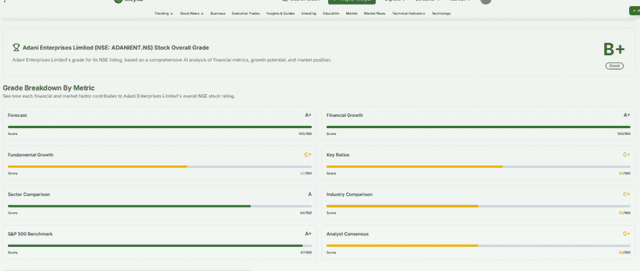
From a technical perspective, the stock maintains a neutral-to-positive long-term trend. Market analysts continue to monitor project execution, debt levels, and earnings recovery as the main factors that could influence future performance.
Conclusion
Adani Enterprises’ first-quarter results present a mixed picture. The ₹1,160 crore loss was driven primarily by a one-time settlement payment and higher operating costs, while the underlying business continued to expand with strong revenue growth. For investors, the next few quarters will matter more than this single result as the company works to turn its infrastructure investments into stronger earnings and steady cash generation.
Disclaimer:
The content shared by Meyka AI PTY LTD is for research and informational purposes only. Meyka is not a financial advisory service, and the information provided should not be treated as investment or trading advice.
What brings you to Meyka?
Pick what interests you most and we will get you started.
I'm here to read news
Find more articles like this one
I'm here to research stocks
Ask Meyka Analyst about any stock
I'm here to track my Portfolio
Get daily updates and alerts (coming March 2026)