Oil prices slide for second straight session: Will US-Iran talks cool markets?
Oil prices fell again on April 15, 2026, marking a second straight session of declines in global crude markets. Brent and WTI both slipped as traders reacted to shifting geopolitical signals from the Middle East. The focus is now on possible US-Iran talks, which could ease long-standing tensions affecting oil supply routes. Markets had earlier reacted sharply to conflict-driven disruptions, but sentiment is now turning more cautious.
Even small political updates are causing noticeable price swings. Investors are watching closely as uncertainty around supply and demand continues.
Advertisement
Oil Prices Extend Declines as US-Iran Talks Shape Market Direction
Oil prices continued to fall on April 15, 2026, marking a second straight session of losses in global crude markets. Brent crude hovered around $94-$95 per barrel, while WTI traded near $90-$91 per barrel, according to multiple market trackers and news reports.
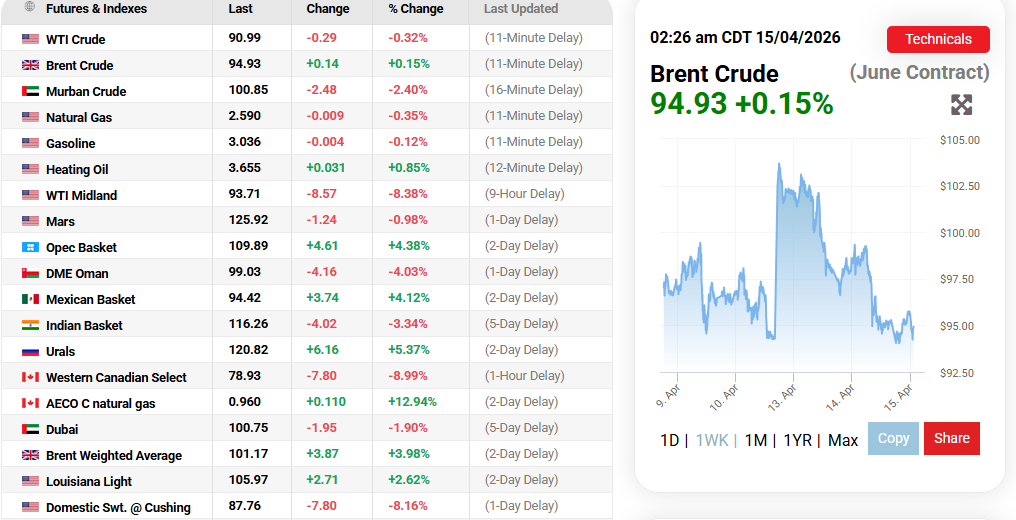
The main driver is rising optimism that US-Iran diplomatic talks may restart, which could ease supply disruptions from the Middle East. Traders believe a possible agreement may unlock restricted oil flows and reduce geopolitical risk premiums. Earlier in the week, oil had dropped sharply after a near 8% single-session fall in US crude futures.
Despite the decline, volatility remains high. Markets are reacting to every political headline. Even small updates on negotiations are triggering sharp price swings.
What is driving the oil price drop right now?
The current decline is mainly driven by expectations of improved diplomacy between the United States and Iran. Investors believe talks could reduce tension in key oil-producing regions and improve global supply stability.
Several key factors are influencing the market:
- Hope of renewed US-Iran negotiations
- Reduced fear of long-term supply disruption
- Slight easing of Middle East shipping risks
- Profit-taking after recent price spikes
Reports suggest earlier disruptions in the Strait of Hormuz, a route handling nearly 20% of global oil trade, pushed prices higher in previous weeks. Now, even small signals of peace are reversing that trend.
According to recent market updates, crude prices dropped for two consecutive days as optimism increased around diplomatic progress. Traders are now waiting for official confirmation before making long-term positions.
How US-Iran talks could impact global oil supply?
US-Iran talks are a major factor for global energy stability. Any breakthrough could significantly change oil supply dynamics. Iran is a key oil exporter, and sanctions have limited its global output for years.
If negotiations succeed:
- Sanctions on Iranian oil exports may ease
- Global supply could increase quickly
- Shipping routes in the Middle East may reopen fully
- Price pressure on crude could continue downward
If talks fail again:
- Supply fears may return immediately
- Oil prices could spike back above $100 per barrel
- Volatility in energy markets will increase
Recent reports highlight that markets are extremely sensitive to negotiation headlines, with oil reacting within hours of political updates. This shows how closely geopolitics and energy markets are now linked.
The Strait of Hormuz remains the biggest risk factor
Even with peace talks in focus, the Strait of Hormuz remains a major risk for oil markets. This narrow passage is one of the most important energy routes in the world. Any disruption immediately impacts global supply chains.
Recent tensions have already reduced shipping activity in the region. Some estimates suggest that flows dropped significantly during peak conflict periods. This has created higher shipping costs and insurance premiums for oil cargoes.
Even small disruptions in this route can lead to sharp price movements. That is why traders are not fully confident about price stability yet.
Until the situation is fully resolved, the market will continue pricing in a risk premium for Middle East supply uncertainty.
Market outlook: Will oil stay below $95 or bounce back?
The short-term outlook for oil remains uncertain. Prices are likely to stay volatile as traders react to diplomatic developments and supply data.
Three possible scenarios are shaping expectations:
- Successful talks → prices may stay under pressure
- Failed talks → sharp rebound above $100 possible
- No clear outcome → sideways volatile trading
Analysts suggest oil may continue moving in a wide range due to mixed signals from geopolitics and demand trends. Even global institutions like the IMF have warned that prolonged energy shocks could slow economic growth.
For now, traders are balancing optimism about diplomacy with caution about unresolved supply risks.
Role of AI-based market tracking tools in oil forecasting
Modern traders are increasingly using AI-powered analytics to track oil price movements and geopolitical risks. These systems analyze news flow, inventory data, and market sentiment in real time.
An AI stock analysis tool can help identify early signals of price shifts by combining technical indicators with global news trends. This improves decision-making in highly volatile markets like crude oil. However, human judgment remains important because political developments can change outcomes quickly.
Final Words
Oil markets are reacting strongly to hopes of renewed US-Iran talks, with prices falling for a second straight session. While diplomacy is easing supply fears, uncertainty remains high due to ongoing geopolitical risks.
The Strait of Hormuz continues to be a critical pressure point. In the near term, oil is likely to stay volatile as traders respond to every development in negotiations and global supply signals.
Disclaimer:
The content shared by Meyka AI PTY LTD is solely for research and informational purposes. Meyka is not a financial advisory service, and the information provided should not be considered investment or trading advice.
Advertisement
What brings you to Meyka?
Pick what interests you most and we will get you started.
I'm here to read news
Find more articles like this one
I'm here to research stocks
Ask Meyka Analyst about any stock
I'm here to track my Portfolio
Get daily updates and alerts (coming March 2026)