Wall Street has entered a volatile phase in February 2026 as artificial-intelligence uncertainty rattles investor confidence and pushes major tech stocks lower. Recent sessions saw the Nasdaq and S&P 500 decline, along with sharp declines in companies heavily tied to AI spending and software demand.
Analysts warn that massive capital outlays on AI may take years to translate into profits, increasing pressure on valuations across the technology sector. At the same time, investors are rotating toward safer or value-driven assets, signaling a broader shift in market sentiment. This growing tension between AI optimism and financial reality is now shaping how Wall Street responds to risk, growth, and the future of tech leadership.
Advertisement
Why are AI fears pushing Wall Street tech stocks lower?
Investor sentiment shifted sharply in early 2026 as doubts grew about whether massive spending on artificial intelligence would deliver near-term profits. Major U.S. tech firms lost significant market value, including Microsoft, down about 17%, and Amazon, down nearly 13.85% year-to-date. NVIDIA, Apple, and Alphabet also saw billions erased from valuations. This pullback reflects a move away from long-term AI optimism toward demands for clear earnings visibility and sustainable returns.
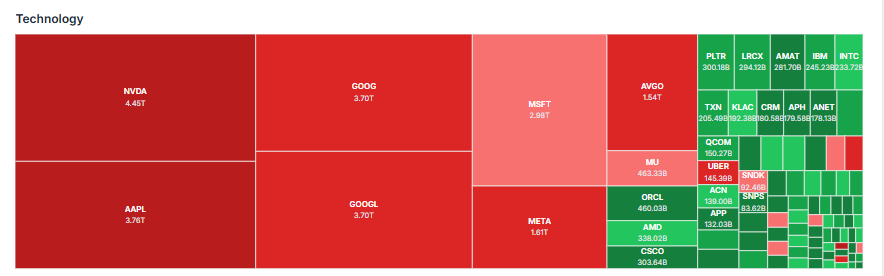
Broader market declines followed similar concerns. Wall Street indexes dropped as heavy AI capital-expenditure plans and competition in advanced models increased uncertainty across the sector.
Which sectors and companies are hit the hardest because of AI fears?
Software and data-service firms faced the steepest selling pressure because investors fear AI could replace core products or compress margins. Several enterprise software names fell sharply, while the S&P 500 software index dropped for multiple sessions.
Globally, similar declines appeared across technology companies as markets reacted to new AI tools capable of handling legal, research, and analytics work. These developments intensified disruption fears and accelerated selling in traditional software businesses.
At the same time, select non-software companies such as TSMC, Samsung, and Walmart gained market value, signaling capital rotation rather than a full market collapse.
What does recent earnings data reveal about AI winners and losers?
Recent results show Wall Street rewarding companies that convert AI investment into real revenue. Meta posted strong quarterly growth, beating earnings expectations and adding over $150 billion in market value after proving AI-driven advertising monetization.
Storage and infrastructure firms also surged. Sandisk delivered earnings far above forecasts and rapid datacenter growth tied to AI demand, pushing shares sharply higher. These outcomes highlight a clear trend: profitability matters more than ambitious AI spending narratives.
Short stock outlook and technical view from Meyka
Meyka’s latest analysis suggests Wall Street now favors measurable AI revenue over speculative growth. Companies showing strong engagement, cash flow, and earnings momentum receive positive reactions, while firms increasing capital spending without clear returns face pressure.
Technical sentiment, therefore, appears mixed. Infrastructure-linked stocks trend upward, but large-cap software and cloud names remain volatile until profit visibility improves. Tools that provide structured AI-driven stock insights can help investors interpret this divergence more clearly in fast-moving markets.
Conclusion
Wall Street’s reaction to AI fears in 2026 signals a bigger change in how investors evaluate technology growth. Massive spending alone no longer supports valuations. Markets now demand proof of earnings, efficiency, and competitive strength.
While volatility may continue, the broader trend points toward selective opportunity rather than universal decline. Companies that translate AI innovation into real profit are likely to define the next phase of Wall Street leadership.
Advertisement
Frequently Asked Questions (FAQs)
Tech stocks on Wall Street dropped in February 2026 as investors worried that heavy AI spending may take longer to produce profits and stable earnings growth.
As of early 2026, firms showing real AI revenue growth are gaining value, while companies with rising costs and unclear returns are facing pressure from cautious investors.
In February 2026, analysts say the sell-off shows both risk and opportunity, depending on whether companies can prove long-term profits from artificial-intelligence investments and demand.
Disclaimer:
The content shared by Meyka AI PTY LTD is solely for research and informational purposes. Meyka is not a financial advisory service, and the information provided should not be considered investment or trading advice.
Advertisement
What brings you to Meyka?
Pick what interests you most and we will get you started.
I'm here to read news
Find more articles like this one
I'm here to research stocks
Ask our AI about any stock
I'm here to track my Portfolio
Get daily updates and alerts (coming March 2026)