Bitcoin Price Today Dips to $66K, Set for Fourth Straight Weekly Loss Ahead of US CPI
The Bitcoin price action has turned cautious this week of February 13, 2026, dipping toward about $66,000 as markets brace for major US inflation news. BTC is now on track for its fourth straight weekly decline, a rare losing streak for the world’s leading cryptocurrency that reflects growing risk aversion among traders ahead of the impending US Consumer Price Index (CPI) report.
This slide comes amid broader weakness in risk assets and concerns over macroeconomic headwinds. Investors are closely watching the CPI release because its outcome could sway expectations around Federal Reserve interest‑rate policy, an important driver of crypto volatility.
Advertisement
Bitcoin’s short‑term outlook remains uncertain with prices hovering above key support levels, but buyer confidence is fragile. Such moves are drawing intense attention from both retail holders and institutional players.
Bitcoin’s Price Action This Week
Bitcoin’s price has been weak in recent sessions. As of February 13, 2026, BTC was trading near $66,000. It dipped slightly lower in the prior session before stabilizing around this level. This price movement puts Bitcoin on track for a fourth straight weekly decline, marking one of the rare multi‑week losing streaks in recent history.
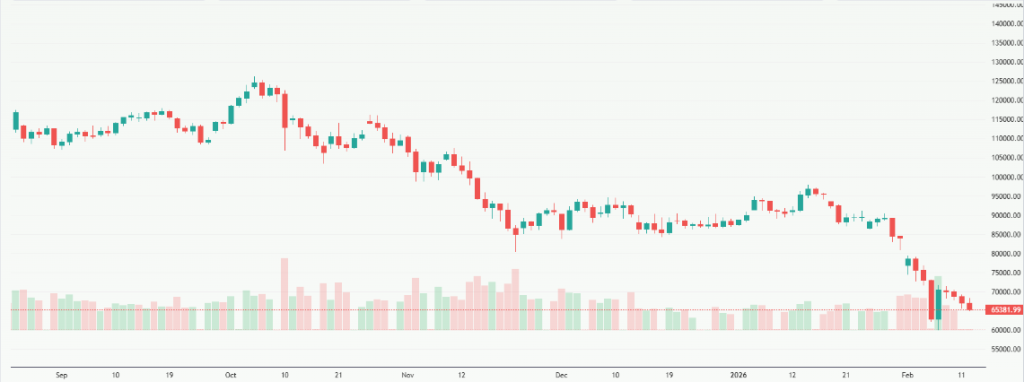
The recent weakness comes amid broader risk‑off sentiment in global markets. Equities, especially tech stocks, have shown pressure, which has spilled over into crypto markets. Investors are cautious ahead of major US inflation data (CPI) releases that could sway monetary policy expectations.
On short‑term charts, Bitcoin has tested key support levels around $66,000. Some analysts view this zone as a critical technical line; a failure to hold could open the door to further downside toward $64,500-$65,000.
At the same time, resistance remains near the $69,000-$70,000 range. Bulls have struggled to sustain pushes above this level, suggesting momentum is currently tilted toward sellers.
Why Bitcoin Is Weakening: Macro & Market Drivers
How Is the US CPI Affecting Bitcoin?
Market participants are heavily watching the upcoming US Consumer Price Index (CPI) report because inflation data often influences Federal Reserve interest rate expectations. If inflation remains higher than expected, traders may anticipate slower interest rate cuts, a scenario that can dampen risk‑asset appetite, including Bitcoin.
In recent months, soft US inflation prints have previously supported bullish sentiment in crypto markets. For example, a lower‑than‑expected CPI in December 2025 helped Bitcoin hold gains near $88,000, showing how inflation surprises can move crypto sentiment.
What Other Macro Data Is Pressuring BTC?
Strong US jobs data earlier in February 2026 reduced expectations for near‑term rate cuts. This has encouraged cautious positioning among traders, contributing to Bitcoin’s range‑bound price action and recent declines.
Broader risk sentiment has also played a role. Bitcoin’s recent moves have increasingly correlated with equities. When stocks fall on macro concerns, BTC often follows, behaving like a high‑beta risk asset instead of a safe‑haven.
What Technical Factors are at Play?
Technically, Bitcoin’s failure to break above resistance near $69,000-$70,000 has reinforced bearish sentiment. Analysis shows buyers lack the momentum to flip these levels into support.
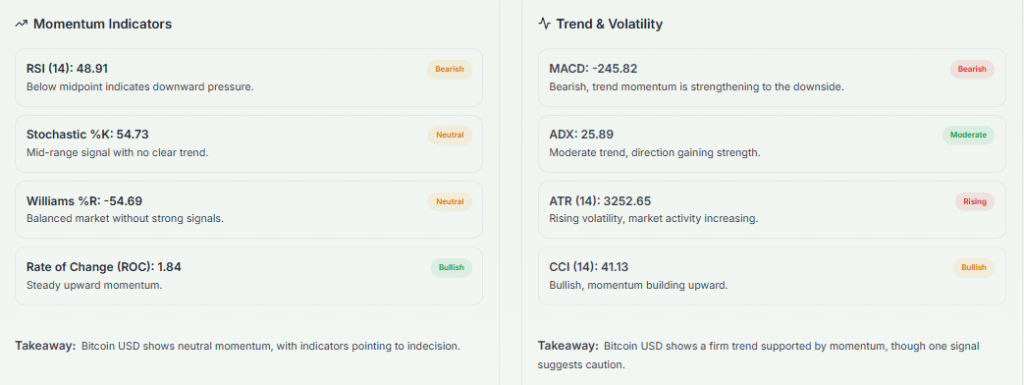
At the same time, the absence of fresh capital inflows and spot demand has allowed sellers to maintain control at critical levels. This has contributed to price instability in the near term.
Has Bitcoin Experienced Larger Downturns Recently?
Bitcoin’s recent weakness follows a period of sharper volatility earlier in February 2026. At one point, BTC dropped to around $60,000, representing one of the steepest downturns since late 2024. This move erased much of the post‑election rally and highlighted how quickly leveraged positions can be forced out during market stress.
That sharp sell‑off triggered large leveraged liquidations, which can amplify short‑term downside pressure. Once key supports were breached, technical selling intensified, contributing to BTC’s recent subdued trading ranges.
This backdrop helps explain why Bitcoin has struggled to regain momentum. Even as prices occasionally rebound, resistance around $69,000-$70,000 remains difficult to overcome, suggesting near‑term trend hesitation among traders and investors.
What Traders & Investors are Watching Next for Bitcoin Price?
When Is the CPI Report Due?
Investors are focused on the upcoming US Consumer Price Index (CPI) data release. This inflation figure heavily influences expectations around the Federal Reserve’s policy path. A cooler CPI could revive optimism for rate cuts, potentially improving BTC sentiment. A hotter print might reinforce caution.
What are Key Price Levels to Watch?
- Support: $64,500-$66,000, key short‑term zones
- Resistance: $69,000-$70,000, critical rejection area
A decisive break above resistance could change market bias.
What Else Matters?
Institutional flows, ETF demand, and macro indicators remain crucial. Traders increasingly use AI tools for stock and crypto analysis to identify liquidity shifts and pattern signals. These tools can give a clearer edge in volatile markets and help flag long‑term trend shifts.
Closing Note
Bitcoin’s dip toward the mid‑$60,000 range and its run of weekly losses reflect more than short‑term volatility. They highlight deep interaction between macroeconomic expectations, risk sentiment, and technical dynamics. With the US CPI report looming, traders are watching inflation and Fed policy cues closely.
Key price levels like $66,000 support and $70,000 resistance will likely define BTC’s next moves. Whether Bitcoin stabilizes, breaks lower, or rebounds depends on macro surprises and market flows. As markets navigate data‑driven uncertainty, a careful, informed approach remains essential.
Advertisement
Frequently Asked Questions (FAQs)
Why is Bitcoin’s price dipping to $66K this week?
Bitcoin fell to around $66,000 this week, February 13, 2026. Weakness comes from risk-off sentiment in markets, slow buying interest, and traders waiting for key US inflation data.
How does the US CPI report affect Bitcoin’s price?
The US CPI report on February 14, 2026, may move Bitcoin. Higher inflation can reduce demand for risk assets, while lower inflation may support BTC and encourage buying.
Is Bitcoin likely to rebound or drop further after this CPI release?
Bitcoin’s direction after February 14, 2026, depends on CPI results and Fed expectations. A surprise may trigger a rebound or drop, while neutral data could keep prices in a tight range.
Disclaimer: The content shared by Meyka AI PTY LTD is solely for research and informational purposes. Meyka is not a financial advisory service, and the information provided should not be considered investment or trading advice.
Advertisement
What brings you to Meyka?
Pick what interests you most and we will get you started.
I'm here to read news
Find more articles like this one
I'm here to research stocks
Ask our AI about any stock
I'm here to track my Portfolio
Get daily updates and alerts (coming March 2026)