Asia Stocks Slip After Wall St Tech Selloff, Still Set for Strong Weekly Gains
Asia stocks markets pulled back on Friday, February 13, 2026, after a fresh wave of losses in U.S. tech shares rippled through global markets. Major Wall Street indexes, including the Nasdaq Composite, slid sharply as investors grappled with renewed worries over artificial‑intelligence disruptions and profit pressures in tech giants.
In Asia, key benchmarks such as Japan’s Nikkei 225 and Hong Kong’s Hang Seng moved lower, even as South Korea’s Kospi saw modest gains. Despite the day’s weakness, many regional indices are still positioned for solid weekly gains, led by record performances in chip and export‑oriented stocks.
Advertisement
This story explores why Asian markets slipped late in the week, yet remain resilient overall, and what it means for investors.
Asia Market Performance After Wall Street Tech Sell‑Off
Asia stocks markets fell on Friday, February 13, 2026, as investors reacted to a renewed technology sell‑off on Wall Street. This pressure came mainly from fears that artificial intelligence (AI) valuation concerns could hurt profits and margins across tech firms in the U.S. and beyond. The technology‑heavy Nasdaq Composite dropped about 2% on Thursday, its biggest daily slide in weeks, pulling global markets lower.
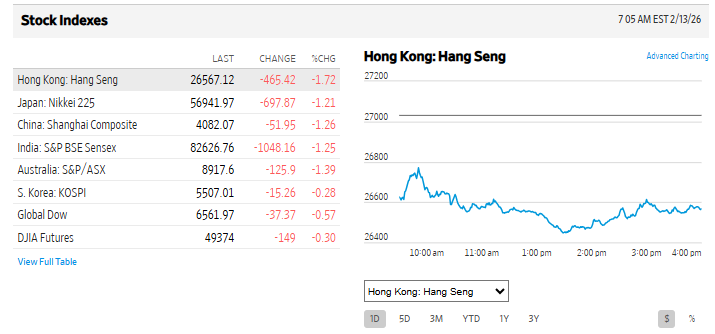
In Asia, major benchmarks such as Japan’s Nikkei 225 slid over 1%, while Hong Kong’s Hang Seng Index lost more than 1.5%. China’s Shanghai Composite also dipped, and Australia’s S&P/ASX 200 fell over 1%. Some markets, like South Korea’s Kospi, reported smaller losses or modest gains, but overall regional trading was lower.
Despite the drop on the day, many Asian indices remained on track for solid weekly gains because of earlier strength driven by post‑election rallies, strong earnings, and local buying.
Why Did Wall Street’s Tech Sell‑Off Hit Asia?
What Triggered the Tech Pullback in U.S. Markets?
The sell‑off in U.S. markets was led by renewed worries about AI‑related valuations and profitability. Several major tech companies, including Cisco Systems and other hardware and software names, saw steep share declines after reports showed margins were lower than expected or future revenues might weaken.
Investors also weighed weaker-than-expected memory‑chip cost projections and inflation data ahead of key U.S. consumer price index releases. As fears rose that high AI spending might not immediately translate into profits, risk appetite dropped sharply.
This sentiment quickly spread to Asian markets, where many tech and semiconductor companies are closely tied to global demand. Asian investors reduced exposure to growth and tech stocks, intensifying the declines.
How Did Asian Markets Specifically React?
- Japan (Nikkei 225): Fell about 1% on Friday after retreating from recent highs.
- Hong Kong (Hang Seng): Dropped more than 1.8%, pressured by weakness in tech and growth names.
- China (Shanghai Composite): Down roughly 0.7%, reflecting broader risk‑off sentiment.
- Australia (ASX 200): Slipped over 1%, as technology and growth stocks faced selling pressure.
- South Korea (Kospi): Showing mixed movement with some gains driven by hardware and chip makers, though overall momentum softened.
Market participants also reduced risk exposure in sectors beyond tech, pushing flows into defensive assets like bonds and gold ahead of significant U.S. macro data.
Can Asia Still End the Week With Gains?
Yes. Despite the recent selling, many regional markets were still poised for weekly gains as of February 13, 2026. This was due to earlier strength in the week, driven by:
- Post‑election optimism in Japan lifted confidence across equities.
- Strong corporate earnings in key sectors supported local indices.
- Select inflows into markets like Hong Kong and South Korea from bargain‑hunters.
This combination helped some benchmarks hold up well over the five‑day period despite the late‑week weakness in technology stocks.
Market researchers using AI stock analysis tools have also shown that seasonal and sentiment factors can cause short‑term corrections even when broader weekly or monthly trends remain intact. This underscores the importance of not overreacting to single‑day volatility.
Asia Market Sector Trends and Risks
Which Sectors Led the Weakness?
The technology sector was the chief driver of declines across Asia. Stocks linked to AI hardware, software, and services were most affected as investors reassessed valuation and earnings projections amid mixed macro signals.
In India, IT stocks suffered one of the worst weekly performances in months. The Nifty IT index plunged more than 8%, with heavyweights like Tata Consultancy Services, Infosys, and HCLTech all recording deep losses. This wiped out roughly $50 billion in market value for top IT firms in February alone.
Are There Broader Risks Beyond Tech?
Yes. Rising yields and expectations that the U.S. Federal Reserve may delay rate cuts have weighed on growth expectations. Combined with stronger-than-expected U.S. data and inflation uncertainty, investors have rotated toward safer assets.
Additionally, foreign investor outflows from Asian equities, particularly in tech and high‑growth segments, have increased compared to earlier months, reflecting broader risk‑off sentiment.
What Investors Should Watch Next?
Will U.S. Inflation Data Move Markets?
Global markets, including Asia, were positioned for volatility around key U.S. CPI data expected later in the week. Traders believe inflation figures could affect Federal Reserve policy and risk sentiment.
A cooler inflation print might boost confidence, easing pressure on equities. But stronger inflation could keep markets cautious and maintain selling pressure in growth and tech stocks.
What Other Data Matters?
Investors will also watch:
- Corporate earnings from major Asian and global firms.
- Economic indicators like trade figures and manufacturing data in key Asian economies.
- Currency trends, especially the Japanese yen and U.S. dollar, which influence export‑oriented markets.
Conclusion
Asian stock markets dipped on February 13, 2026, after Wall Street’s tech sell‑off rattled investor sentiment. Fears around AI‑linked valuations and profit margins weighed on global tech shares, spilling into major Asian benchmarks.
However, many markets maintained strong weekly trends thanks to earlier rallies, post‑election optimism, and earnings enthusiasm. The technology sector remains a key driver of short‑term volatility, but broader market fundamentals still show resilience.
With major economic data on the horizon and mixed signals across macro and corporate fronts, traders and investors may continue to see swings in sentiment before a clearer trend emerges.
Advertisement
Disclaimer:
The content shared by Meyka AI PTY LTD is solely for research and informational purposes. Meyka is not a financial advisory service, and the information provided should not be considered investment or trading advice.
Advertisement
What brings you to Meyka?
Pick what interests you most and we will get you started.
I'm here to read news
Find more articles like this one
I'm here to research stocks
Ask our AI about any stock
I'm here to track my Portfolio
Get daily updates and alerts (coming March 2026)