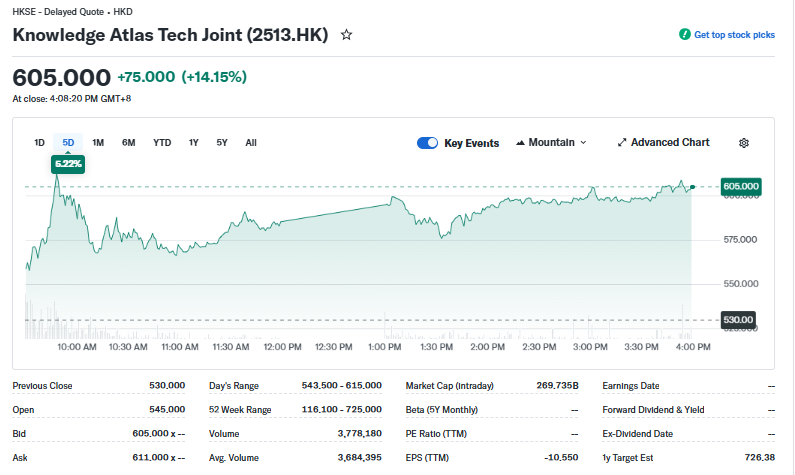
On March 16, 2026, shares of Chinese artificial intelligence company Zhipu AI surged after the firm introduced GLM-5-Turbo, a new large language model built for the fast-growing OpenClaw AI agent ecosystem. The announcement pushed the company’s Hong Kong-listed stock up as much as 16% to around HK$615, reflecting strong investor interest in next-generation AI infrastructure.
GLM-5-Turbo is designed to help AI agents complete complex tasks, connect with external tools, and run long chains of automated actions across digital platforms.
Advertisement
As businesses increasingly adopt autonomous AI systems, companies building specialized models for these ecosystems are gaining attention. Zhipu’s latest launch signals a new phase in the global AI race, one where intelligent agents, not just chatbots, could reshape how technology works.
Zhipu AI: The Rising Contender in China’s AI Race
From Tsinghua Research Project to Global AI Startup
Zhipu AI has quickly become one of China’s most closely watched artificial intelligence companies. The firm was founded in 2019 by researchers linked to Tsinghua University and focuses on developing large language models under the GLM family.
The company gained global attention after releasing several advanced models aimed at competing with Western AI systems from companies like OpenAI and Anthropic. Its GLM models focus heavily on coding ability, reasoning, and automated task execution.
In February 2026, the company introduced GLM-5, a large model with around 744 billion parameters, designed to improve AI-driven coding and agent-based workflows. This release positioned Zhipu among the top emerging AI developers in China.
The company also promotes open development. Some versions of its models are released under permissive licenses to encourage developers to build tools and applications on top of its AI ecosystem.
IPO and Rapid Market Growth
Zhipu’s rapid rise has also attracted strong investor interest. The company listed on the Hong Kong Exchange in January 2026, making it one of the first major AI model developers to go public.
The stock has seen strong volatility since the listing. At one point, the company’s shares rose more than 380% from the IPO level, reflecting strong market demand for AI infrastructure companies.
Investors view companies like Zhipu as key players in the race to build foundational AI models and platforms that can power the next generation of digital products.
What Is GLM-5-Turbo? Key Features and Capabilities
Built Specifically for AI Agent Workflows
GLM-5-Turbo is designed for a new category of artificial intelligence applications known as AI agents. These systems can perform tasks automatically instead of only responding to prompts like traditional chatbots.
According to the company’s developer platform, the model focuses on improving how AI agents interact with tools, software, and digital services. Key capabilities include:
- Advanced tool invocation, allowing AI systems to call external APIs or services
- Strong instruction following for complex commands
- Ability to manage long chains of tasks without losing context
- Integration with enterprise software and messaging platforms
The model is optimized for the OpenClaw ecosystem, a framework designed to run intelligent AI assistants that can operate across enterprise systems and digital tools. GLM-5-Turbo also supports structured output formats and real-time response streaming, which makes it easier for developers to embed it into enterprise applications.
How Does It Improve on Earlier GLM Models?
GLM-5-Turbo builds on the earlier GLM-5 architecture released in February 2026. The base model itself introduced several technical upgrades over previous versions. Some of the key improvements include:
- Larger training datasets reaching 28.5 trillion tokens
- A mixture-of-experts architecture designed for efficiency
- Higher performance in coding benchmarks
- Better reasoning capabilities for automated tasks
The model also reflects a shift toward what developers call “agentic engineering.” This concept focuses on AI systems that can write code, run programs, and complete workflows with minimal human input. These capabilities are especially important for businesses building automated tools and digital assistants.
The OpenClaw Ecosystem
What Is OpenClaw and Why Is It Trending?
OpenClaw is an open-source AI agent platform that has quickly become popular among developers. It allows artificial intelligence systems to perform real-world digital tasks such as:
- Searching the web
- Sending messages
- Running software commands
- Managing workflows
Unlike standard chatbots, OpenClaw agents can break down tasks and execute them step by step across different applications. The technology gained viral popularity in late 2025 and early 2026 as developers realized its potential for workplace automation.
Why are Tech Companies Racing to Integrate It?
Many technology companies are rushing to build tools compatible with OpenClaw. The platform has created a strong wave of innovation in China’s AI sector. For example:
- Tencent launched WorkBuddy, an AI agent designed for workplace tasks.
- Zhipu introduced AutoClaw, its own local implementation of the OpenClaw concept.
- MiniMax released MaxClaw, another agent built on the same ecosystem.
These developments triggered strong investor interest in AI stocks connected to the technology. Analysts say OpenClaw could become a major platform for building automated digital workers.
Why are Zhipu Shares Rising?
Investor Excitement Around AI Agent Infrastructure
The launch of GLM-5-Turbo immediately boosted investor confidence in Zhipu’s long-term strategy. On March 16, 2026, the company’s Hong Kong-listed shares jumped as much as 16% to HK$615 after the announcement. Investors believe AI agents represent the next major phase of generative AI. Models optimized for these systems could become essential infrastructure.
The strong market reaction also reflects growing demand for AI tools that can automate business processes.
AI Startups Challenging Tech Giants
The rise of companies like Zhipu shows that innovation in AI is no longer limited to large technology firms. New AI startups are releasing competitive models at a rapid pace. This competition is pushing the entire industry forward. For example:
- MiniMax gained a valuation of around $44 billion shortly after its public listing.
- Several Chinese AI companies are launching their own agent platforms to capture the growing market.
This trend suggests the AI market may soon include many specialized model developers rather than only a few dominant tech giants.
The Bigger Picture: China’s Intensifying AI Model Race
How Strong Is China’s AI Industry Today?
China’s artificial intelligence sector is expanding rapidly. Government data shows that the country’s core AI industry exceeded 1.2 trillion yuan (about $166 billion) in 2025. Several companies are competing to develop advanced AI models and platforms. Key players include:
- Zhipu AI
- DeepSeek
- MiniMax
- Baidu
- Alibaba
These companies are focusing on open models, coding AI, and autonomous agents.
Why AI Agents Could Be the Next Major Technology Wave?
AI agents represent a shift from simple conversation tools to systems that can perform tasks automatically. Instead of asking a chatbot for information, users can instruct an AI agent to complete entire workflows, such as:
- Researching a topic
- Writing reports
- Managing emails
- Running business operations
Because of this potential, many analysts believe AI agents could become one of the most important developments in the technology industry during the next decade.
Potential Risks and Challenges
Security and Governance Concerns
Despite the excitement, AI agents also raise serious concerns. Critics warn that autonomous software could access sensitive data or perform actions without proper supervision. Security experts say companies must ensure:
- Strong access controls
- Transparent AI decision processes
- Data protection safeguards
These issues will likely attract regulatory attention in many countries.
Infrastructure and Compute Limitations
Another challenge for AI companies is computing power. Large models require massive infrastructure to train and run. Zhipu recently faced criticism after users reported service issues linked to limited computing resources. The company even asked global computer providers to support its models, highlighting the intense infrastructure demands of modern AI systems.
What Does This Mean for Investors and Developers?
Opportunities for AI Developers
Platforms like OpenClaw create new opportunities for developers to build intelligent automation tools. Developers can create:
- AI agents for business operations
- automated customer service systems
- research assistants
- coding tools
These applications could reshape productivity software and digital workplaces.
Zhipu Stock Details and Technical Outlook
Zhipu AI trades in Hong Kong under the ticker 2513 through Knowledge Atlas Technology. Recent stock highlights:
- Listed in January 2026
- Shares have risen more than 380% since listing at one stage
- Jumped up to 16% to HK$615 after the GLM-5-Turbo announcement
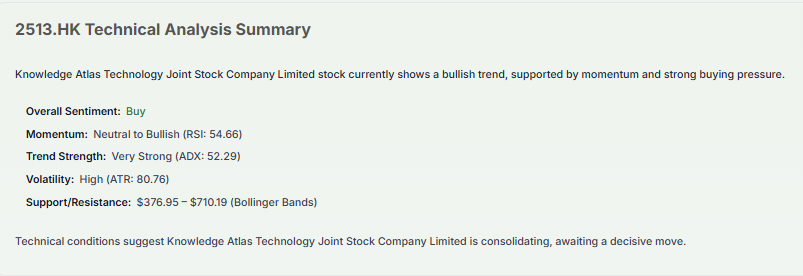
Technical analysis suggests strong momentum due to AI sector enthusiasm, but volatility remains high because the company is still in an early growth phase.
What Meyka Says About Zhipu Stock?
According to analysis from Meyka.com, Zhipu stock remains a high-growth but high-risk AI investment. Key insights highlighted by Meyka’s AI stock analysis tool include:
- Strong upside potential due to AI infrastructure demand
- Market sentiment is heavily influenced by new model releases
- Risk from computing capacity limits and competition
Analysts note that companies building foundational AI models may benefit most if AI agents become mainstream.
Views From Other Analysts
Industry analysts also see long-term opportunity in AI infrastructure companies. According to investment experts at Chanson & Co., the popularity of OpenClaw provides a major opportunity for AI model developers to attract new users and expand their ecosystems. This trend suggests the AI race is shifting from simple chatbot tools to full automation platforms powered by large language models.
Bottom Line
Zhipu’s launch of GLM-5-Turbo shows how quickly artificial intelligence is moving beyond chatbots toward autonomous agents. The strong reaction in Zhipu shares reflects growing investor belief that AI infrastructure will power the next wave of technology innovation.
If platforms like OpenClaw continue to expand, companies building specialized AI models may play a central role in shaping the future of automation, digital work, and intelligent software systems.
Disclaimer:
The content shared by Meyka AI PTY LTD is solely for research and informational purposes. Meyka is not a financial advisory service, and the information provided should not be considered investment or trading advice.
Advertisement
What brings you to Meyka?
Pick what interests you most and we will get you started.
I'm here to read news
Find more articles like this one
I'm here to research stocks
Ask our AI about any stock
I'm here to track my Portfolio
Get daily updates and alerts (coming March 2026)