In March 2026, traders and investors are curious about whether the National Stock Exchange (NSE) and Bombay Stock Exchange (BSE) will shut down for key festivals. The answer matters for planning orders, settlements, and cashflows.
According to the official 2026 trading holiday calendar, markets will remain open during Ugadi and Gudi Padwa on 19 March and even on Eid‑ul‑Fitr, which is expected around 20-21 March 2026 but falls on a Saturday, a regular non‑trading day. This article cuts through the confusion so you know exactly which festival dates affect NSE & BSE trading and which don’t.
Advertisement
NSE & BSE Holiday Schedules in March 2026
Which days will the NSE and BSE be closed in March 2026?
In March 2026, the National Stock Exchange (NSE) and Bombay Stock Exchange (BSE) will close trading on three official weekday occasions. These are listed on the exchange 2026 holiday calendars and affect equity, derivatives, and major segments.
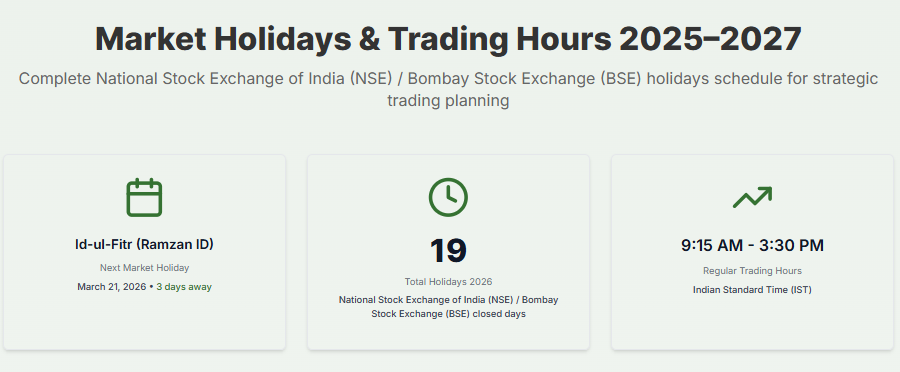
Here are the confirmed exchange closures:
- March 3, 2026 (Tuesday): Holi – markets will be closed for all segments.
- March 26, 2026 (Thursday): Shri Ram Navami – official holiday across NSE and BSE.
- March 31, 2026 (Tuesday): Shri Mahavir Jayanti – exchanges will be shut.
These three days represent the only mid‑week non‑trading days in March 2026, aside from weekends. Weekend closures (Saturdays and Sundays) also apply as usual, but they are not counted as officially declared holidays because trading does not occur then anyway.
Will Ugadi and Gudi Padwa cause stock market holidays?
The short answer for traders is no. Ugadi and Gudi Padwa fall on March 19, 2026 (Thursday), but neither NSE nor BSE lists these festivals as official closures in their trading calendar.
Despite their cultural importance across southern and western India, the exchanges have not included them in the trading holiday schedule. This means:
- Indian markets will be open for equity and derivatives trading on March 19.
- Traders should plan transactions and settlements accordingly.
State administrative holidays (for banks or local institutions) are separate from exchange‑declared holidays and do not affect daily trading on NSE or BSE.
Does Eid‑ul‑Fitr lead to a market holiday?
Many investors search “Will NSE/BSE close for Eid in March 2026?” The answer depends on the actual date of Eid and how it intersects with the weekly schedule.
According to recent forecasts based on moon sighting predictions, Eid‑ul‑Fitr in India is expected on March 21 or 20, 2026. Local celebrations and moon sightings still play a role in the final public observance. However:
- March 21, 2026 (Saturday) is a regular weekend, so the exchanges are closed by default.
- As a result, no extra weekday holiday is declared specifically for Eid in March 2026.
This means that even though many people celebrate Eid, trading availability does not change beyond the standard weekend closure.
Are there segment‑specific exceptions for commodity or evening trading?
Most holiday notices cover equity, equity derivatives, currency derivatives, and repo segments. For these segments, trading is fully suspended on the three holidays listed. But there are some nuances for the commodity segment:
- On Holi (March 3), commodity and electronic gold receipts (EGR) markets are closed in the morning session but open in the evening session from 5:00 PM to 11:55 PM.
- Similar evening trading availability may apply on March 26 and March 31 for commodity derivatives but not for equity segments.
These segments‑specific details are useful for traders who use futures and commodity strategies.
How do these holidays affect settlements and trading plans?
Exchange‑declared holidays directly influence the settlement cycle (T+1 / T+2) and planning of buy/sell orders. A single mid‑week market closure can shift settlement dates by a day or more, especially if it falls between a trade date and a pay‑in/pay‑out day.
To manage this:
- Mark the holiday dates on your trading calendar.
- Plan trades before Holi, Ram Navami, and Mahavir Jayanti if you need settlements ahead of closures.
- Track global markets and pre‑market signals, as overseas moves will still price in when NSE/BSE are closed.
Using an AI analysis tool can help assess the impact of holiday gaps on opening prices before trading resumes.
What should traders watch after holiday closures?
After a market holiday, volatility can spike. Traders and investors often monitor global overnight indexes and pre‑open indicators to predict open direction. Here is what to focus on:
- GIFT Nifty or global futures prices before the Indian market opens.
- Sector momentum since holidays can create gaps in price.
- Volume spikes as traders enter/exist when markets reopen.
These practices help cope with the structural breaks created by holiday closures.
Conclusion
In March 2026, NSE and BSE will not close for Ugadi or Gudi Padwa, and though Eid‑ul‑Fitr falls in the same period, it does not lead to a weekday shutdown. Only Holi (March 3), Shri Ram Navami (March 26), and Shri Mahavir Jayanti (March 31) are official exchange holidays. Knowing these exact dates helps traders plan orders, manage settlements, and control risk.
Advertisement
Frequently Asked Questions (FAQs)
No. NSE and BSE will remain open on Ugadi and Gudi Padwa (March 19) and Eid (March 21, 2026).
Markets will close on Holi (March 3), Shri Ram Navami (March 26), and Mahavir Jayanti.
Yes. NSE and BSE will be open on March 19, 2026, during Ugadi and Gudi Padwa celebrations across India.
Disclaimer:
The content shared by Meyka AI PTY LTD is solely for research and informational purposes. Meyka is not a financial advisory service, and the information provided should not be considered investment or trading advice.
Advertisement
What brings you to Meyka?
Pick what interests you most and we will get you started.
I'm here to read news
Find more articles like this one
I'm here to research stocks
Ask Meyka Analyst about any stock
I'm here to track my Portfolio
Get daily updates and alerts (coming March 2026)