











The U.S. Treasury Department is now preparing to take an unusual step to tackle rising fuel costs by targeting the oil futures market, a financial arena that helps set global fuel prices. As of March 5-6, 2026, officials have signaled that new measures could be announced as early as this week to help slow surging energy prices driven by geopolitical tensions in the Middle East.
Futures for Brent crude and U.S. oil benchmarks have climbed sharply, pushing up gasoline costs at the pump and squeezing household budgets. This possible policy shift would mark a rare move by Washington to influence energy costs through financial markets rather than physical oil supply actions, making it a story worth watching closely.
What Exactly Is the U.S. Treasury Considering?
In early March 2026, senior White House officials signaled that the U.S. Treasury Department could announce new measures to help slow rising energy prices. These measures may include potential action in the oil futures market, a financial arena where traders buy and sell contracts on future oil delivery. This is significant because past government responses focused on physical supply tools like strategic reserve releases, not financial markets.
The expected announcement has been described as potentially coming as early as March 5-6, 2026. Officials declined to release details in advance, but the focus on futures reflects growing concern over surging crude prices. Brent crude has climbed as high as about $85 a barrel due to geopolitical tensions in the Middle East.
Unlike standard policy responses, action in futures markets would mean the government may use financial mechanisms to influence price expectations, not just physical supply. The strategy draws on the financial market experience of Treasury Secretary Scott Bessent, a former hedge fund manager.
Why the US Treasury’s Oil Futures Move Is Unprecedented?
Why Would the Government Target a Futures Market?
The oil futures market signals expected future prices rather than immediate physical shortages. Traders bid prices up or down based on supply risk, demand forecasts, and geopolitical news. A government stepping in here would be unusual because it crosses from physical energy policy into market pricing mechanisms.
Officials may believe that dampening speculative pressure or adjusting futures curve dynamics could moderate the rapid price acceleration. This kind of tool has not been publicly used by the Treasury to manage fuel prices before. Analysts describe it as an unusual choice because financial markets react to a complex set of influences beyond immediate supply constraints.
Does It Change Oil Physical Supply Issues?
No. Futures‑market actions do not create more oil. They only aim to affect market sentiment and pricing expectations. The core issue behind higher prices is physical supply disruption due to geopolitical events in the Middle East, particularly around the Strait of Hormuz, a critical channel for global oil shipments. Roughly 20 % of world oil normally passes through this strait, and disruptions have raised price risk premiums.
Oil Market and Price Reaction to US Treasury Measures
How Have Prices Moved Recently?
Oil prices had risen sharply in early March 2026. Before any government action, Brent crude futures climbed about 18 %, and U.S. West Texas Intermediate (WTI) futures increased roughly 21 % in just a few trading sessions since the conflict in the Middle East flared. This push was tied to concerns about supply route closures and refinery shutdowns.
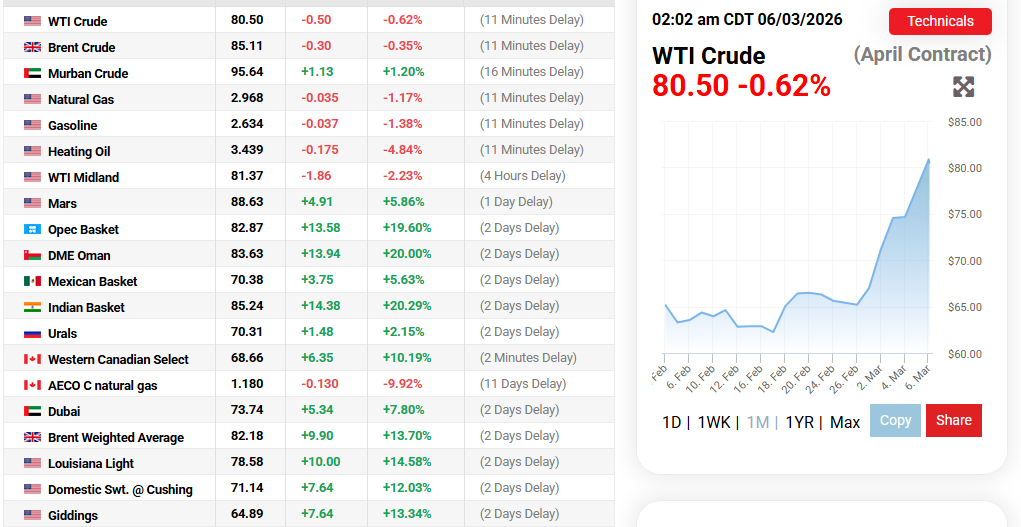
However, reports on March 6, 2026, showed oil prices falling slightly after news that the U.S. might intervene in futures and issue waivers allowing companies to buy Russian crude to ease physical supply limits. Brent dropped around 1.3 % to about $84.27, and WTI fell about 1.8 % to nearly $79.55.
What are Traders Saying?
Commodity analysts note that while futures intervention could temper purely speculative trades, it cannot fully offset supply constraints caused by Middle East disruptions. Some believe that futures tools may only help soften volatility. Others warn that pricing is driven largely by real supply and demand, so financial actions are limited in scope.
Risks, Challenges & Broader Implications
What are the Risks of Futures Market Intervention?
Stepping into the futures market carries both political and economic risks:
- Market distortion: Government positions in futures could bias trades, risking losses if prices move opposite the intervention stance.
- Legal complexity: Futures markets are regulated by the Commodity Futures Trading Commission (CFTC), and any large government action must navigate existing rules. The Commodity Futures Modernization Act of 2000 and other statutes shape how derivatives and futures are overseen.
- Limited supply impact: Futures actions do not increase the physical flow of oil. With real bottlenecks at ports and shipping routes, markets may remain sensitive to supply news.
How Might This Affect Global Markets?
If the U.S. takes an active position in oil futures, international markets could see shifts in how pricing risk is shared. Exporting nations, hedging programs, and global trading desks may adjust strategies based on how Washington engages the contracts. Some analysts compare this to past quantitative easing actions in financial markets, where central bankers bought assets to influence liquidity and pricing signals.
Futures intervention could also influence inflation expectations, financial asset correlation, and bond yields, as rising oil prices feed into broader consumer costs. Various analysts use tools, including advanced AI stock analysis models, to gauge how this may ripple through energy stocks and macro assets.
Final Words
The U.S. Treasury’s contemplation of oil futures market action is an unusual and bold leap in energy policy. It reflects the urgency policymakers feel amid rising crude prices tied to geopolitical conflict. Futures intervention may ease price swings, but its success hinges on global supply conditions and market trust. As details emerge, markets and consumers will watch closely to see if this financial strategy can truly tame volatile energy costs in 2026.
Frequently Asked Questions (FAQs)
As of March 6, 2026, the US Treasury may take steps in the oil futures market. This could influence prices by affecting trading expectations, not physical oil supply.
Treasury action might help stabilize oil prices by reducing market speculation. It may not fully lower prices because supply issues and global demand still affect the market.
The Treasury may focus on futures to control price expectations. Physical oil supply actions, like reserve releases, may be slower or less effective against current market volatility.
Disclaimer:
The content shared by Meyka AI PTY LTD is solely for research and informational purposes. Meyka is not a financial advisory service, and the information provided should not be considered investment or trading advice.
What brings you to Meyka?
Pick what interests you most and we will get you started.
I'm here to read news
Find more articles like this one
I'm here to research stocks
Ask our AI about any stock
I'm here to track my Portfolio
Get daily updates and alerts (coming March 2026)