US Stock Market Today: Futures Slip on Trump Tariff Uncertainty, Iran‑US Talks in Focus
The U.S. stock market opened sharply lower on February 23, 2026, as global markets reacted to fresh tariff uncertainty and rising geopolitical tension. Traders are wobbling after President Donald Trump’s new tariff hike and legal challenges cloud the U.S. trade outlook, weighing on the Dow, S&P 500, and Nasdaq futures.
At the same time, renewed Iran-U.S. nuclear talks are shifting investor focus toward riskier geopolitical outcomes, adding another layer of market anxiety. Safe‑haven assets like gold and silver are climbing, while oil and tech stocks feel the pressure. With markets on edge and volatility picking up, many investors are left asking: What comes next, and how should you position your portfolio?
Advertisement
U.S. Stock Market Overview: Futures & Index Performance Today
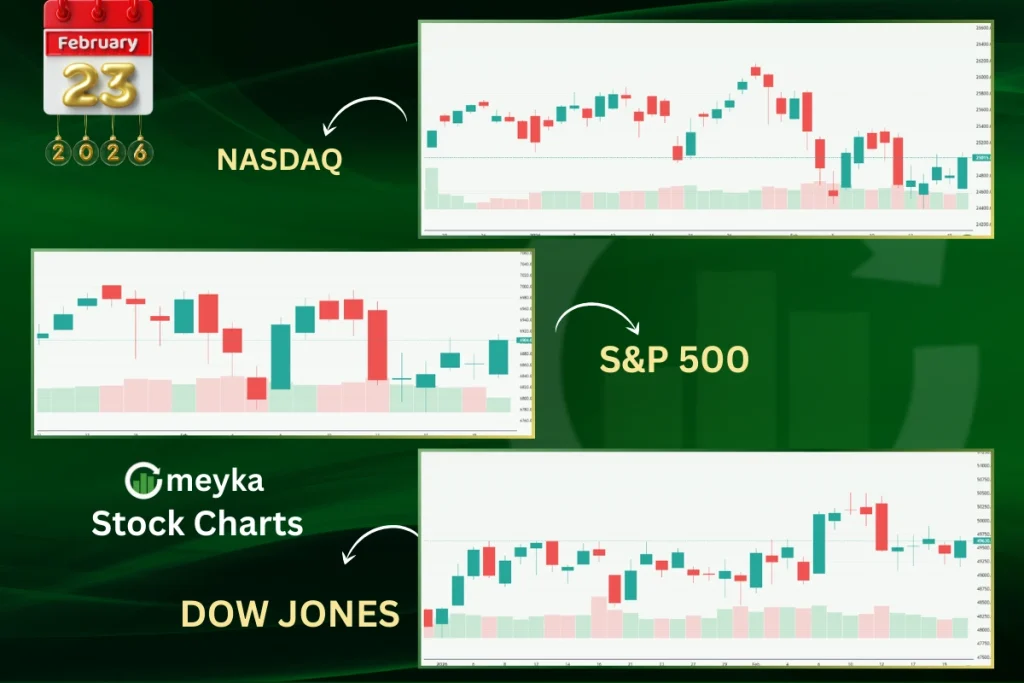
On February 23, 2026, major U.S. stock index futures weakened as traders digested tariff uncertainty and geopolitical shifts. Futures tied to theDow Jones Industrial Average dropped about 0.6%, S&P 500 futures slid around 0.7%, and Nasdaq 100 futures fell close to 0.9% in early trading. This slide came after the U.S. Supreme Court invalidated much of President Trump’s broad tariff authority, reopening market questions on trade policy.
The U.S. dollar also softened, as global confidence wavered and safe-haven assets gained interest. Asian markets showed mixed performance, with some indexes up while others lagged, reflecting global caution.
At the same time, Bitcoin dropped nearly 5%, sliding below the $65,000 level, as risk‑off sentiment picked up among crypto investors.
Gold and silver climbed as traders sought protection amid unclear trade policy. Gold hit a multi‑week high, while silver gained notable ground.
These moves highlight how uncertainties around tariffs and diplomatic developments are shaping investor behavior across asset classes.
Key Drivers Behind U.S. Stock Market Moves
Why are Tariffs Causing Market Volatility?
The main driver of today’s market shifts is confusion over U.S. tariff policy. On February 22-23, the U.S. Supreme Court struck down wide‑ranging tariff powers previously used by the White House. In response, President Trump quickly announced new tariffs of 15% on global imports under a different legal authority.
The rapid change unsettled traders. Markets dislike uncertainty. They are now unsure how long trade costs will last, how they will affect corporate profits, and what agreements trading partners might pursue next. Global growth expectations now face downward pressure due to potential slower demand from tariff impacts.
Rodrigo Catril, a senior FX strategist at NAB, said that “uncertainty is not good news for any economy or market”, pointing to the circular risk of new tariffs being announced then reversed, and repeating.
This policy ping‑pong also affects confidence in sectors sensitive to global trade, such as industrials, materials, and transportation. Those sectors tend to underperform during periods of tariff ambiguity.
How are Iran‑US Talks Affecting Sentiment?
Another major factor is the renewed diplomatic focus between the United States and Iran. Reports confirm that both nations are preparing for a third round of nuclear negotiations in Geneva later this week.
This development has a dual effect. On one side, progress toward a deal eases fears of armed conflict in the Middle East. That has contributed to a drop in crude oil prices. Brent crude futures slid over 1% to around $71.01 a barrel, and U.S. West Texas Intermediate (WTI) crude futures also weakened.
On the other side, while the risk of war recedes, the ongoing uncertainty in negotiations still keeps risk premiums in prices. Traders remain cautious until clearer outcomes emerge. Oil analysts note that even though talks are underway, the threat of escalation, political or military, still underpins commodity volatility here.
Iran has indicated possible concessions on its nuclear program in exchange for sanctions relief and recognition of certain rights, signaling some diplomatic flexibility.
What Happens to Commodities and Safe Havens?
Safe‑haven assets are benefiting from the uncertainty.
- Gold rose to a more than three‑week high, as investors look for protection amid tariff and geopolitical risk.
- Silver prices jumped significantly, with notable gains in both international and domestic markets.
In contrast, oil weakened as diplomatic progress lowered immediate conflict risk, reducing some premium from crude prices.
These commodity responses show a classic risk‑off pattern. When policy risk rises and equities struggle, safe assets like precious metals gain appeal.
Sector & Stock Trends to Watch
Tech stocks, especially AI‑linked names, are under pressure amid broader market weakness. Traders are watching Nvidia’s upcoming earnings closely. NVIDIA’s results will test confidence in tech and AI’s growth narrative, a sector previously seen as a key market driver.
Beyond Nvidia, lower trade clarity tends to hurt cyclical stocks and benefit defensive sectors such as utilities and consumer staples. Energy stocks are reacting to oil’s slide, while precious metal miners see interest as gold and silver rise.
In this context, using tools like the AI stock analysis feature on platforms such as Meyka can help investors gauge sentiment and technical factors more clearly, especially for high‑volatility names.
What Investors Should Know about the U.S. Stock Market?
Investors should expect ongoing volatility until there is clarity on U.S. tariffs and progress in Iran‑U.S. talks. Trade policy uncertainty directly affects earnings forecasts and risk appetite. Safe variations in portfolio allocation, including exposure to defensive and non‑correlated assets, could help manage short‑term risk.
Key upcoming events include tech earnings releases, economic data on labor and inflation, and policy commentary from central banks. These will offer fresh signals on market direction.
Wrap Up
The U.S. market faces uncertainty from tariffs and global diplomacy. Futures slipped on February 23, 2026, while safe-haven assets rose. Investors should monitor policy updates, earnings, and market signals to manage risk.
Advertisement
Frequently Asked Questions (FAQs)
On February 23, 2026, U.S. stock futures fell as traders reacted to unclear trade rules and rising tension from Iran–U.S. talks. Investors sold risky assets and bought safe-haven commodities.
New tariffs announced by President Trump in February 2026 created uncertainty. Traders worry that higher import costs will hurt company profits, causing stocks to drop and markets to become more volatile.
Ongoing Iran‑U.S. nuclear talks in February 2026 affect oil prices and risk sentiment. Any progress may calm markets, while setbacks can increase uncertainty and push stocks and commodities up or down.
Disclaimer:
The content shared by Meyka AI PTY LTD is solely for research and informational purposes. Meyka is not a financial advisory service, and the information provided should not be considered investment or trading advice.
Advertisement
What brings you to Meyka?
Pick what interests you most and we will get you started.
I'm here to read news
Find more articles like this one
I'm here to research stocks
Ask our AI about any stock
I'm here to track my Portfolio
Get daily updates and alerts (coming March 2026)