











US Jury Holds Meta and YouTube Responsible in Social Media Addiction Case
A landmark legal decision in the United States has reshaped the debate around technology accountability and digital safety. A US Jury delivered a historic verdict holding Meta and YouTube responsible for harm linked to social media addiction, marking one of the most significant legal challenges ever faced by major technology platforms. The ruling has drawn global attention from regulators, investors, and policymakers because it may influence future lawsuits and reshape the broader stock market outlook for major technology companies.
The case stands at the intersection of law, mental health, and technology innovation, raising serious questions about platform design, user safety, and corporate responsibility in the digital era.
Background of the Social Media Addiction Trial
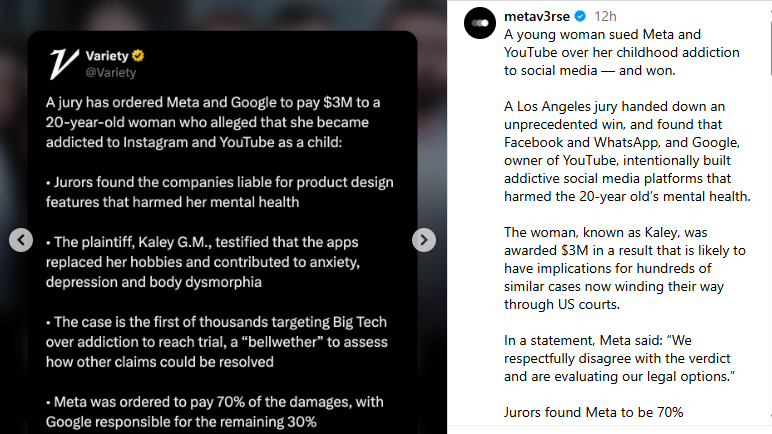
The lawsuit centered on a young woman identified in court documents as K.G.M., who argued that prolonged exposure to Instagram and YouTube during childhood caused severe mental health issues. The trial took place in Los Angeles County Superior Court and became the first major bellwether case among thousands of similar lawsuits filed against social media companies.
According to court findings, the plaintiff began using YouTube at age six and Instagram at age nine. Lawyers argued that platform features such as infinite scrolling, autoplay videos, and algorithm-driven recommendations were intentionally designed to increase user engagement and dependency.
After weeks of testimony and expert analysis, the US Jury concluded that both companies were negligent in how their platforms were designed and operated.
Verdict Details and Financial Damages
The jury awarded approximately $6 million in total damages, including compensatory and punitive penalties. Meta was assigned 70 percent responsibility, while YouTube, owned by Alphabet, carried the remaining 30 percent share.
Key findings included:
- Platforms were a substantial factor in worsening the plaintiff’s mental health.
- Companies failed to adequately warn users about potential risks.
- Addictive design elements played a central role in prolonged usage.
The decision represents one of the first times a court has directly linked platform design to psychological harm rather than focusing solely on user-generated content.
Both companies announced plans to appeal the verdict, maintaining that they provide safety tools and deny direct responsibility for users’ mental health outcomes.
Why the US Jury Decision Is Considered Historic
Legal experts describe the ruling as a turning point similar to early tobacco industry litigation. Instead of targeting online content, plaintiffs focused on product design, allowing courts to bypass traditional legal protections that previously shielded technology companies.
The jury determined that algorithmic engagement systems encouraged excessive use among young users, effectively redefining how courts interpret responsibility in digital environments.
This legal strategy could influence more than 1,600 consolidated lawsuits currently progressing through U.S. courts, making this case a critical precedent.
Impact on Technology Stocks and the Stock Market
The verdict immediately sparked discussion across the stock market, particularly among investors tracking AI stocks and major technology firms. Market analysts highlighted three major implications:
1. Increased Legal Risk
Technology companies may face higher compliance costs and potential settlements as similar lawsuits move forward.
2. Regulatory Pressure
Lawmakers may accelerate digital safety regulations such as youth protection laws and algorithm transparency requirements.
3. Investor Sentiment
Uncertainty around legal exposure can influence valuations of large-cap tech stocks involved in advertising and social media ecosystems.
While the ruling does not directly change company earnings today, it introduces long-term risk factors considered during stock research analysis.
How Platform Design Became the Central Issue
During the trial, attorneys argued that engagement-focused features were engineered to maximize user retention. Evidence presented showed that recommendation algorithms continuously suggested personalized content designed to keep users active.
Jurors concluded these mechanisms were not neutral tools but intentional design choices that encouraged compulsive behavior. Examples discussed in court included:
- Endless content feeds.
- Push notifications encouraging repeated app visits.
- Beauty filters contributing to body image concerns.
- Personalized video autoplay systems.
This focus shifted legal responsibility from user behavior to corporate engineering decisions.
Broader Legal and Policy Implications
The verdict could reshape technology regulation worldwide. Policymakers are already examining stronger online safety frameworks, including potential reforms targeting how platforms design recommendation systems.
Advocacy groups believe the ruling strengthens arguments for child protection laws and digital wellness standards. Analysts also expect increased scrutiny from institutions studying online behavior and mental health impacts.
Experts warn that companies may need to redesign engagement models to avoid future liability, potentially affecting advertising revenue structures across the industry.
Corporate Response from Meta and YouTube
Both companies defended their platforms during the trial, emphasizing existing safety tools and parental control features.
Executives argued that scientific consensus on social media addiction remains debated and that many external factors contribute to mental health outcomes. However, the jury rejected these arguments, concluding that platform design played a measurable role in harm experienced by the plaintiff.
Statements released after the verdict confirmed that appeals are underway, meaning the legal process may continue for years.
What This Means for Future Social Media Litigation
Legal observers believe this case will serve as a blueprint for upcoming trials. Thousands of plaintiffs, including families and school districts, are pursuing similar claims across the United States. Key expectations include:
- More lawsuits focusing on algorithm design.
- Expanded expert testimony on digital psychology.
- Greater disclosure requirements for technology companies.
The decision may also influence international courts evaluating platform accountability.
Investor Perspective and Long-Term Outlook
From an investment standpoint, the ruling introduces a new category of risk for large technology firms. Analysts conducting stock research now consider legal exposure alongside traditional metrics such as revenue growth and user engagement.
Despite the immediate headlines, many investors view the outcome as part of a longer regulatory cycle similar to previous shifts in industries like finance and healthcare.
AI stocks connected to recommendation systems could also face scrutiny if algorithm design becomes a central legal concern.
Conclusion
The US Jury ruling against Meta and YouTube marks a defining moment in the relationship between technology companies and society. By holding platforms accountable for design choices rather than content alone, the decision establishes a new legal framework that could reshape digital regulation, investor expectations, and platform development strategies.
As appeals proceed and additional trials emerge, the case may become one of the most influential technology rulings of the decade, altering how innovation balances engagement with user safety.
FAQs
The jury found Meta and YouTube negligent for designing addictive platforms that contributed to mental health harm and awarded about $6 million in damages.
It shifts legal responsibility toward platform design, potentially opening the door for thousands of similar lawsuits and stricter regulation.
The financial impact is limited in the short term, but long-term investor sentiment and regulatory risks may influence valuations across the stock market.
Disclaimer:
The content shared by Meyka AI PTY LTD is solely for research and informational purposes. Meyka is not a financial advisory service, and the information provided should not be considered investment or trading advice.
What brings you to Meyka?
Pick what interests you most and we will get you started.
I'm here to read news
Find more articles like this one
I'm here to research stocks
Ask our AI about any stock
I'm here to track my Portfolio
Get daily updates and alerts (coming March 2026)