











Tencent’s latest earnings season delivered a twist few saw coming. On March 18, 2026, the Chinese tech giant reported a strong Q4 2025 performance, with revenue climbing about 13% and net profit up sharply thanks to gains in gaming and advertising. Yet, instead of cheering investors, the stock slid sharply on the Hong Kong market. The reason?
Growing worry over Tencent’s plans to boost artificial intelligence (AI) spending, and scale back share buybacks to fund that push. This has sparked fresh debate on whether heavy AI investment is worth the short‑term cost. Stay with us to unpack why strong earnings didn’t stop the stock sell‑off.
Tencent’s Q4 2025 Earnings Beat But Stock Falls on AI Spending Concerns
Tencent Q4 2025 Performance
Tencent Holdings Limited delivered strong Q4 2025 results on March 18, 2026, with revenue of RMB 194.4 billion (≈13% year‑over‑year growth) and net profit of RMB 58.26 billion. Both figures slightly exceeded analyst expectations and marked a fifth straight quarter of double‑digit growth.
Gaming continued to lead growth, with domestic gaming revenue up around 15% and international gaming up more than 30%. Advertising also grew as AI‑enhanced ad targeting lifted performance across Tencent’s digital services.
Despite this solid earnings beat, Tencent’s share price declined sharply in the Hong Kong market, with the stock opening down over 4% on the day of the report. Investors reacted cautiously because Tencent signaled plans to reduce share buybacks and redirect capital toward AI development and technology spending.
Financial leadership confirmed this shift in strategy during the post‑earnings media call, stressing a priority on long‑term AI capability over near‑term returns.
Why Did Tencent Shares Fall Despite Strong Earnings?
Focus on Future Costs Rather Than Past Results
Investors often price stocks based on expected future earnings and growth prospects. Even though Tencent delivered strong Q4 results, markets reacted negatively because the company outlined expanded spending plans for 2026, especially in artificial intelligence (AI). Analysts and traders viewed this as a sign that cost growth could pressure profitability in the near term, reducing short‑term returns for shareholders.
AI Investment Plans and Capital Allocation Shift
Tencent explicitly stated it intends to boost its AI investment in 2026, including funding new proprietary models, developing an AI agent for its flagship app WeChat, and launching the “OpenClaw” AI product suite.
The company also spent over RMB 1 billion promoting its AI chatbot Yuanbao during the Lunar New Year, signalling aggressive competition in the crowded Chinese AI sector. These decisions suggest that Tencent is prioritising building long‑term AI capabilities, potentially at the expense of share buybacks and short‑term earnings growth.
This kind of capex focus often weighs on share prices when investors are risk‑averse or seeking near‑term returns. Similar patterns have appeared in other tech leaders where AI spending has softened stock reactions despite strong performance.
Stock Snapshot & Short‑Term Trends
Current Price & Market Context
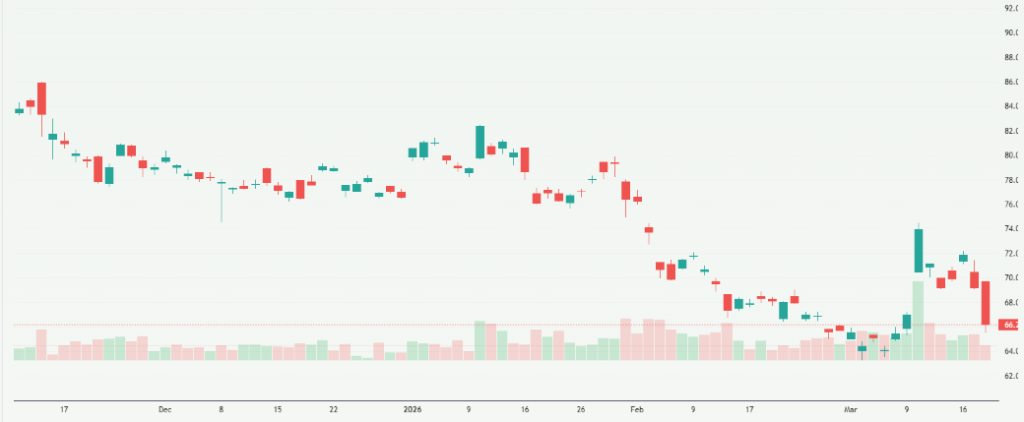
- The Tencent ADR (TCEHY) trades around $66 per share as of mid‑March 2026, near the lower end of its recent range but still above recent annual lows.
- On the Hong Kong exchange, Tencent (00700.HK) also saw notable weakness as tech stocks broadly reassess future growth prospects.
Short‑Term Technical Signals
Analyses from Meyka indicate a mixed short‑term outlook:
- Technical indicators suggest neutral conditions with potential for price movement, and some models give a 12‑month target near $77.6.
- At the same time, momentum indicators such as RSI suggest the stock is not strongly overbought or oversold, creating a wait‑and‑see pattern for traders.
- Other technical views, including daily moving averages, lean towards bearish signals based on sell indicators on short timeframes.
These mixed signals reflect investor uncertainty. Some traders stay cautious, pricing in near‑term profit pressures from heavy tech capex, while others see the pullback as an opportunistic entry. AI stock analysis tools like Meyka’s forecast models can help investors gauge potential scenarios, but they should be combined with fundamental research.
Tencent Shares: Analyst Views and Broader Insights
Consensus Targets and Ratings
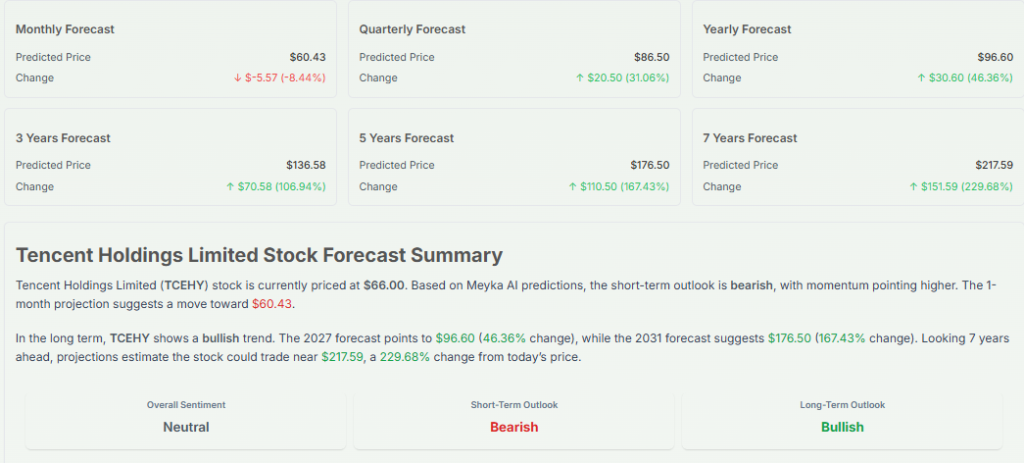
Market consensus from major analyst coverage points to a buy rating for Tencent ADR, with 12‑month price targets averaging near $97 and potential upside of around +47% from current levels.
Growth Drivers
Analysts highlight Tencent’s position in gaming, digital ads, and AI‑enhanced services as core long‑term growth engines. These business lines deliver recurring revenue and strong cash flow, supporting future investments even as margins fluctuate.’
Risks to Watch
Key risks include:
- Continued regulatory shifts in China’s tech landscape.
- Rising AI competition from domestic rivals such as Alibaba and ByteDance.
- Short‑term margin compression if AI investments outpace revenue growth.
These risk factors contribute to stock price volatility and divergent analyst opinions. Investors should monitor upcoming earnings guidance and macro trends closely.
Final Words
Tencent’s strong Q4 2025 results show solid growth across gaming and advertising, but concerns about elevated AI spending and shifting capital allocation have pushed its stock lower. Investors are weighing short‑term profit pressure against long‑term strategic positioning in AI and digital platforms. The key question now is whether Tencent’s heavy investment in AI will deliver sustainable earnings growth that justifies the current valuation adjustment.
Frequently Asked Questions (FAQs)
Tencent shares fell on March 18, 2026, because investors worry that heavy AI spending may reduce short-term profits despite strong growth.
Yes, investors are cautious. Large AI investments in 2026 may increase costs, affecting near-term earnings and pressuring stock performance.
Recovery depends on AI returns and growth. If Tencent generates profits from AI projects, its stock could regain value later in 2026.
Disclaimer:
The content shared by Meyka AI PTY LTD is solely for research and informational purposes. Meyka is not a financial advisory service, and the information provided should not be considered investment or trading advice.
What brings you to Meyka?
Pick what interests you most and we will get you started.
I'm here to read news
Find more articles like this one
I'm here to research stocks
Ask our AI about any stock
I'm here to track my Portfolio
Get daily updates and alerts (coming March 2026)