











On 6 February 2026, Stellantis stunned the auto world with a dramatic announcement: the company will book a €22.2 billion write‑down tied largely to its electric‑vehicle plans. This massive financial hit came as the carmaker acknowledged it had overestimated how quickly customers would switch to EVs, and that the market isn’t shifting as fast as once expected.
The news sent Stellantis shares tumbling more than 20 % in trading and led to the suspension of its 2026 dividend, a rare move for a global automaker. With competitors also scaling back EV investments, this write‑down marks a critical turning point in the industry’s electrification story.
What Happened: Stellantis’ €22.2 Billion Write‑Down Explained
On 6 February 2026, Stellantis announced it would book about €22.2 billion in charges as part of a major reset of its electric‑vehicle strategy. The company said these charges reflect costs tied to shifting its product plans to better match real‑world customer demand and evolving market conditions. A large portion of the charges stems from re‑aligning product plans, canceling certain BEV programs, and impairments linked to lowered volume expectations.
Stellantis stated the write‑down is part of a strategic reset meant to focus on “freedom of choice” by offering a mix of electric, hybrid, and advanced internal‑combustion vehicles rather than pushing full electrification at a fixed pace. CEO Antonio Filosa said the company “over-estimated the pace of the energy transition” and needed to realign its business with customer preferences.
The €22.2 billion total includes roughly €6.5 billion in cash outflows expected over the next four years, mainly supplier compensation and related costs. In addition, Stellantis will issue up to €5 billion in non‑convertible hybrid bonds to preserve liquidity.
As a result of the write‑down and related impacts, the automaker suspended its 2026 dividend and now expects a net loss between €19 billion and €21 billion for the second half of its 2025 fiscal year.
How Did the Market React? Shares Plunge and Investor Worry
Stellantis’ write‑down triggered a dramatic market response on 6 February 2026. Milan‑listed shares dropped sharply, dipping as much as 24-28 % in early trading, the steepest one‑day fall since the 2021 merger of Fiat Chrysler with PSA. In the U.S., Stellantis shares also declined significantly.
Investors reacted negatively to both the magnitude of the charge and its implications for future earnings. The suspended dividend was a clear sign that Stellantis is prioritizing balance‑sheet stability over returning cash to shareholders.
Analysts noted the charge was larger than many had expected, with the total write‑off exceeding market capitalization at certain points during the trading sell‑off. Other major automakers like Ford and GM have also reported EV‑related write‑downs recently, suggesting a broader sector recalibration.
Market watchers now have their eyes set on Stellantis’ final 2025 financial results, due on 26 February 2026, and an upcoming strategic day scheduled for 21 May 2026, where management will lay out a clearer long‑term plan.
Why Stellantis Misjudged EV Demand?
What Went Wrong with EV Forecasts?
Stellantis publicly acknowledged that its earlier EV forecasts were too optimistic. The write‑down reflects a misestimation of how fast customers would transition from internal‑combustion and hybrid vehicles to full battery electric vehicles (BEVs). CEO Antonio Filosa said the company leaned too heavily on assumptions about rapid EV adoption that did not match actual customer behavior.
Several factors contributed to this gap:
- Slow uptake in key markets like Europe and the U.S., where consumers have been hesitant to switch, partly due to high EV prices and lack of charging infrastructure.
- Rollbacks on government incentives, especially in the U.S., which reduced the appeal of EVs.
- Intense competition from Chinese and other low‑cost EV makers that have been more aggressive in pricing and features.
Internal Strategic Shifts
Under Filosa’s leadership, Stellantis moved away from the previous strategy under former CEO Carlos Tavares that heavily emphasized electrification. The new direction broadens focus to include hybrids and advanced internal‑combustion engines, which still appeal to many customers worldwide.
This strategic pivot highlights a realignment with actual market demand, but it also underlines how rapidly changing consumer trends and policy uncertainty can disrupt even well‑funded plans.
Strategic Reset: What Stellantis Plans Next ?
A Broader Powertrain Strategy
Stellantis says it will adopt a “freedom of choice” approach, offering:
- Battery electric vehicles (EVs) where demand is strong
- Hybrid models that bridge technology gaps
- Advanced internal‑combustion engine vehicles for markets where electrification remains slow
This allows the company to appeal to a wider customer base and reduce reliance on any single powertrain technology.
Financial and Operational Steps
To strengthen its balance sheet after the charge:
- Stellantis suspended the 2026 dividend to conserve cash.
- The board authorized up to €5 billion in hybrid bonds to maintain liquidity.
- The company plans to sell its 49 % stake in a Canadian EV battery joint venture back to partner LG Energy Solution.
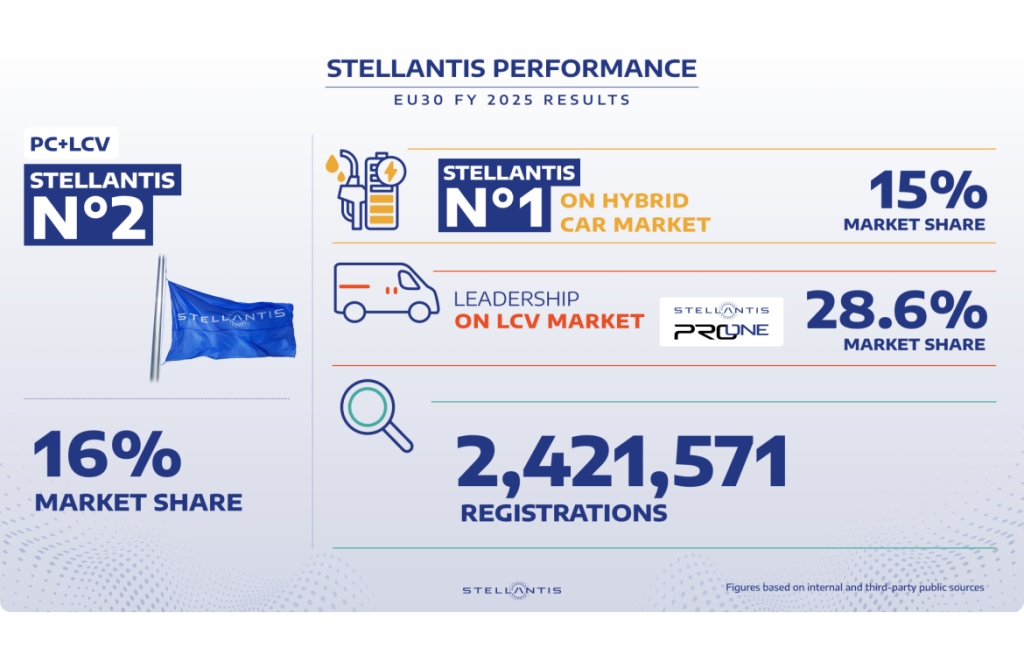
Stellantis also reported improvements in quality and customer ordering trends in the second half of 2025, suggesting some early benefits from revising its product strategy.
Looking Ahead
Management will present a detailed strategic plan in May 2026 that is expected to outline priorities for products, markets, and powertrain investments. How effectively Stellantis balances electrification with other technologies will be key to its long‑term prospects.
Industry Impacts: What This Means for the Global Auto Market
Stellantis’ massive write‑down isn’t an isolated event. Other large automakers like Ford and General Motors have also recorded significant EV‑related charges, signaling a broader industry reassessment of electrification timelines.
Many legacy manufacturers now face similar challenges:
- Slower consumer adoption of full BEVs than expected
- Growing emphasis on hybrids as a transitional technology
- Competitive pressure from Chinese EV makers offering lower‑cost models and strong product appeal
Policy shifts in major markets have also altered the landscape. In the U.S., rollback of subsidies and regulatory changes have reduced incentives for EV buyers. In Europe, potential adjustments to emission‑regulation deadlines have created uncertainty.
For customers, this means more choice but also more confusion about future technology directions. For investors, the write‑down highlights the risks of betting too heavily on long‑term trends without flexible strategies.
Conclusion: A Wake‑Up Call for Automakers
Stellantis’ €22.2 billion write‑down is a stark reminder of how fast market realities can outpace even the biggest strategic bets in the auto industry. The company’s pivot reflects changing consumer demand, competitive pressures, and policy shifts that have slowed the pace of pure electrification.
By broadening its focus to include hybrids and internal‑combustion vehicles, Stellantis aims to align product plans with real‑world preferences and stabilize financial performance. Investors will be watching closely as the company unveils its detailed strategy in May 2026.
What happens next at Stellantis may well set a precedent for how traditional carmakers approach the energy transition in the years ahead.
Frequently Asked Questions (FAQs)
On 6 February 2026, Stellantis took a €22 billion write-down. The company said it overestimated how fast customers would switch to electric vehicles. It is now adjusting its car plans and budgets.
After the €22 bn write-down on 6 February 2026, Stellantis shares fell about 24-28%. The company also suspended its 2026 dividend to save cash. Investors reacted with caution and concern.
Stellantis is now offering a mix of electric, hybrid, and gasoline cars. The company focuses on customer choice and will delay some EV projects to match real market demand.
Disclaimer:
The content shared by Meyka AI PTY LTD is solely for research and informational purposes. Meyka is not a financial advisory service, and the information provided should not be considered investment or trading advice.
What brings you to Meyka?
Pick what interests you most and we will get you started.
I'm here to read news
Find more articles like this one
I'm here to research stocks
Ask our AI about any stock
I'm here to track my Portfolio
Get daily updates and alerts (coming March 2026)