











Samsung Electronics is facing fresh market pressure as its shares price slid sharply this week after reports that mass production at its new Taylor, Texas, semiconductor facility could be further delayed into early 2027. Investors had hoped the cutting‑edge 2nm chip plant would begin volume output this year, but shifting timelines and operational challenges have raised concerns about the company’s next‑generation chip strategy.
The drop in Samsung’s stock reflects broader anxieties about global chip supply chains and competition in advanced semiconductor manufacturing. As markets digest this latest update, many are left asking what it means for Samsung’s competitiveness and future growth prospects.
What Is Causing the Delay in Samsung’s Texas Chip Plant Production?
Samsung’s semiconductor facility in Taylor, Texas, was first announced in 2021 as a major step in expanding advanced chip manufacturing in the United States. The plant was designed to produce cutting‑edge 2‑nanometer (2nm) process chips for high-performance computing and AI markets.
However, the mass production timeline has now slipped from late 2026 to “early 2027”, according to multiple sources familiar with the matter reported in March 2026.
Reports indicate that the facility has begun pilot operations and limited testing runs, but full‑scale mass output has been postponed due to ongoing challenges with factory utilization and achieving efficient production rates.
Samsung has not formally confirmed a new start‑of‑production date, but company representatives have clarified that references to production should be understood as completing preparations for mass manufacturing by the end of 2026.
This delay contrasts sharply with earlier company guidance, which positioned 2026 as the year for meaningful volume output of second‑generation 2nm process chips.
How Has the Delay Affected Samsung’s Share Price and Market Reaction?
Samsung Shares and the KOSPI Slide
Samsung’s share price reacted strongly after the March 3-4, 2026 reports. The company’s stock fell sharply on the Seoul exchange, extending losses over consecutive sessions.
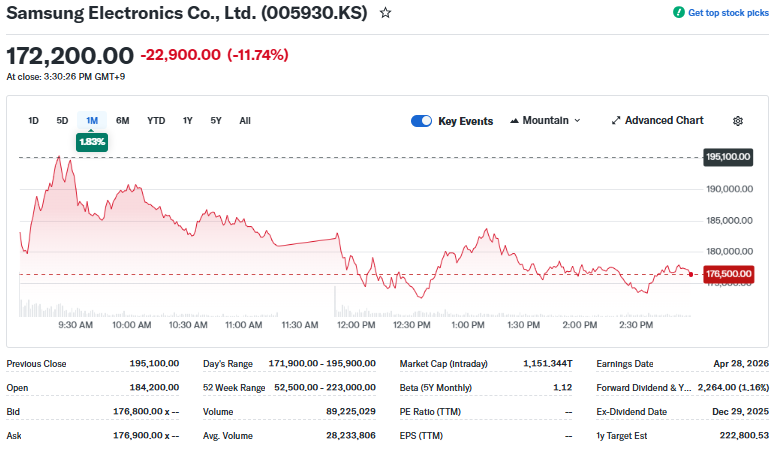
Here is what happened:
- Samsung’s share price plunged nearly 12% to about 172,100 KRW on March 4, 2026.
- The stock had also lost about 10% in the previous session.
- The broader KOSPI index dropped over 7%, its worst sell‑off since 2024, partly triggered by the Samsung Taylor delay news alongside geopolitical pressures.
Investors reacted to the revised timeline because the Taylor plant was widely viewed as a cornerstone of Samsung’s mission to compete in advanced foundry services — especially against rivals like TSMC.
Broader Market Impact
Shares of other Korean semiconductor firms also suffered. SK Hynix, Samsung’s major memory segment peer, saw its shares fall more than 11% on the same day.
The sell‑off triggered circuit breakers on the KOSPI, as panicked selling from foreign and institutional investors hit extreme levels.
Why Is This Delay a Big Deal for Samsung’s Chip Strategy?
Strategic Importance of 2nm and Foundry Business
Samsung’s foundry division has struggled to keep pace with larger rivals in advanced logic chips. The Taylor facility was meant to help close that gap by producing next‑generation 2nm process chips in significant volume.
The delay impacts:
- Samsung’s competitive position versus TSMC, the global leader in leading‑edge nodes.
- The timeline for scaling up advanced logic chip output for high-demand tech sectors such as AI and cloud computing.
Without full production at Taylor, Samsung may continue facing lower foundry utilization rates and revenue. Analysts previously noted that Samsung’s foundry share lags well behind TSMC’s global dominance.
Which Major Clients are Affected by the Texas Delay?
Samsung has secured large contracts tied to its future 2nm output, notably with Tesla.
Tesla Deal
In July 2025, Samsung signed a $16.5 billion deal with Tesla to produce advanced AI chips — including AI5 and AI6- at the Taylor facility.
This deal was hailed as a strategic win for Samsung’s foundry business, but the full realization of that contract now depends on the delayed production ramp‑up timeline.
Industry watchers believe that other potential big tech clients, such as Google and AMD, may also be in discussions for future production once stable output is achievable.
Is There Any Positive Momentum Around the Taylor Fab?
Despite the delays, there are signs of activity and preparation:
- Samsung is increasing hiring at the Taylor site, planning to expand staff to 1,500-1,800 workers to support manufacturing ramp‑up efforts.
- Limited onsite operations, including equipment installation and engineering moves, are continuing as the company builds toward future production readiness.
These developments signal that Samsung maintains strategic focus on the Texas foundry as a hub for next‑gen semiconductor output, even if production has slipped to early 2027.
What Analysts are Saying About Samsung’s Texas Chip Delay?
Industry analysts generally view the delay as a setback for Samsung’s foundry ambitions, but not a complete derailment:
- Some analysts argue that extended delay highlights the complex technical challenges in advanced 2nm manufacturing, including yield optimization and equipment calibration.
- The sharp stock drop triggered by the news also reflects broader market anxiety about foundry competition and geopolitical risk.
- Other voices point to the ongoing demand for AI chips globally and believe Samsung’s position could recover once stable volume production is achieved.
AI‑powered stock analysis tools also indicate that the current valuation reaction may overstretch long‑term prospects, emphasizing fundamentals over short‑term noise.
What does this mean for Samsung’s Future?
Samsung’s advanced chip strategy remains crucial to its long‑term growth plans. The delay at Taylor, Texas, adds pressure and extends uncertainty into 2027, but ongoing client contracts and infrastructure buildup suggest that the company is still committed to leading in cutting‑edge semiconductors.
For investors, the near‑term picture is murky, with market volatility likely until the production timeline solidifies and volume output begins.
Final Words
The delay at Samsung’s Texas chip plant highlights the challenges of next‑generation semiconductor production. While shares fell sharply, the company’s long‑term strategy and major client contracts remain intact, leaving room for recovery once full-scale operations begin in early 2027.
Frequently Asked Questions (FAQs)
Samsung’s Taylor, Texas, plant is delayed because of technical and production challenges. Mass production of 2nm chips now moves to early 2027. This update was reported on March 4, 2026.
After the delay news on March 4, 2026, Samsung shares dropped nearly 12%. Investors worried about future chip output and revenue, affecting stock and causing broader market concern.
Full-scale production at Samsung’s Taylor plant is expected in early 2027. Pilot runs and preparation continue, but large-volume output will not start until next year, as of March 2026.
Disclaimer:
The content shared by Meyka AI PTY LTD is solely for research and informational purposes. Meyka is not a financial advisory service, and the information provided should not be considered investment or trading advice.
What brings you to Meyka?
Pick what interests you most and we will get you started.
I'm here to read news
Find more articles like this one
I'm here to research stocks
Ask our AI about any stock
I'm here to track my Portfolio
Get daily updates and alerts (coming March 2026)