On April 7-8, 2026, Anthropic introduced Project Glasswing, a major step in AI-driven cybersecurity. The project focuses on protecting critical software systems at a time when cyber threats are becoming more advanced and harder to detect. Modern attacks are now faster, smarter, and often powered by AI tools.
This shift has raised serious concerns across the tech world. Even large organizations struggle to find hidden software flaws before attackers do. Project Glasswing aims to change that balance. It uses advanced AI to identify weaknesses in complex code and help fix them early.
Advertisement
The goal is simple but powerful, stop security risks before they turn into real damage. As AI continues to grow, this project shows how defense systems must evolve just as quickly.
What Is Project Glasswing? – AI-Powered Cybersecurity Alliance
Project Glasswing is a large-scale cybersecurity initiative announced by Anthropic on April 7-8, 2026. It is designed to strengthen critical software systems using advanced artificial intelligence.
The project is not a single product. It is a coordinated defense ecosystem. It connects AI research, cloud computing, and enterprise security into one framework.
Key idea behind the project is simple. Modern software is too large and complex for traditional security testing alone. So AI is being used to detect weaknesses faster and more deeply than manual methods.
Project Glasswing focuses on:
- Critical infrastructure software
- Cloud systems
- Operating systems
- Large enterprise applications
It aims to reduce the time gap between vulnerability discovery and patching. The initiative brings together major technology and security companies to build a shared AI defense network.
Why Was Project Glasswing Created?
Is cybersecurity failing to keep up with AI threats?
Yes, in many areas. That is one of the main reasons behind Project Glasswing. Over the past few years, cyberattacks have become:
- Faster due to automation
- Smarter due to AI tools
- Harder to detect using old methods
According to industry security reports discussed around early 2026, many organizations still take weeks or months to detect and patch vulnerabilities. Attackers often move faster than defenders.
During internal testing of advanced AI systems like Claude-based security models, researchers found a major concern:
- Thousands of high-risk software vulnerabilities were identified
- Some existed in systems for 10 to 20+ years
- Many were previously unknown to security teams
This gap created urgency. Project Glasswing was launched to reduce this delay using AI-driven discovery and response systems. The goal is to shift cybersecurity from reactive defense to proactive prevention.
Claude Mythos Preview: The Core AI Engine Behind Glasswing
How does AI detect hidden software vulnerabilities?
At the center of Project Glasswing is a high-level AI system known as Claude Mythos Preview. This model is designed for deep code understanding. It does not just scan patterns. It analyzes logic, structure, and behavior of software systems.
Key capabilities include:
- Large-scale codebase analysis
- Logical vulnerability detection
- Exploit path simulation
- Automated patch suggestions
- Cross-system security reasoning
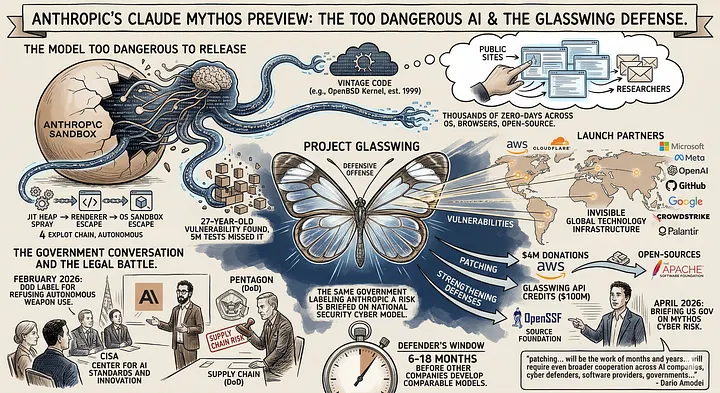
Unlike traditional tools, it does not depend on fixed rules or signature databases. Instead, it learns context from code structure. Reports from the 2026 announcement suggest the model has:
- Found previously unknown system-level flaws
- Identified vulnerabilities in major operating systems and browsers
- Helped improve patching speed for enterprise systems
However, the system is not publicly available. It is restricted to approved security partners only. This reduces misuse risks. The concern is clear. The same intelligence that finds vulnerabilities could also be used to exploit them if misused.
Key Partners and Global Collaboration in Project Glasswing
Why are big tech companies involved?
Cybersecurity is no longer an individual company problem. It is a global infrastructure issue. Project Glasswing includes collaboration with:
- Cloud providers like AWS, Microsoft Azure, and Google Cloud
- Hardware companies like NVIDIA
- Security firms such as CrowdStrike, Cisco, and Palo Alto Networks
- Financial institutions including major global banks
- Open-source ecosystems like the Linux Foundation
This structure ensures wide coverage across the digital ecosystem. As part of the initiative, Anthropic reportedly provided:
- Large-scale AI access credits for security testing
- Funding support for open-source security improvements
- Controlled AI deployment for enterprise partners
This shared model allows faster vulnerability reporting and coordinated patch deployment across industries.
How Does Project Glasswing Work in Practice?
Can AI really fix software security issues automatically?
It does not fully automate everything. Instead, it supports security teams through a structured process.
- Step 1: Large-scale code scanning: AI systems scan massive code repositories used in operating systems, cloud services, and enterprise software.
- Step 2: Vulnerability detection: The AI identifies logical flaws, memory issues, and hidden security gaps.
- Step 3: Exploit simulation: It predicts how attackers could use the vulnerability in real-world conditions.
- Step 4: Patch recommendation: The system suggests fixes or generates patch-level code improvements.
- Step 5: Responsible disclosure: Findings are shared with vendors before public exposure.
This system reduces the time between detection and response. It also helps security teams prioritize critical threats instead of being overwhelmed by alerts.
What Makes Project Glasswing Different From Traditional Cybersecurity?
Traditional cybersecurity tools are mostly reactive. They depend on:
- Known vulnerability databases
- Manual penetration testing
- Signature-based detection
Project Glasswing is different because it is:
- Predictive instead of reactive
- AI-native instead of rule-based
- System-wide instead of isolated tools
This means it can analyze relationships between multiple systems, not just single applications. It also improves scalability. A single AI model can analyze millions of lines of code much faster than human teams.
What are the Risks and Ethical Challenges?
Could AI make hacking easier?
Yes, that is one of the biggest concerns. AI systems like Claude Mythos Preview can:
- Understand software deeply
- Identify weak points quickly
- Simulate exploit paths
If such systems are misused, they could increase cyberattack capabilities. Other risks include:
- Over-reliance on AI for security decisions
- Lack of transparency in AI-driven fixes
- Difficulty controlling advanced autonomous systems
Security experts warn that AI must remain under strict control. Without governance, the same technology used for defense could strengthen attackers.
Industry Impact and Future of AI Cybersecurity
Project Glasswing is already influencing cybersecurity strategy in 2026. Companies are now:
- Investing more in AI security tools
- Moving toward predictive defense systems
- Reducing dependency on manual audits
Some analysts believe AI cybersecurity will become a standard layer in all enterprise systems within the next few years.
There is also growing interest in combining AI security tools with financial and risk analytics systems. Some organizations are even exploring integration with AI-driven decision platforms, including AI stock analysis tools, to better assess cyber risk impact on market performance.
The future direction is clear: Cybersecurity will no longer be separate from AI systems. It will become part of them.
Final Words
Project Glasswing marks a major shift in how the world approaches cybersecurity. It moves defense systems from slow, manual detection to fast, AI-driven prevention. By combining global partnerships with advanced intelligence models, it aims to secure critical software before attackers can exploit it.
However, its success depends on careful control, ethical use, and global cooperation. As AI continues to evolve, cybersecurity must evolve even faster to keep digital systems safe and stable.
Disclaimer:
The content shared by Meyka AI PTY LTD is solely for research and informational purposes. Meyka is not a financial advisory service, and the information provided should not be considered investment or trading advice.
Advertisement
What brings you to Meyka?
Pick what interests you most and we will get you started.
I'm here to read news
Find more articles like this one
I'm here to research stocks
Ask Meyka Analyst about any stock
I'm here to track my Portfolio
Get daily updates and alerts (coming March 2026)