Portugal’s government took to the debt markets on April 8, 2026, and secured €1.28 billion in long‑term financing through 10‑ and 14‑year bond issues. The sale drew solid participation from investors, even as yields shifted modestly compared with past auctions. This move comes at a key moment, with global interest rates in flux and the eurozone watching how sovereign borrowers balance cost and confidence.
For Portugal, the results matter not just for raising cash today, but for shaping how markets view its fiscal resilience in 2026 and beyond.
Advertisement
Key Highlights of Portugal’s Bond Auction
On April 8, 2026, Portugal’s debt agency IGCP, E.P.E. successfully sold €1.28 billion in government bonds through a dual‑tranche auction of 10‑ and 14‑year maturities. The operation aimed to raise between €1.25 billion and €1.50 billion, and finished squarely within that range, showing balanced market demand.
In total:
- €745 million of 10‑year bonds were placed at a 3.304% yield, higher than the 3.142% recorded in the February auction.
- €533 million of 14‑year bonds were sold at 3.610%, slightly lower than the 3.633% yield from March 2025.
- Demand for the 10‑year line was ~1.8 times the amount offered, and ~1.56 times for the 14‑year issue.
These results reflect solid investor interest in Portuguese debt despite rising eurozone rate pressures and broader market caution.
What Do the Yield Changes Tell Us?
Why Did the 10‑Year Yield Rise?
The 10‑year bond yield at this auction was 3.304%, higher than the 3.142% seen in February 2026. A rising yield typically means investors demanded more return to lend at long maturities. This can reflect higher inflation expectations, risk premia, or shifts in monetary policy outlook across Europe.
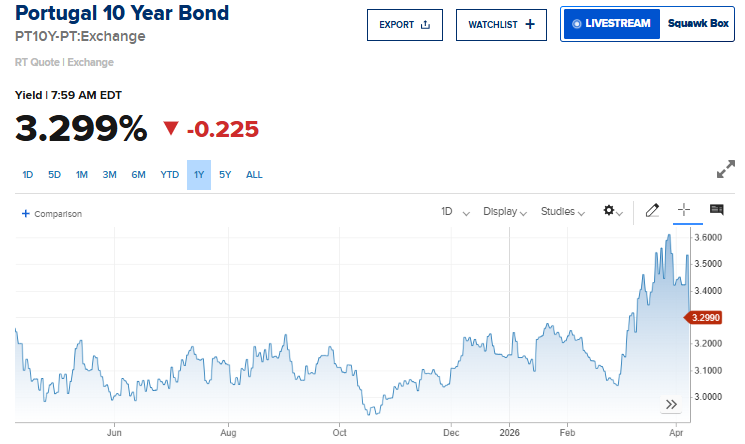
The broad Portugal 10‑year government bond yield also dipped slightly on April 8 according to interbank figures, settling around 3.31%, after rising earlier in the week. This shows yields remain volatile but within a familiar range for Portugal in early 2026.
Why Did the 14‑Year Yield Edge Lower?
The 14‑year line came at 3.610%, marginally lower than the previous comparable auction’s 3.633%. A lower yield here suggests some investor confidence in longer‑term debt, or appetite for extended duration at that pricing.
What This Means?
When yields edge up, the cost of borrowing increases for the state. That can affect future auctions and debt servicing costs. Offering bonds at slightly higher yields can also be a pragmatic approach to ensure full placement in tighter markets.
How Strong Was Investor Demand?
Demand at the auction was notable but not overwhelming. The bid‑to‑cover ratios, the total bids relative to the amount sold were:
- 1.8x for the 10‑year line
- 1.56x for the 14‑year line
A ratio above 1 means there was more interest than supply. However, markets often see ratios above 2 during strong demand periods. These results suggest investors are willing to buy Portuguese debt, but they are cautious amid shifting inflation, eurozone monetary policy expectations, and geopolitical risk, particularly volatility in global energy markets.
How Does This Fit into Portugal’s 2026 Funding Plan?
Portugal planned to issue around €24 billion in long‑ and medium‑term debt in 2026, with about a third already placed by late March. This auction is a part of that broader funding schedule.
Issuing early in the year can help lock in financing before potential rate rises. It also shows disciplined debt management that keeps financing costs predictable, which is a positive signal for investors and rating agencies. Long‑term yields in Portugal remain well below crisis‑era levels seen in the early 2010s.
Why are These Government Bond Auctions Important?
Government bond auctions matter because they influence:
- National borrowing costs
- Investor confidence in sovereign debt
- Liquidity in public finances
- Wider interest rates in the economy (like mortgages linked to Euribor)
Portugal’s yields, although rising slightly, remain below many eurozone peers for similar maturities. This points to relative fiscal stability versus riskier sovereigns.
What are Market Analysts Watching Next?
Interest Rate Outlook
The European Central Bank (ECB) still stewards euro‑area policy rates. Any hints about rate cuts or further tightening will sway yields. Rising yields in early April across markets have partly been driven by risk sentiment and inflation expectations.
Inflation and Geopolitical Risk
Higher energy prices and geopolitical tensions can push up inflation expectations. Bond markets quickly price these risks into yields, and sovereign auctions become key data points.
Auction Pacing and Strategy
How quickly Portugal continues to issue bonds, and at what terms, will determine borrowing costs over the medium term. Many analysts also use AI stock and bond analysis tools to gauge yield curve trends and investor appetite in real time, helping to refine outlooks for future auctions.
Comparison With Recent Portuguese Auctions
Portugal has held multiple auctions so far in 2026:
- In February, it sold bonds maturing in 2029 and 2036, showing consistent market access.
- Earlier long‑term issuance statistics show yields gradually rising from historically low levels seen in years prior, reflecting broader market shifts post‑pandemic and following ECB policy changes.
These patterns indicate a maturing debt issuance strategy that balances timing, cost, and investor demand.
Conclusion
Portugal’s €1.28 billion bond auction on April 8, 2026, showed solid but measured demand at slightly higher yields on the 10‑year line and stable pricing on the 14‑year line. The results reflect investor confidence tempered by broader market volatility and eurozone interest rate expectations.
Efficient debt management and strategic issuance timing will be critical in maintaining favorable borrowing conditions through 2026 and beyond.
Advertisement
Disclaimer:
The content shared by Meyka AI PTY LTD is solely for research and informational purposes. Meyka is not a financial advisory service, and the information provided should not be considered investment or trading advice.
Advertisement
What brings you to Meyka?
Pick what interests you most and we will get you started.
I'm here to read news
Find more articles like this one
I'm here to research stocks
Ask Meyka Analyst about any stock
I'm here to track my Portfolio
Get daily updates and alerts (coming March 2026)