India’s financial landscape is buzzing after the Power Finance Corporation (PFC) board gave in‑principle approval on February 6, 2026 to merge with REC Ltd, a move backed by the Union Budget 2026 to restructure key public sector lenders. The plan, still subject to approvals, aims to combine two major state‑run financiers into a stronger entity that can fund large power and infrastructure projects more efficiently.
For shareholders, this isn’t just another headline. Stock prices for both PFC and REC have already reacted to the news, and market analysts, including UBS, are weighing in on what it could mean for valuations and future returns.
Advertisement
What Is the PFC‑REC Merger and Why Does It Matters?
The Power Finance Corporation (PFC) and REC Ltd merger plan is one of the biggest moves in India’s public sector finance space in years. On February 6, 2026, PFC’s board approved in‑principle steps to merge with its subsidiary, REC, after acquiring 52.63% of government shares in REC Ltd.
This follows Union Budget 2026 proposals to restructure key public sector non‑banking financial companies (NBFCs), strengthen scale, and improve credit delivery in power and infrastructure sectors. Finance Minister Nirmala Sitharaman highlighted this merger as part of the Viksit Bharat vision.
Both PFC and REC operate as government‑controlled NBFCs focused on financing power generation, transmission, and renewable energy projects across India. The merger aims to create a larger, more efficient public sector lender that can support India’s growing infrastructure needs.
How Does the PFC-REC Merger Work?
What Has Happened So Far?
PFC has become the holding company after buying a controlling stake in REC from the government. The boards of both companies have agreed in principle to merge. The final merger scheme is yet to be finalized and will require regulatory and shareholder approvals.
After completion, PFC will continue as the surviving government company and REC will be absorbed into it. The combined entity will remain under the administrative control of the Ministry of Power.
What Will Happen to Shareholders?
REC shareholders can expect PFC shares in exchange once the share swap ratio and detailed merger scheme are announced. Analysts say the swap ratio will be key for determining value impact.
The merger could also reduce operational overlap, unify governance, and enhance capital strength. However, minority REC holders should track formal disclosures for conversion terms when these are filed.
What are the Stock Market Trends on PFC and REC?
How Have the Stocks Reacted Recently?
Shares of PFC and REC have been volatile around merger news. On February 9, 2026, both counters fell after PFC’s board approved the merger. PFC declined about 1.5% to ₹413.55, and REC dropped 3.5% to ₹357.00 on the NSE.
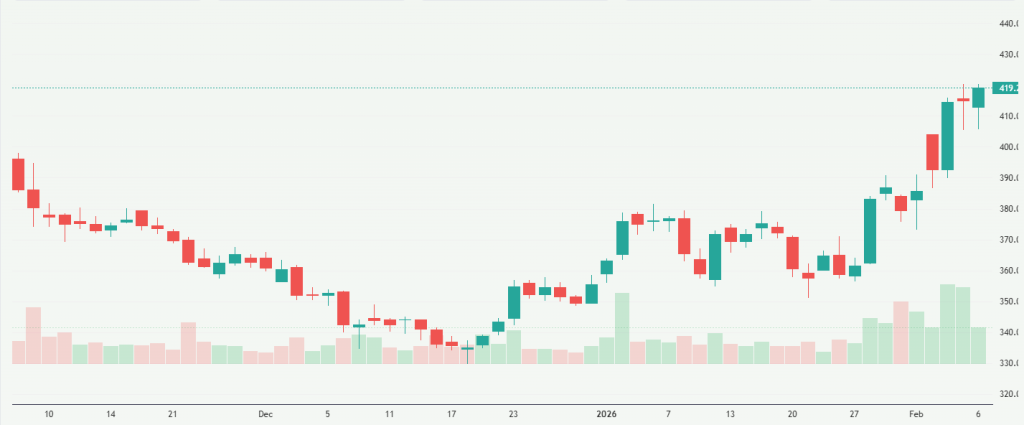
Earlier, after the Budget 2026 announcement, both stocks saw gains as markets priced in restructuring benefits.
What Does Meyka Say About PFC (PFC.NS)?
According to Meyka, PFC shares have been responsive to the Budget and merger talk, with price action above short‑term and long‑term moving averages and active trading volumes indicating investor interest. Meyka shows PFC trading near ₹392-₹393 with a market cap over ₹1.3 trillion. Short‑term momentum indicators like MACD remain positive, but resistance near recent highs is noted.
Meyka also highlights that PFC’s valuation metrics, such as PE around 5.23 and dividend yield above 4%, reflect stable fundamentals for long‑term investors.
What Analysts Forecast for PFC?
Independent forecasts point to continued upside potential. For example, consensus estimates see 12‑month average price targets around ₹488, suggesting 15‑20% theoretical upside from current levels, based on analyst models like TradingView and Investing.com.
Work with current technical and fundamental data and AI stock analysis tools can help investors understand possible price paths, but always combine these with official filings and risk tolerance.
UBS’s View: What Analysts are Saying?
UBS analysts, in their latest note dated February 9, 2026, confirm that the merger process will start following the Budget‑led restructuring signal.
UBS emphasizes that:
- The merger aligns with government strategy to scale public sector NBFCs.
- Combined portfolios can improve credit penetration and operational efficiency.
- Prudential risk controls and clarity on valuations are necessary to uphold investor confidence.
The UBS also notes that PFC’s strong asset quality and capital support could make the merged entity a leading NBFC financier in power and infrastructure, provided execution risks are managed.
What are the Potential Risks and Concerns?
Could This Merger Weaken Public Sector Control?
Some experts and industry observers have raised concerns that restructuring may eventually weaken public sector NBFCs, spark debates over governance, and even fuel longer‑term privatisation speculation.
What are Market and Execution Risks?
- Final merger terms are not yet available, which creates uncertainty for minority shareholders.
- Integration risks could delay expected synergies if systems and governance structures differ widely.
- Stock volatility around merger news shows how sentiment can shift quickly.
What Should Shareholders Do Now?
Before the formal merger scheme is filed, shareholders should:
- Follow official filings on share swap ratios and timelines.
- Track quarterly performance of PFC and REC as separate entities.
- Consider fundamental valuation and dividend trends as part of long‑term planning.
- Evaluate merger disclosures as soon as they are published.
Conclusion: Big Change With Big Questions
The proposed PFC‑REC merger represents a major restructuring of India’s state‑run power and infrastructure financing landscape. With boards agreeing to proceed and the Budget 2026 providing the policy backdrop, investors are watching closely for merger terms and valuation impacts.
UBS’s view reinforces the strategic logic, but execution details will shape long‑term outcomes. Meanwhile, share price movements and analyst forecasts suggest cautious optimism. Shareholders should stay informed with filings and expert insights as this story unfolds.
Advertisement
Frequently Asked Questions (FAQs)
The PFC‑REC merger is a plan to combine Power Finance Corporation and REC Ltd. On February 6, 2026, both boards gave in-principle approval to merge into one stronger public company.
Yes, REC shareholders are expected to receive PFC shares after the merger. The exact share swap ratio is not finalized yet. Investors should watch official filings for details in 2026.
After the merger news on February 6-9, 2026, PFC shares fell about 1.5%, while REC shares dropped around 3.5%. The market reacted with short-term volatility amid investor uncertainty.
Disclaimer:
The content shared by Meyka AI PTY LTD is solely for research and informational purposes. Meyka is not a financial advisory service, and the information provided should not be considered investment or trading advice.
Advertisement
What brings you to Meyka?
Pick what interests you most and we will get you started.
I'm here to read news
Find more articles like this one
I'm here to research stocks
Ask our AI about any stock
I'm here to track my Portfolio
Get daily updates and alerts (coming March 2026)