











Oil Prices Jumps 4% as Iran Denies US Talks; Brent Hits $103.94, WTI at $91.62
On March 24, 2026, the global oil market prices took another sharp turn. Crude prices surged as traders reacted to conflicting signals from the United States and Iran over diplomatic talks meant to ease tensions in the Middle East. Iran publicly denied any direct negotiations with Washington, even as U.S. officials suggested progress had been made. This unexpected denial shook confidence that a diplomatic solution could calm markets.
As a result, key benchmarks like Brent and U.S. crude saw notable gains, driven by fears of ongoing supply risks through vital routes such as the Strait of Hormuz, where disruptions could tighten global oil flows. Today’s price action shows just how sensitive energy markets remain to geopolitical uncertainty.
Oil Prices Today: Market Reaction to the News
On March 24, 2026, oil prices jumped sharply on renewed supply‑risk fears after Iran publicly denied any diplomatic talks with the United States to end the ongoing conflict in the Middle East. This denial came as a direct rebuttal to U.S. statements that negotiations had yielded progress, adding confusion and volatility to energy markets.
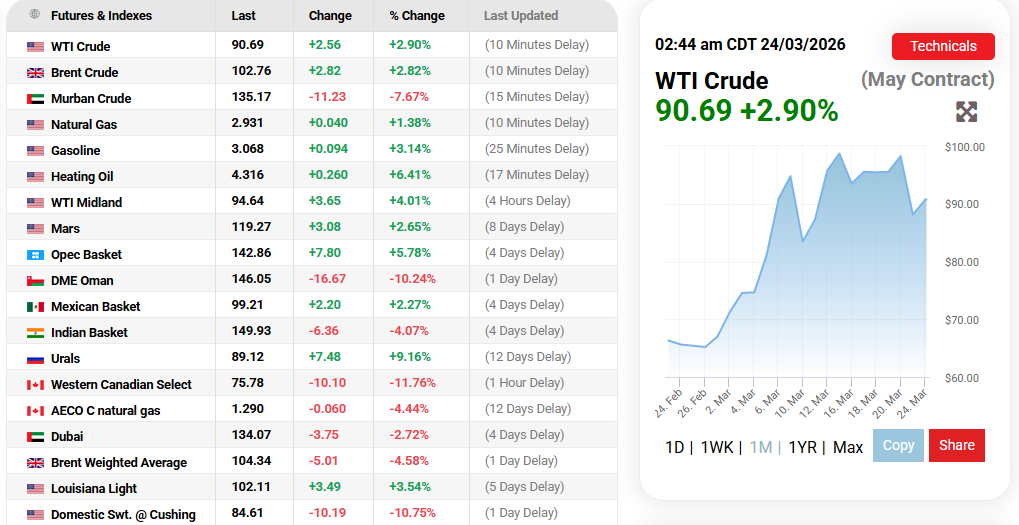
According to Reuters, Brent crude climbed back above $102-$104 per barrel while U.S. West Texas Intermediate (WTI) also rose, reflecting heightened concern over potential disruptions to supplies via the Strait of Hormuz.
These price moves represent a renewed wave of volatility. Earlier sessions had seen steep swings, including both sharp drops and rebounds, as traders weighed geopolitical headlines. Oil’s sensitivity to news underscores how traders now factor in the risk of supply interruptions even when actual shipments remain uncertain.
What Triggered the Recent Spike in Oil Prices?
Why did oil rise Today?
Oil rose because markets saw a bigger risk that supply could tighten. Iran denied that any talks with the U.S. meant to de‑escalate tensions. This contradicted President Trump’s statements claiming progress in negotiations. That conflict in messaging made traders push prices higher again.
Adding to the pressure were reports of attacks on energy infrastructure in the region. These reports spiked fears that facilities could be damaged and reduce output. Market participants responded by driving benchmarks like Brent and WTI higher late in the trading session.
What role does the Strait of Hormuz play?
The Strait of Hormuz remains a central factor. It is a crucial oil shipping channel through which about 20 percent of global crude flows. Recent disruptions have caused many tankers to avoid the route entirely. The near halt in tanker traffic has heightened fears of a real supply squeeze, and prices moved up as a direct result.
Even before these latest moves, oil prices had already swung dramatically in March due to the crisis. Brent temporarily went above $119 per barrel earlier in the month amid heightened fears of wartime closures and attacks on energy facilities.
Deep Dive: Geopolitical Drivers Behind the Spike
How do Iran-U.S. tensions affect global energy markets?
The ongoing conflict between Iran and the U.S., including indirect involvement from allied forces, has kept oil markets alert. Traders view any breakdown in diplomatic progress as a trigger for higher prices. When Tehran denied recent negotiations, it reinforced the belief that the crisis could be prolonged, thus keeping a risk premium built into oil prices.
This risk premium reflects the possibility of:
- Closure or further disruption of key shipping routes.
- Attacks on infrastructure that reduce oil production capacity.
- Supply bottlenecks that last longer than traders first expected.
These geopolitical risks often outweigh traditional supply–demand fundamentals in the short term. Real‑time AI stock analysis tools used by some traders now include geopolitical scoring to help forecast near‑term price moves, showing how sentiment and risk are intersecting with technical data.
How serious is the disruption at Hormuz?
According to shipping data analysis, tanker traffic through Hormuz has dropped sharply since late February. Some reports suggest vessel transits fell from over 100 per day to only a few dozen or fewer, indicating near‑total avoidance of the route until risk conditions improve.
This sharp contraction in traffic has global implications since producers in Saudi Arabia, Kuwait, the UAE, and Iraq rely heavily on Hormuz flows. Analysts warn that a prolonged closure could keep prices elevated or push them even higher.
What Analysts are Saying: Expert Perspectives
What are price forecasts now?
Market analysts view the current environment as unpredictable but tilted toward higher risk. In recent reports, some forecast that Brent could stay above $100 per barrel or even climb further if the crisis persists through spring. This view reflects both supply concerns and ongoing geopolitical uncertainty.
Other analysts emphasize that if diplomatic breakthroughs do occur and shipping resumes, prices could settle back lower, but only after a period of volatility. Many forecasting models now include scenario ranges rather than single price targets because of the unusual level of uncertainty.
Are strategic reserves being used?
The International Energy Agency (IEA) is said to be consulting with member states about the possible release of strategic petroleum reserves to ease price pressure. This mechanism has been used in past supply shocks, but its effect is typically short‑term unless combined with other stabilizing actions.
Broader Economic & Consumer Impact
How will this affect fuel and inflation?
Rising crude prices often pass through to higher fuel costs at the pump. If Brent stays above $100 per barrel for an extended period, many economies could experience meaningful pain at the consumer level.
Higher fuel costs tend to feed into the prices of goods transported by road and sea, adding inflationary pressure. Economic forecasters are monitoring this closely, especially in markets already facing inflation challenges.
What does this mean for global markets?
Financial markets have shown sensitivity to these oil price swings. On the same day oil rebounded, global stock futures were mixed, as traders balanced risk sentiment with hopes for diplomatic progress. Bond yields and currency markets also reflected increased uncertainty tied to energy price expectations. Prolonged high energy prices could slow economic growth by raising costs for businesses and consumers alike.
Final Words
The recent oil price jump shows how sensitive global markets are to geopolitical tensions. Iran’s denial of U.S. talks and risks at the Strait of Hormuz pushed Brent above $103 and WTI near $92. Traders, consumers, and governments must watch developments closely.
Supply disruptions, diplomatic moves, and energy infrastructure risks will continue to shape prices in the coming weeks. Staying informed and monitoring real-time market data is key to navigating this volatility.
Frequently Asked Questions (FAQs)
On March 24, 2026, oil rose 4% as Iran denied US talks, raising fears of supply disruptions globally.
The Strait of Hormuz carries 20% of global oil. Any threat there can quickly push prices higher in March 2026.
Brent reached $103.94 and WTI $91.62 on March 24, 2026. Prices may fluctuate with geopolitical and supply news.
Disclaimer:
The content shared by Meyka AI PTY LTD is solely for research and informational purposes. Meyka is not a financial advisory service, and the information provided should not be considered investment or trading advice.
What brings you to Meyka?
Pick what interests you most and we will get you started.
I'm here to read news
Find more articles like this one
I'm here to research stocks
Ask our AI about any stock
I'm here to track my Portfolio
Get daily updates and alerts (coming March 2026)