Oil markets opened in 2026 in a volatile storm. As of April 6, 2026, Brent crude prices have pushed above $110 per barrel, building on an aggressive surge that included an 8 % jump recently amid rising geopolitical tensions. Traders and analysts are watching the Strait of Hormuz, a route carrying nearly 20 % of global oil supply, as disruptions there continue to tighten markets and push global benchmarks sharply higher.
Supply fears, conflict‑linked attacks on infrastructure, and uncertainty over when shipping lanes may fully reopen have all added a “war premium” to crude prices. With inflationary pressures mounting and energy markets in flux, consumers, businesses, and policymakers alike are bracing for broader economic impact.
Advertisement
What’s Happening in Oil Markets Now?
Oil prices are moving sharply higher in early April 2026 as global markets respond to supply fears tied to geopolitical instability. On April 6, 2026, Brent crude futures climbed to about $110.74 per barrel, up roughly 1.6%, while U.S. West Texas Intermediate (WTI) also rose to near $112.25 per barrel. This comes after volatile trading last week in which Brent jumped nearly 8%, and WTI surged over 11%, the biggest absolute gains since 2020, according to Reuters.
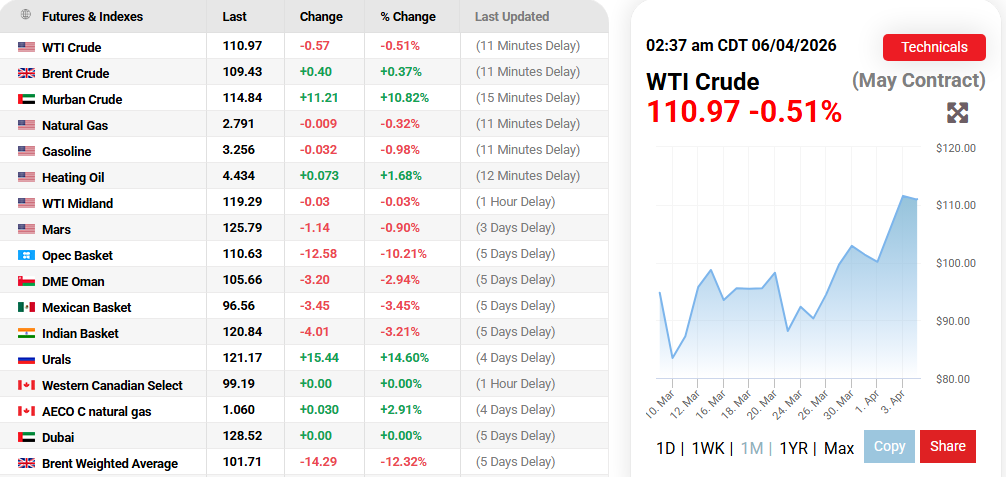
Prices are reacting to ongoing disruptions linked to the US-Israeli conflict involving Iran, which began on February 28, 2026. The conflict has forced partial closures and attacks on shipping routes, especially the Strait of Hormuz, a transit point for a significant share of global oil exports.
Markets remain sensitive, with traders watching every headline for signs of escalation or de‑escalation. Strong price moves reflect fear of lasting supply constraints and growing risk premiums in crude futures.
What’s Driving the Oil Prices Surge?
Why sre Oil Prices Rallying So Quickly?
Oil prices are surging primarily due to rising geopolitical risk. The U.S.-Israeli war with Iran has tightened supply expectations. Iranian attacks in the Gulf region, including strikes on oil infrastructure and shipping, have pushed traders to price in larger supply losses.
Strait of Hormuz and Global Supply Fears
- The Strait of Hormuz carries around 20% of the world’s crude exports. When flows slow or halt, supply becomes constrained.
- Iran’s actions have restricted shipping, prompting fears of nearly major supply cuts from Middle Eastern producers.
Even partial disruptions raise anxiety across markets because oil demand remains high while real supply availability shrinks. Some data show Brent oil spot prices have even climbed as high as $141 per barrel for physical delivery, emphasizing tight immediacy in supply.
Political Rhetoric and Military Actions
Political statements also matter. For example, threats of expanded military action against Iran have reinforced risk pricing. Markets took this seriously, with prices rallying further as war rhetoric intensified.
Supply Fundamentals vs. Fear Premium
Fundamentals like global supply and demand still matter. But right now, sentiment and risk perception are driving most of the price moves. AI stock analysis tools and energy models show that traders are pricing in severe scenarios, sometimes over fundamentals. This creates volatility and swift swings in oil benchmarks.
Global Impact: From Consumers to Markets
How are Higher Oil Prices Affecting the Global Economy?
Rising oil prices have broad effects on consumers, businesses, and financial markets worldwide. Higher crude costs typically feed through to gasoline, diesel, and household energy bills. Even a modest increase in crude can push fuel prices up several cents per gallon in major markets. This tends to raise inflation pressures, especially in countries that import most of their oil.
For example, buyers of crude and refined products in the U.S. and Europe are already paying more at the pump as benchmarks climb above $110 per barrel.
Impact on Financial Markets
Energy company stocks often benefit from higher oil prices, as earnings rise with stronger revenue. However, other sectors like airlines and transportation feel the impact of higher fuel costs, which can squeeze profit margins and push stocks lower. Broader markets may also react to higher oil via inflation expectations, which influence interest rates and investor positioning.
Bond markets have also shown sensitivity. In some regions, higher yields and oil‑linked inflation fears have weighed on government debt performance.
Emerging Market Risks
Countries that rely heavily on oil imports face greater strain. Higher energy costs can reduce consumer spending and slow economic growth. These effects become more pronounced when prices remain elevated for weeks or months.
Oil Prices Overview: What Analysts are Saying?
Some analysts believe that the oil rally may continue if supply disruptions persist. Forecasts suggest crude prices could surge further if the Strait of Hormuz remains partly closed or if military tensions widen. Recent market commentary emphasizes that geopolitical risk premiums now play a dominant role in pricing.
However, other analysts caution that fundamentals may eventually counteract the rally. Major research groups, for example, have argued that if global supply growth outpaces demand later in 2026, prices could ease and even return to more typical averages. This highlights a split outlook where near‑term risk and long‑term fundamentals may push prices in different directions.
Final Words
Oil’s sharp rally above $110 per barrel in April 2026 underscores how geopolitical tensions can reshape global energy markets. Persistent risks around the Strait of Hormuz, coupled with supply fears and strong demand, are driving prices higher and keeping markets on edge.
Whether this trend continues depends on diplomatic developments, military actions, and how quickly supply routes reopen. For now, traders, policymakers, and consumers alike must watch closely as the balance between risk and reality continues to evolve.
Disclaimer:
The content shared by Meyka AI PTY LTD is solely for research and informational purposes. Meyka is not a financial advisory service, and the information provided should not be considered investment or trading advice.
Advertisement
What brings you to Meyka?
Pick what interests you most and we will get you started.
I'm here to read news
Find more articles like this one
I'm here to research stocks
Ask our AI about any stock
I'm here to track my Portfolio
Get daily updates and alerts (coming March 2026)