











Nintendo Co. Ltd. shares (TYO: 7974.T) fell nearly 10% in Tokyo trading on February 4, 2026, catching investors off guard after strong early sales of the new Switch 2 console. The drop came as markets reacted to growing concerns about whether demand can stay strong beyond the initial launch phase. While Nintendo reported solid holiday performance, analysts flagged slower momentum expectations and rising hardware costs as key risks. Investors were also looking for clearer signs of a blockbuster game pipeline to support long-term growth.
The sharp move highlights a familiar market reality, good sales do not always equal investor confidence. As expectations reset, Nintendo’s next steps could shape how the stock performs in the months ahead.
Stock Market Reaction: What Caused the 10% Drop?
On February 4, 2026, Nintendo’s Tokyo-listed shares (7974.T) plunged roughly 10% in a single session as investors reacted to the company’s latest updates and market sentiment. The slide came despite solid year-end Switch 2 sales figures and maintained earnings forecasts, a rare disconnect between market expectations and corporate results.
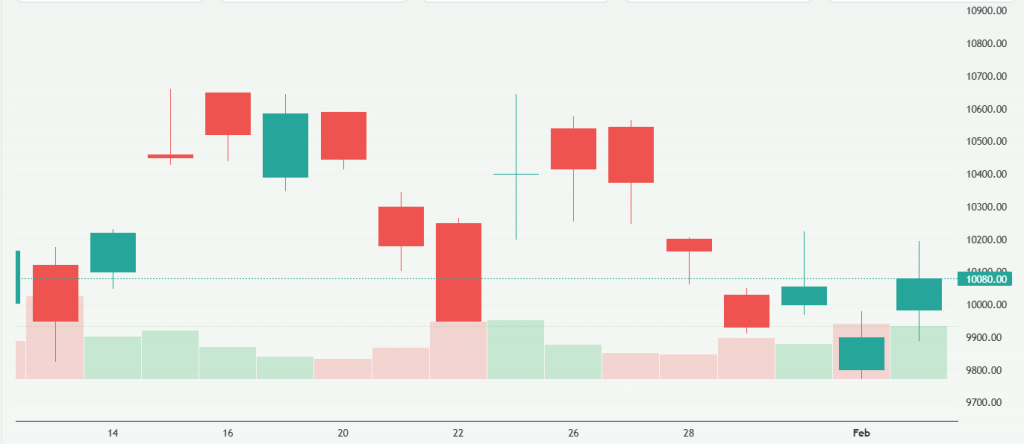
Analysts widely pointed to “momentum fears” as the key driver, investors had hoped for either upgraded guidance or clearer signals of future growth catalysts, particularly blockbuster game releases to sustain Switch 2 demand. Jefferies analyst Atul Goyal said that while results were record-setting, they were “not great” enough to justify the strong optimism already priced into the stock.
Rising memory chip costs and future margin pressures also spooked markets, even if Nintendo’s quarterly earnings haven’t yet been harmed.
Nintendo (7974.T) Stock Snapshot & Meyka Forecast
Before diving deeper into business performance, here’s how the stock looks:
Meyka AI Stock Summary
- Current price range: ~¥9,000 JPY on the Tokyo Stock Exchange.
- Trend: Shares are down sharply from peaks seen in mid-2025, reflecting heightened volatility and sentiment shifts.
- Meyka suggests: Strong sales performance supports fundamentals, but chip cost risks and software momentum concerns weigh on sentiment.
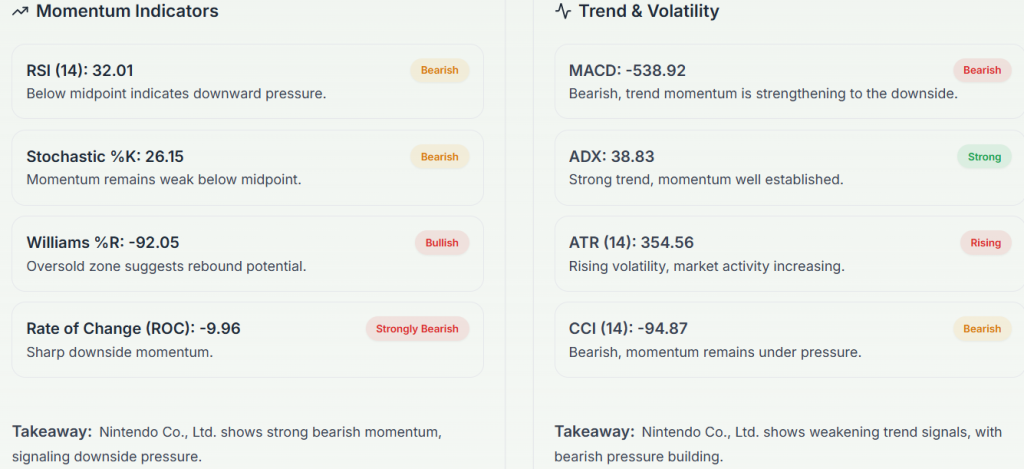
Meyka AI Technical & Forecast
- Meyka lists real-time news and analysis for 7974.T, showing price volatility and sign of consolidation after recent sell-offs.
- Technical analysis from financial platforms suggests the stock could reorder between short-term support near ~¥8,500-¥9,000 and resistance closer to prior highs above ¥12,000.
- Wall Street price target consensus ranges widely, with some analysts seeing upside if momentum returns.
Supporting Analyst Views
- Freedom Capital Markets upgraded Nintendo to a Buy rating late in 2025, citing early-cycle Switch 2 demand.
- Jefferies raised price targets following strong early Switch 2 metrics, though price action didn’t fully align with this optimism.
How Big Is Switch 2 Demand Really?
Despite the stock slide, consumer demand for the new Nintendo Switch 2 remains strong.
Sales & Forecasts
- As of December 31, 2025, Nintendo sold ~17.4 million Switch 2 consoles since its launch in June 2025, making it one of the fastest-selling consoles in company history.
- The company reaffirmed its forecast of 19 million Switch 2 units sold for the fiscal year ending March 31, 2026.
- This projection was upgraded from an earlier 15 million unit estimate, reflecting stronger than expected adoption.
Context vs. Original Switch
The original Nintendo Switch went on to become the best-selling Nintendo console of all time, selling over 155 million units globally, a record that helped build the foundation for Switch 2 demand.
As noted in recent reporting, the Switch 2 topped U.S. hardware sales during the key December 2025 holiday season, even outpacing major competitors in certain markets.
Are Rising Costs Impacting Profitability?
Chip and Component Cost Pressure?
One of the factors behind investor caution is the surge in memory prices, a trend driven in part by demand from AI servers and other tech sectors. DRAM prices have jumped sharply, and NAND flash prices have risen as well, creating cost pressure on devices like the Switch 2.
Nintendo has so far absorbed these costs, with quarterly earnings showing profit growth, but analysts caution this may tighten margins over time if costs remain elevated.
What Does It Means for Investors?
Higher production costs could lead Nintendo to raise console prices or risk compression in hardware margins. This is a delicate balance, price increases risk dampening consumer demand in price-sensitive markets.
What are Analysts Saying About Switch 2’s Long-Term Momentum?
Optimistic Views
- Many analysts still see the Switch 2’s install base growth as a long-term positive, especially if software development accelerates with blockbuster titles.
- Continued strong game attach rates for titles like Mario Kart World and Donkey Kong Bananza support ongoing demand.
Concerns Among Skeptics
- Some research firms have lowered Switch 2 sales forecasts, citing tariffs, pricing pressures, and slower high-profile game pipeline.
- Market sentiment has grown cautious if Nintendo’s software lineup doesn’t keep pace with consumer expectations, a key driver of hardware sales momentum.
Does a 10% Drop Mean Trouble for Nintendo?
Short-term moves like the 10% slump on Feb 4, 2026 reflect investor expectations reset rather than fundamental breakdown.
Nintendo’s core business remains strong with robust hardware sales, solid quarterly profit growth, and an expanding global install base. Yet, market pricing often outruns corporate fundamentals, especially in consumer tech stocks tied to product cycles.
A balanced view is crucial: the company’s near-term challenges (costs, software pipeline) sit alongside longer-term strengths (brand power, install base, and global popularity).
Final Words
Nintendo’s 10% stock drop reflects shifting expectations, not weak demand. Switch 2 sales remain solid, but costs and game momentum matter. The next earnings update will be key for investor confidence.
Frequently Asked Questions (FAQs)
Nintendo shares fell about 10% on February 4, 2026 because investors grew worried that demand for the Switch 2 may slow and future game sales might not meet high expectations.
Switch 2 sales remain strong overall, but some analysts think the sales pace could soften after the initial launch, causing mixed confidence among traders in early 2026.
stors expect stocks to open higher and tech and large-cap sectors may lead gains.
Some analysts see long-term value in Nintendo, while others urge caution because of sales and cost concerns. Investors should check recent reports before deciding.
Disclaimer:
The content shared by Meyka AI PTY LTD is solely for research and informational purposes. Meyka is not a financial advisory service, and the information provided should not be considered investment or trading advice.
What brings you to Meyka?
Pick what interests you most and we will get you started.
I'm here to read news
Find more articles like this one
I'm here to research stocks
Ask our AI about any stock
I'm here to track my Portfolio
Get daily updates and alerts (coming March 2026)