India’s real estate market is showing steady momentum in 2026, even as growth begins to normalize after a strong post-pandemic surge. In Q4 FY26, Lodha Developers reported an 18% year-on-year jump in collections, reaching around ₹5,230 crore.
The company also expanded its future pipeline significantly, adding projects with a gross development value (GDV) of nearly ₹60,000 crore by March 31, 2026. These numbers highlight strong execution and sustained housing demand in key metro cities.
Advertisement
However, global uncertainties and shifting buyer sentiment are starting to influence sales trends. So, what is really driving Lodha’s growth, and can it sustain this pace in the coming quarters?
Lodha Developers Q4 FY26: Complete Operational and Financial Update
What were Lodha’s key operational results in Q4 FY26?
In the fourth quarter ending March 31, 2026, Lodha Developers delivered strong operational performance across pre-sales and collections. The company reported its highest-ever quarterly pre-sales of ₹58.9 billion (₹5,890 crore), a 23% increase year-on-year compared to Q4 FY25. For the full financial year FY26, pre-sales stood at ₹205.3 billion (₹20,530 crore), up 16% YoY.
The management noted that select sales were deferred in March 2026 due to geopolitical tensions related to the Iran war, which led to pre-sales being approximately ₹4.7 billion below the annual guidance of ₹21,000 crore.
Collections also showed strength. In Q4 FY26, collections reached ₹52.3 billion (₹5,230 crore), up 18% YoY from ₹44.4 billion in Q4 FY25. This marked a notable quarter-on-quarter improvement as construction execution accelerated. For the full year, collections totalled ₹151.6 billion (₹15,160 crore), a 5% YoY increase.
Which markets drove these results?
The performance was backed by sustained demand across key urban regions, including the Mumbai Metropolitan Region (MMR), Pune, Bengaluru, and the National Capital Region (NCR). The developer’s brand strength in these established markets continued to attract homebuyers, especially in mid‑to‑premium housing segments.
How significant was Lodha’s GDV expansion strategy?
Gross Development Value (GDV) measures the total potential revenue from a developer’s project pipeline. In FY26, Lodha added 12 new projects with a combined GDV of ~₹600 billion (₹60,000 crore). This addition is approximately 2.4 times the company’s annual guidance for business development, showing an aggressive expansion push during the year.
What does this mean?
- GDV additions signal future revenue visibility from upcoming launches.
- As of April 1, 2026, Lodha had approximately ₹2 trillion in GDV available for sale, excluding certain long‑term township land.
- This broad pipeline provides a strong foundation for future sales growth and delivery.
Why did Lodha miss its FY26 pre‑sales guidance?
A key issue in FY26 was the impact of external geopolitical factors. The company’s pre‑sales for the year, although up 16% YoY, fell just short of its target. Lodha had guided for ₹21,000 crore in annual pre‑sales but ended FY26 at ₹20,530 crore, with a gap of roughly ₹470 crore linked to March 2026 sales deferrals caused by the Iran war.
Industry reports also note that broader sentiment in Q4 was influenced by launch delays and softer buyer response due to macro uncertainty, affecting many real estate players, not just Lodha.
Despite this, the quarterly performance itself was strong, and the shortfall was linked more to the timing of transactions rather than weak demand fundamentals.
How healthy is Lodha’s financial position?
Lodha continued to strengthen its balance sheet in FY26.
- Net debt reduced by around ₹800 crore in the latest quarter, lowering total net debt to approximately ₹5,370 crore.
- The net debt‑to‑equity ratio stood at 0.23x, which is below the company’s internal ceiling and considered conservative for the real estate industry.
This debt discipline supports Lodha’s strategic aim to focus more on cash flow and liquidity going forward, rather than rapid expansion.
What is Lodha’s strategy for the next two years?
According to company disclosures, Lodha plans to shift focus from heavy new investments to stronger cash flow generation over the next 24 months. The idea is to optimize capital deployment, complete ongoing projects faster, and increase operating cash flows from delivered and near‑completion inventory.
Analysts using advanced AI stock analysis tools have highlighted this shift as a positive signal for financial health, especially in a moderating market. The emphasis on free cash flow can help the company weather demand fluctuations and reduce reliance on external funding.
How have markets and analysts reacted?
Shares of Lodha Developers opened flat near ₹710 on April 7, 2026, and showed modest intraday gains, reflecting cautious optimism following the Q4 update. However, the stock remains significantly down (about 56%) from its July 2024 highs, indicating ongoing sectoral pressures on real estate equities.
Analysts have taken a mixed view: operational metrics like pre‑sales and collections were praised, while guidance misses and macro slowdown concerns dampened sentiment. Some market commentary also noted softness in the broader realty index in March 2026.
How does Lodha compare with peers in Q4 FY26?
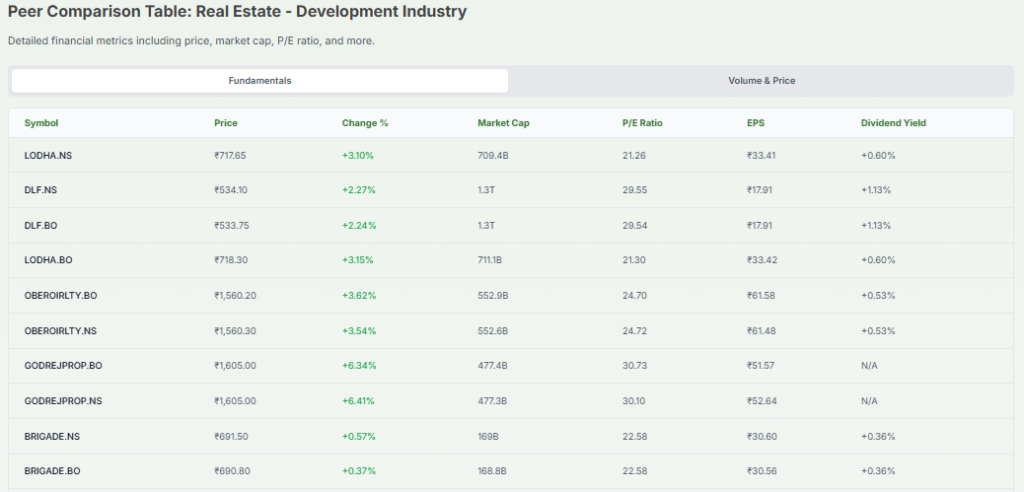
In Q4 FY26, other realty developers also reported varied results. For example:
- Max Estates reported a strong March quarter pre‑sales and maintained a healthy GDV pipeline of ~₹16,000 crore, though its full-year results were flat.
- Sobha Ltd reported an 11% year‑on‑year rise in Q4 sales, driven by strong housing demand across key markets.
These comparisons show Lodha remains among the larger developers with sizeable scale and diversified geography.
What does this mean for the real estate sector in 2026?
Lodha’s results underline a transition phase in India’s residential real estate market. After strong growth in previous years, developers are now balancing sustainable demand, cash flow discipline, and geopolitical headwinds. While premium housing still draws interest, softer sentiment and delayed launches are recurring themes across the sector.
Final Words
Lodha Developers’ Q4 FY26 results show strong execution, rising collections, and a ₹60,000 crore GDV pipeline. While geopolitical and market challenges affected short-term pre-sales, the company’s focus on cash flow, debt reduction, and disciplined expansion positions it well for steady growth in India’s real estate sector.
Disclaimer:
The content shared by Meyka AI PTY LTD is solely for research and informational purposes. Meyka is not a financial advisory service, and the information provided should not be considered investment or trading advice.
Advertisement
What brings you to Meyka?
Pick what interests you most and we will get you started.
I'm here to read news
Find more articles like this one
I'm here to research stocks
Ask Meyka Analyst about any stock
I'm here to track my Portfolio
Get daily updates and alerts (coming March 2026)