











IRFC Shares Jump 4% After ₹12,842 Crore Refinancing Deal with Hindustan Urvarak & Rasayan
Indian Railway Finance Corporation’s (IRFC) stock saw a sharp rise on March 24, 2026, jumping about 4% after the company signed a ₹12,842 crore refinancing deal with Hindustan Urvarak and Rasayan Ltd (HURL). This deal marks one of IRFC’s biggest refinancing moves and highlights a shift toward broader infrastructure financing.
Investors reacted positively as the market opened strongly and PSU stocks gained traction. For a company long known as the finance arm of Indian Railways, this development adds a fresh layer to its growth story.
What Triggered the ₹12,842 Crore Refinancing Deal and Share Reaction
Key Deal Details
On March 24, 2026, Indian Railway Finance Corporation Ltd. (IRFC) signed a ₹12,842 crore rupee‑term loan refinancing agreement with Hindustan Urvarak and Rasayan Ltd. (HURL). This deal gave IRFC a major refinancing assignment to restructure HURL’s existing long‑term debt and strengthen its financial position. The refinancing pact is one of IRFC’s largest such initiatives in recent years, marking a strategic shift from its traditional railway financing role toward broader infrastructure funding under its IRFC 2.0 vision.
HURL, a government‑backed fertilizer producer with operations at key plants in Gorakhpur, Sindri, and Barauni, is supported by major public sector promoters, including NTPC, Coal India, and Indian Oil. This refinancing deal allows HURL to optimise interest costs and repayment schedules while preserving operating cash flows.
Immediate Market Reaction
The market responded positively. IRFC shares jumped over 4% in early trade on March 24, 2026, as investors reacted to the large refinancing victory and what it signals for the company’s future growth. This movement reflected renewed optimism about IRFC’s diversification into financing infrastructure projects beyond just railway rolling stock. Such diversification could bolster its assets under management and open new revenue streams, supporting long‑term valuation.
Who is IRFC and How Has Its Business Evolved?
Who is IRFC?
Indian Railway Finance Corporation Ltd. (IRFC) was founded on December 12, 1986, as the dedicated financing arm of Indian Railways. It raises long‑term capital from commercial markets, domestic bonds, and other instruments. The funds are then used to acquire rolling stock, including locomotives, passenger coaches, and freight wagons, which are leased back to Indian Railways.
IRFC’s core role has traditionally been raising funds at competitive rates and supporting the growth of rail infrastructure. It was granted Navratna status in March 2025, reflecting its strategic importance to national infrastructure financing.
IRFC 2.0 – A Strategic Pivot
In recent years, IRFC has consciously moved toward business diversification. This includes refinancing existing large infrastructure loans, funding entities connected to national logistics networks, and exploring projects with strong links to rail transport. Internal investor presentations show that in Q3 FY2025‑26, IRFC executed refinancing agreements worth over ₹14,821 crore and completed a ₹9,821 crore refinancing with DFCCIL, replacing foreign currency exposure with rupee funding.
The diversification strategy is aimed at increasing profit margins and reducing reliance on a single client (Indian Railways). Management and rating agencies note that IRFC keeps zero non‑performing assets (NPA) and maintains AAA/Stable ratings backed by sovereign ownership.
What Is the Current Market Situation for IRFC Shares?
Recent Financials & Profit Trends
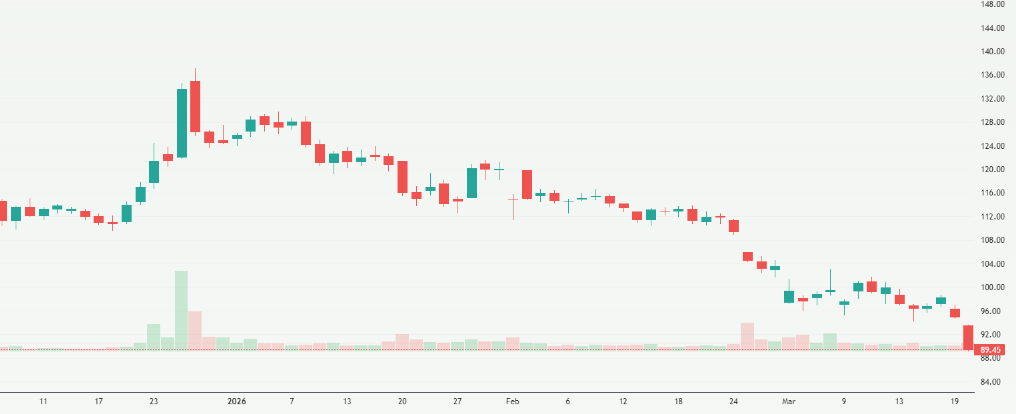
IRFC’s stock price has been under pressure in recent months. Before the refinancing news, the share had been trading near multi‑month lows around the ₹89-₹105 range with volatility driven by profit booking, government stake sales, and broader market sentiment. Retail and institutional investors reacted differently to government Offer for Sale (OFS) events, which created short‑term selling pressure.
Share Price History & Volatility
The refinancing deal on March 24, 2026, gave the stock a boost. IRFC shares rose about 3.6-4% on major Indian exchanges following the announcement. The immediate reaction suggests that markets view this large refinancing assignment as an affirmation of IRFC’s strategic shift and potential to unlock new lending avenues. It also came alongside broader market momentum and PSU stock attention on that trading session.
Analysts and traders note some key technical and sentiment indicators:
- Support levels around ₹89-₹92 suggest price floors where demand increased recently.
- 52‑week range shows significant price fluctuation, highlighting both investor caution and opportunity.
- Liquidity trends reflect mixed volumes as buyers and sellers weigh broader macro cues.
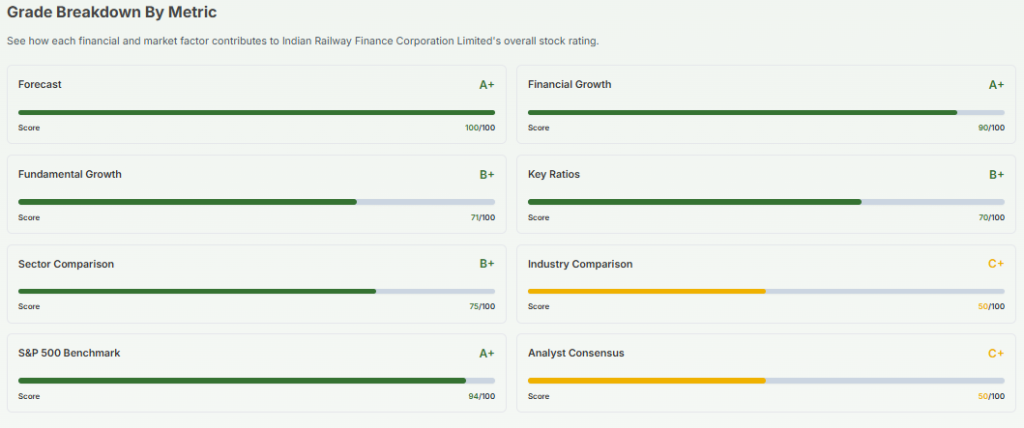
AI stock analysis tools like those on Meyka identify near‑term support and resistance levels, but longer‑term forecasts vary widely depending on government infrastructure spending and IRFC’s diversification success.
Why the Refinancing Deal Matters for IRFC’s Strategy?
The ₹12,842 crore refinancing pact with HURL is more than a large loan assignment. It signals a strategic shift in IRFC’s business model. Traditionally, IRFC focused only on leasing rolling stock to Indian Railways. The HURL transaction shows it can now handle complex refinancing deals for large infrastructure clients that are rail‑linked but operate outside railway operations.
This deal aligns with IRFC’s IRFC 2.0 framework, which emphasises a whole‑of‑government financing philosophy. It helps IRFC tap sectors connected to logistics, manufacturing, and national supply chains. In HURL’s case, the lenders and promoters include multiple major PSUs, such as NTPC, Coal India, and Indian Oil, extending IRFC’s link beyond railways into economically critical industries.
By broadening its client base, IRFC may:
- Reduce concentration risk connected to a single client (Indian Railways).
- Improve interest margins relative to traditional railway leases.
- Strengthen its reputation as a national infrastructure financier.
Sector experts suggest that, if replicated, similar refinancing deals could expand IRFC’s assets under management and help capture a larger share of India’s infrastructure debt market. Longer‑term success depends on execution, interest rate cycles, and broader policy support.
IRFC Shares: What Analysts are Saying?
For IRFC
Market commentary from financial platforms and broker reports highlights a range of views:
- The refinancing deal is seen as a positive catalyst for IRFC’s strategic diversification. It validates management’s push into non-railway-linked sectors.
- Broader market sources describe the transaction as a significant step under IRFC’s IRFC 2.0 push and reflective of India’s whole‑of‑government financing goals.
For PSU Lending Landscape
- Some analysts caution that short‑term share performance remains sensitive to OFS supply, macro volatility, and PSU stock sentiment. Recent stakeholder discussions on forums show mixed confidence regarding entry points and price targets.
- Credit rating agencies reaffirm IRFC’s AAA/Stable ratings and underscore the strength of its asset quality and sovereign backing, which supports investor confidence.
In essence, bullish views highlight diversification and refinancing success, while bearish viewpoints focus on price volatility and short‑term supply pressures.
Bottom Line
The ₹12,842 crore refinancing deal with HURL gives IRFC a fresh strategic direction. It marks a key step in expanding beyond its traditional role into broader infrastructure finance. While markets cheered the announcement with a share uptick, long‑term value will depend on how IRFC executes its diversification plans, manages risks, and attracts new lending opportunities that align with India’s national growth agenda. Investors should watch future deal flows and policy shifts closely.
Frequently Asked Questions (FAQs)
IRFC shares rose about 4% on March 24, 2026, after signing a ₹12,842 crore refinancing deal with HURL.
On March 24, 2026, IRFC agreed to refinance ₹12,842 crore for HURL, helping restructure its long-term debt efficiently.
The refinancing deal may support IRFC’s growth, but stock movement depends on market trends and investor sentiment as of March 2026.
Disclaimer:
The content shared by Meyka AI PTY LTD is solely for research and informational purposes. Meyka is not a financial advisory service, and the information provided should not be considered investment or trading advice.
What brings you to Meyka?
Pick what interests you most and we will get you started.
I'm here to read news
Find more articles like this one
I'm here to research stocks
Ask our AI about any stock
I'm here to track my Portfolio
Get daily updates and alerts (coming March 2026)