Shares of Infosys Ltd. have slid sharply in recent trading, marking a return to price levels not seen in years. On March 17, 2026, the stock dipped to fresh multi‑year lows as global market uncertainty and weak tech demand weighed heavily on investor sentiment. This drop comes amid a broader slump in IT sector stocks, with major peers also under pressure.
For long‑time watchers, this fall is striking. Just weeks ago, Infosys was trading closer to its 52‑week highs. Now, it stands far below those peaks, reflecting deepening doubts about global economic growth and corporate tech budgets.
Advertisement
Why has this happened, and what does it mean for the future of this tech giant? Keep reading to find out more.
Current Market Snapshot: Infosys Shares Under Pressure
Shares of Infosys Ltd. have been trading weak across sessions in March 2026. On March 17, 2026, the stock fell to around ₹1,215-₹1,250, touching its lowest levels in years on the BSE/NSE, amid broad selling in IT stocks driven by global uncertainty and slowing demand for services.
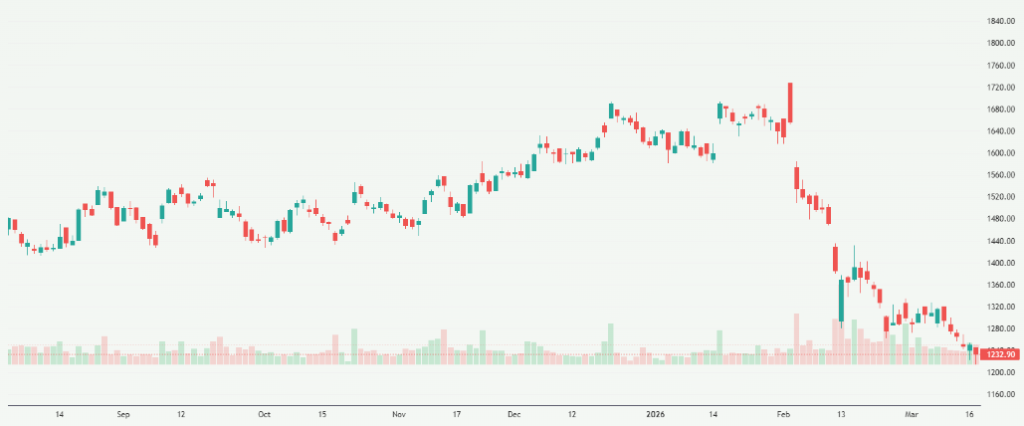
This recent price action marked a 25% drop so far in calendar year 2026, significantly deeper than the ~11% fall in the broader Nifty 50 index. During intra‑day trades, Infosys’ market capitalization slipped below ₹5 trillion, reflecting sharp value erosion. Investors now watch the scheduled Q4FY26 results on April 23-24, 2026, for clearer direction on earnings and growth expectations.
Infosys also trades in the United States as ADR, where prices have underperformed broader markets and peers like Oracle, indicating global investor caution.
Infosys Stock Details and Latest Forecast
How is Infosys stock positioned technically and forecasted?
According to Meyka AI’s forecast model for INFY.NS (NSE listed), the stock’s technical setup is oversold, and models suggest it could trade lower in the short term but has potential upside over a 12‑month period.
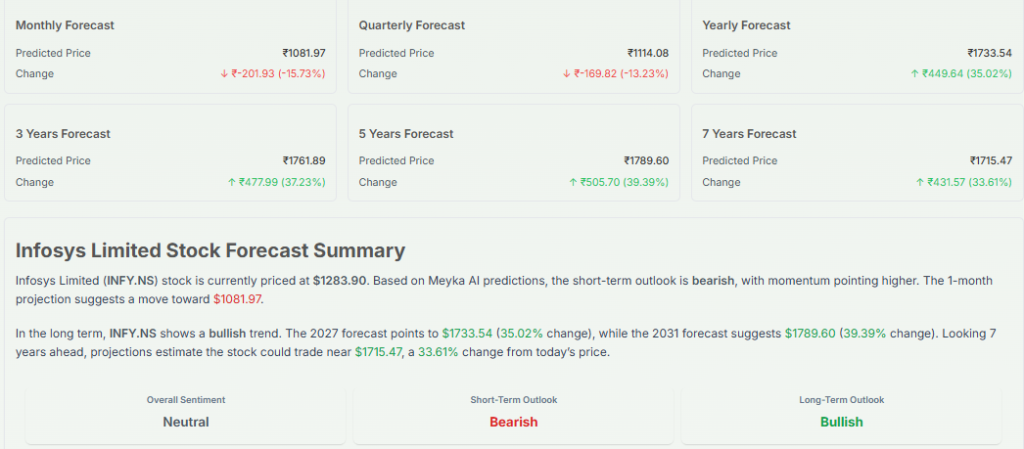
The 12‑month target from Meyka’s model is approximately ₹1,733-₹1,760, implying a potential ~30-38% upside from current prices if growth and sentiment improve. This view balances short‑term weakness against structural opportunities in digital and AI‑related services.
However, broader forecasts that mix long‑term projections and short‑term caution exist. One Meyka projection shows a bearish trend for INFY ADR prices over several years, illustrating how model assumptions and timeframes can differ widely.
Consensus across 41 analysts tracked by Investing.com still favors long‑term recovery, with the average 12‑month price target near ₹1,712, a high around ₹2,076, and a low near ₹1,290, reflecting a mix of moderate optimism and risk.
What’s Driving the Infosys Share Price Decline?
Global Demand Slowdown and Tech Sell‑Off
Infosys’ share price weakness aligns with broader weakness in technology stocks globally. Rising concerns around slower IT spending in key markets like the US and Europe have weighed on expectations for revenue growth in services.
Macro factors such as lingering inflation, higher interest rates, and geopolitical uncertainties have made corporate clients more cautious with discretionary tech budgets. These pressures have amplified selling pressure in Indian IT stocks, including Infosys.
AI Disruption Concerns in Services Contracts
One of the notable contributors to the sell‑off has been investor concerns over AI‑driven disruption to traditional outsourcing and application development services. Rapid advances, including tools from global AI firms, raise fears that automation could reduce billable hours or shift pricing dynamics, squeezing revenue growth for companies built on legacy service models.
This sentiment has been echoed in trading floors and social sentiment channels, where some market participants suggest that AI could compress traditional revenue streams by 25-30%, although long‑term effects remain debated among analysts.
Foreign Institutional Selling and Sector Rotation
Foreign institutional investors (FIIs) have also been net sellers of Indian tech stocks, partly driven by profit‑taking after strong gains in prior years and rotation into sectors perceived as safer amid uncertainty. This shift of capital away from IT has reinforced downward pressure on shares like Infosys.
Infosys Shares: What Analysts are Saying?
Short‑Term Sentiment vs Long‑Term Opportunity
- Technical analysts highlight oversold conditions and potential rebound zones if near‑term earnings or demand signals improve.
- Fundamental analysts still see value in Infosys due to its strong client base, recurring digital services revenue, and increasing AI services revenue share, but caution that the pace of recovery depends on global tech budgets and macro stability.
- Brokerage outlooks (e.g., CLSA) have retained Outperform or Buy ratings on Infosys and other IT stocks despite recent volatility, suggesting that the sell‑off may have priced in some bearish risks already.
This mixed view highlights that while technical indicators and sentiment are bearish short term, corporate fundamentals and global deal pipelines provide reasons for strategic investors to monitor developments closely.
Key Risks and Catalysts to Watch Next
Earnings and Guidance (Q4FY26)
The most immediate catalyst for the stock will be Infosys’ Q4FY26 earnings and management commentary expected in late April 2026. Investors will focus on revenue growth guidance, margin trends, client spending patterns, and commentary on global demand. Positive commentary here could reduce near‑term volatility.
Global Tech Spending
The rate at which global corporations resume or sustain IT spending, particularly in digital transformation and cloud initiatives, will be critical for longer‑term revenue growth.
AI Implementation and Wins
Infosys’ progress in securing AI‑centric contracts and expanding services tied to automation and cloud could serve as growth drivers if they translate into larger deal wins and recurring revenue streams.
Sector Context: Broader IT Share Movements
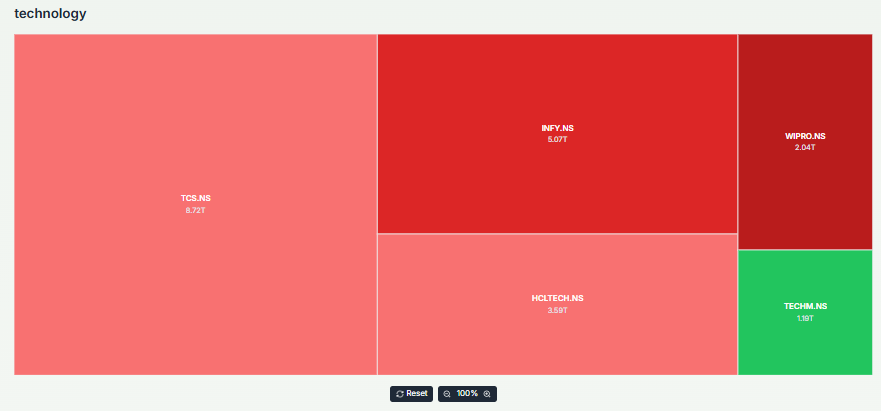
It’s important to see Infosys’ share movement in the context of the entire IT sector. Major peers such as TCS, HCLTech, Wipro and Tech Mahindra also experienced sharp declines due to similar factors, leading to the Nifty IT Index dropping about 25% in 2026. This systemic weakness highlights how sector‑wide trends, rather than company‑specific issues alone, have pushed valuations lower.
Final Words
Despite Infosys shares hitting multi‑year lows, the decline reflects broader global uncertainty and IT sector weakness rather than company failure. Strong client pipelines, AI service expansion, and upcoming Q4FY26 results provide potential recovery catalysts.
Investors should watch global tech spending, macro trends, and earnings guidance closely, as these factors will likely determine whether the stock rebounds or remains under pressure in the near term.
Advertisement
Frequently Asked Questions (FAQs)
Infosys shares fell sharply on March 17, 2026, due to global market uncertainty, weak tech demand, and sector sell-offs.
The decline is mainly from global uncertainty and weak IT spending, with AI disruption concerns adding cautious investor sentiment in 2026.
Analysts expect potential recovery if global tech demand improves. Upcoming Q4FY26 results and AI services growth may support stock upside.
Disclaimer:
The content shared by Meyka AI PTY LTD is solely for research and informational purposes. Meyka is not a financial advisory service, and the information provided should not be considered investment or trading advice.
Advertisement
What brings you to Meyka?
Pick what interests you most and we will get you started.
I'm here to read news
Find more articles like this one
I'm here to research stocks
Ask Meyka Analyst about any stock
I'm here to track my Portfolio
Get daily updates and alerts (coming March 2026)