











Indian Stock Market: How Sensex and Nifty 50 Could Perform This Week Amid US-Iran Ceasefire Talks
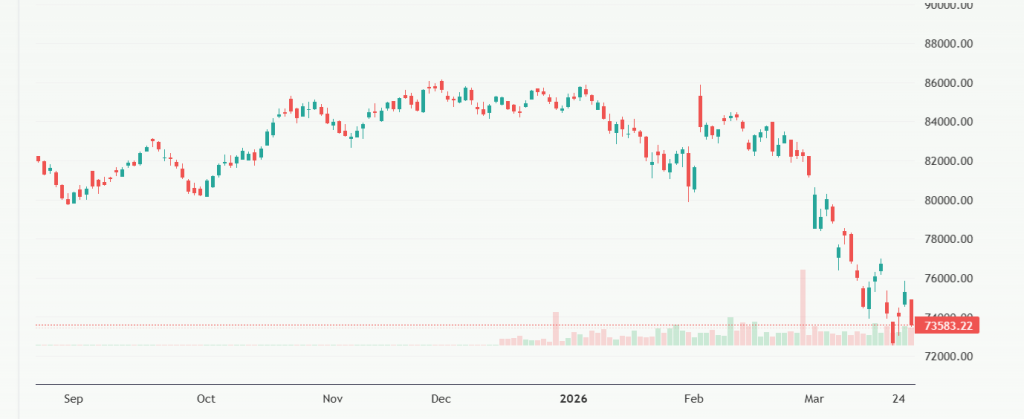
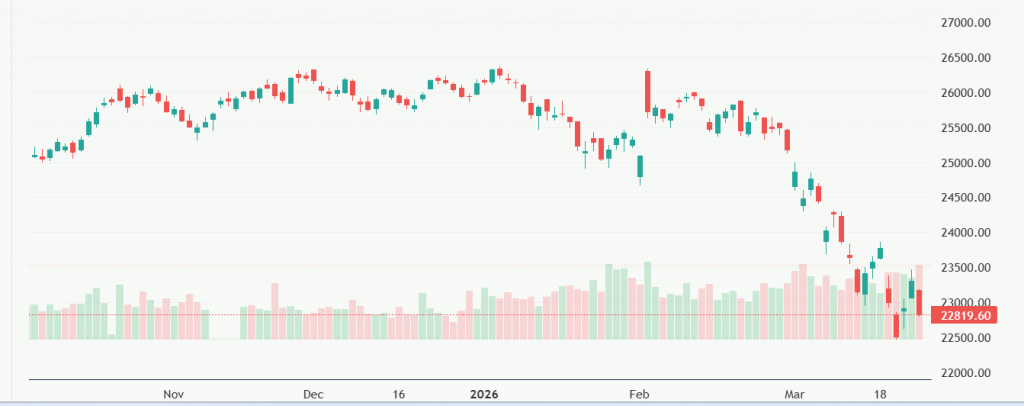
The Indian stock market enters the week of March 28, 2026, on a weak footing after sharp declines. Both benchmark indices closed lower, reflecting fragile sentiment and global uncertainty. The Nifty 50 ended at 22,819.60, falling 486.85 points or 2.09% on Friday. Meanwhile, the Sensex closed at 73,583.22, down 1,690 points or 2.25%.
We are seeing pressure driven by geopolitical tensions, rising crude oil prices, and foreign outflows. The ongoing US-Iran ceasefire talks remain a key trigger for global risk sentiment. As a result, the Indian stock market outlook this week depends heavily on global cues and technical levels holding firm.
Indian Stock Market Trend: Weak Close Signals Cautious Start
Weekly Performance and Market Structure
The Indian stock market showed consistent weakness throughout the week, despite brief recovery attempts. The Nifty 50 declined 1.28% weekly, while the Sensex lost 1.27%, confirming a negative bias. Bank Nifty underperformed sharply, closing at 52,274.60, down 1,433.50 points or 2.67% on Friday, with a weekly fall of 2.16%.
This broad-based decline highlights sector-wide pressure, especially in financials. Elevated crude prices and currency volatility added stress to equities. According to data from NSE India, foreign institutional investors continued to reduce exposure, worsening sentiment.
We are also seeing limited participation in rallies, which signals weak internal strength. The market structure remains fragile, with resistance levels capping upward movement.
Global Cues: US-Iran Talks and Crude Oil Impact
Why Geopolitics Matters for Indian Markets
The Indian stock market is currently reacting more to global developments than to domestic triggers. The US-Iran ceasefire talks are crucial because they directly influence crude oil prices. India imports over 85% of its crude oil, making markets sensitive to price swings.
Higher oil prices increase inflation and widen the current account deficit. This impacts corporate margins and investor confidence.
Currency movement is another key factor. A weaker rupee increases import costs and puts pressure on earnings. Global risk-off sentiment also drives capital outflows from emerging markets like India.
Key Levels Summary
Sensex
- Closing Level: 73,583.22
- Support Levels: 73,000 → 72,000
- Resistance Levels: 74,400 → 75,000
- Trend: Weak
Nifty 50
- Closing Level: 22,819.60
- Support Levels: 22,500 → 22,000
- Resistance Levels: 23,500 → 24,000
- Trend: Volatile
Bank Nifty
- Closing Level: 52,274.60
- Support Levels: 50,500 → 48,800
- Resistance Levels: 53,800 → 55,300
- Trend: Weak
Sensex Outlook: Key Levels to Watch
Resistance and Support Zones
The Sensex is currently trading near 73,500–73,600, a critical zone after recent losses. Immediate resistance is placed between 74,400 and 74,900. A sustained move above 75,000 is required to improve sentiment meaningfully.
On the downside, support lies at 73,000. A decisive break below this level could push the index toward 72,500–72,000. This indicates limited upside unless strong buying emerges.
We are also seeing selective buying at lower levels, but it lacks broad participation. This suggests institutional investors remain cautious.
Nifty 50 Outlook: Volatility Likely to Continue
Technical Levels and Market Direction
The Nifty 50 closed below the 22,850 mark, signaling continued weakness. Immediate support is placed at 22,500. If this level breaks, the index may decline toward 22,000.
On the upside, 23,500 acts as a strong resistance zone. Only a sustained move above this level can trigger a recovery toward 24,000. Until then, rallies may face selling pressure.
The index has shown high volatility, reflecting uncertainty in market direction. Banking and large-cap stocks remain under pressure, limiting upside momentum.
Key takeaways for Nifty 50 levels:
- Support: 22,500 → 22,000
- Resistance: 23,500 → 24,000
- Trend: Weak with high volatility
The Indian stock market is likely to remain range-bound with a negative bias unless global conditions improve.
Bank Nifty Outlook: Banking Sector Under Pressure
Key Support and Resistance
Bank Nifty remains the weakest among major indices. The index closed at 52,274.60, reflecting sustained selling pressure.
Immediate support is seen near 50,500. A break below this level could push the index toward 48,800, which aligns with the 200 WEMA. This makes it a critical long-term support zone.
On the upside, resistance is placed between 53,800 and 55,300. The index needs to cross this range to regain strength.
We are seeing continued weakness due to rising yields and cautious lending outlooks. Banking stocks are sensitive to macro conditions, which remain uncertain.
The Indian stock market trend will depend heavily on Bank Nifty recovery. Without banking support, sustained upside remains unlikely.
Indian Stock Market Strategy: What to Expect This Week
Market Behavior and Key Drivers
The Indian stock market is expected to remain volatile in the coming week. Global cues will dominate direction, especially crude oil prices and geopolitical updates.
Key factors to track:
- US-Iran ceasefire developments
- Crude oil price movement
- Rupee performance against the dollar
- Foreign institutional investor activity
- Banking sector strength
We are seeing a cautious stance from institutions, with limited aggressive buying. Defensive sectors and domestic-focused themes may show relative stability.
Disclaimer:
The content shared by Meyka AI PTY LTD is solely for research and informational purposes. Meyka is not a financial advisory service, and the information provided should not be considered investment or trading advice.
What brings you to Meyka?
Pick what interests you most and we will get you started.
I'm here to read news
Find more articles like this one
I'm here to research stocks
Ask our AI about any stock
I'm here to track my Portfolio
Get daily updates and alerts (coming March 2026)